

The Carney government released its 2026 budget against a backdrop of two years of economic uncertainty generated by the US-Canada trade war. Titled “Masters of Our Destiny,” the budget features a raft of new spending measures aimed at improving Canada’s economic performance. The budget projects a budgetary deficit of C$63.3 billion this fiscal year, peaking at C$70.2 billion in 2027–28. Naturally, critics immediately turned their attention to financing the deficit and its impact on future debt loads.
Government spending plays a significant role in the national economy, accounting for 17% of GDP. Federal debt-to-GDP sits at 40%, the lowest among the G7 nations. Often overlooked is the fact that over 65% of the federal debt is held by Canadian public and private institutions. Equally important is the overall balance sheet, in which a low debt burden is supported by large government asset holdings, such as the Canada Pension Plan. Canada enjoys a AAA credit rating, which supports significant holdings by overseas investors.
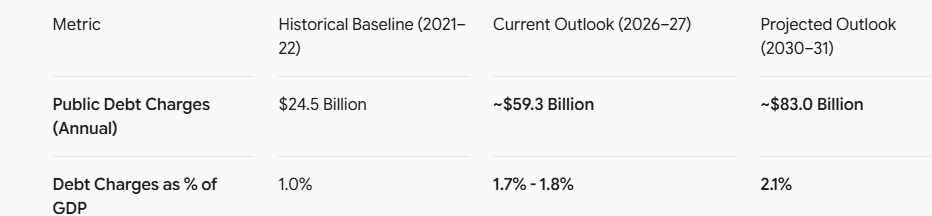
However, the budget does reveal the importance of deficit financing. Relative to earlier projections, tax revenues benefited from a surge in oil royalties and relatively greater revenues. At the same time, debt servicing costs were higher than earlier estimates as interest rates rose to levels not seen in a decade or more. Overall, the Parliamentary Budget Office projects that public debt charges are the fastest-growing budget line item, going from C$63.3 billion in 2026–27 to C$83.0 billion by 2030–31.
Financing costs will be growing due to a combination of two related factors. First, a significant amount of low-interest rate bonds are coming due and will be rolled over, but at higher current rates. Second, higher annual deficits will mean the government has to issue more debt. To provide some context, public debt charges were as high as 6.5% of national income in the 1990s. That huge burden fell to 1.0% of GDP in 2021. So, today’s debt costs of 1.7% of GDP do not pose a significant burden to taxpayers.
Summing up, Canada’s overall debt responsibilities on a macroeconomic scale are very manageable. The current structure of interest rates is expected to continue during this budgetary cycle. Thus, federal debt managers are looking at a mixture of short-term debt (under 5 years) with much longer-dated bonds (10–30 years) to fund the deficit.


Comments
Log in or sign up to join the conversation.