

Some people just never learn from their mistakes, especially the US administration which warns that it will levy a batch of new tariffs affecting the Canada-US auto industry. Having lost seats in both House of Representative and the Senate in key border states to Democrats, the President is all set to up the stakes with higher tariffs on the Canadian auto industry exports. As of late November 2026, the US administration has put Canada on notice that it will levy a distinct set of U.S. tariff changes targeting Canadian exports to affect January 1,2027. The US President continues his mantra that “ Canada cheats us” and needs to be punished.
Part negotiating strategy and part hubris, the American President is trying to get a deal on the broader trade pact, CUSMA. Both governments resumed talks in November 2026. US Trade Representative Jamieson Greer stated that Washington is open to an interim agreement that "accommodates" Canada on sectoral duties ahead of formal CUSMA review negotiations, though autos remain the primary sticking point. If no interim deal is reached by December 31, 2026, the 50% auto hike will take effect on January 1. So far, the Carney government has not shown any willingness to accede to these demands. A game of chicken, perhaps?
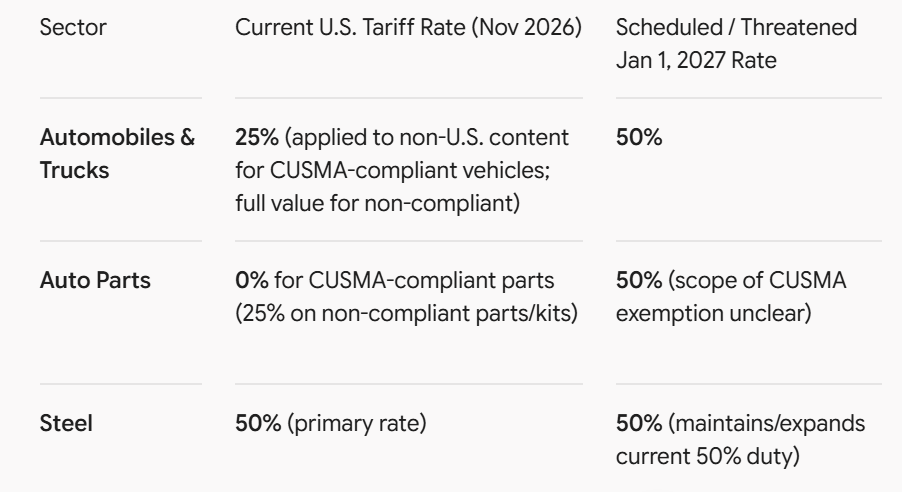
A 50% U.S. tariff on Canadian vehicles and auto parts would have a double-barreled impact on the industry, simultaneously cutting into demand and shocking the complex supply chain featured in this highly integrated industry. Lower demand and higher costs are characteristic of stagflation. The Bank of Canada would be under pressure to raise its lending rate at a time when the economy is hit with a demand shock.
. Approximately, 80%-90% of vehicles assembled in Canada are exported directly to the US. A 50% border tax on assembled vehicles would make many models unprofitable if absorbed by the manufacturer and/or if passed onto the consumer,unsaleable. Ontario would face significant plant closures and layoffs. Furthermore, we expect losses rippling all the way down the supply chain in some different related industries. Longer term, new capital investment would be halted.
Politically, trade issues are complicated by the Democrats sweeping victory in both chambers. Industry executives place relatively low odds that a full blown 50% auto tariff will take effect on January 1 2027. US trade officials want some deal to ease pressure from the incoming Congress. Ottawa says that negotiations will continue to lower sectoral rates next week. Recall, that when these additional tariffs were announced about four months ago, few could anticipate the outcome of the midterms in November. The US administration has fewer bargaining chips now.The incoming Congress is expected to pass legislation curbing the President’s use of tariffs, especially aimed at Canada.



Comments
Log in or sign up to join the conversation.