

Today’s decision by the Bank of Israel to stand pat results from a mixture of different forces hitting the shekel, some positive, others negative. The policy rate remains at 3.25%, a decision that will remain intact until the next meeting in early January 2027. While there is no clear winner from the October 27th election, this short window still introduces considerable uncertainty as to the nation’s immediate future.
On balance, one would expect a rate cut today, given that Israel has the lowest inflation rate in the OECD. In October the CPI fell by 0.1%, and the 12-month inflation gauge is 1.1%, even below the Bank’s midpoint target of 1% to 3%. What held the rate decision in check was the deterioration in the shekel, losing nearly 8% against the dollar and 5% against the euro. With imports costing more, the Bank expects the inflation rate to pick up during the next 6 months.
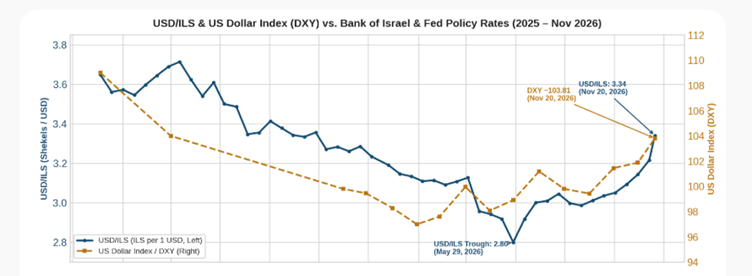
Source; Gemini
In the spring and summer of 2026, the shekel appreciation enabled rate cuts. Now, the tables are slightly turned as the shekel depreciates along with political uncertainty, all the while inflation is virtually non-existent. ,
Also holding back a rate cut is that the GDP grew at a very robust rate of 8% in the third quarter relative to the previous quarter. Private consumption, business investment, and exports all grew at very high rates. Israeli statisticians strip out the performance of Israeli firms overseas from national income calculations. GDP net of production overseas still grew at a healthy rate of 4%. The economy does not exhibit any weaknesses in key sectors that would prompt the Bank to offer more monetary stimulus.
Turning to the external sector, the current account, usually in surplus, slid into deficit in the first two quarters of the year. Countering this is a surge in Foreign Direct Investment headed for the tech. Over US$ 15 billion has been invested in Israel so far, providing the obvious explanation for the USD/ILA hitting a historic low of 2.8 earlier in the year. Lastly, the cumulative deficit from government expenditures in the past 12 months is running at 3.3 % of GDP, and remains below the government’s deficit target.
So, the Bank was faced with a dilemma this month. Cut the rate in response to a very low inflation rate. Or hold the rate in the face of an inconclusive election result that may extend into the new year. Cutting the bank rate also risked a widening of the US-Israel interest rate spread, which would result in capital outflows and a further deterioration in the shekel. As long as other major central bankers talk up the need to raise rates to combat inflation, the Bank of Israel made the right decision to keep the spread from widening. Moreover, the strength of the domestic economy confirms that a rate cut is not necessary to promote growth.


Comments
Log in or sign up to join the conversation.