

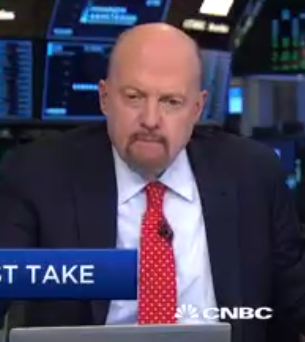
On Wednesday, the Fed announced that it does not expect to raise interest rates for the rest of this year, which further confirms the complete dovish reversal of the Fed’s position from the fall of last year. The 20% stock market rout and pressure from President Donald Trump are the reason for the Fed’s flip-flop. Many market commentators – including CNBC’s Jim Cramer – cheered the Fed’s dovish shift:
“I thought that Jay was great [Wednesday],” Cramer told “Squawk Box, ” referring to Powell’s news conference at the conclusion of the central bank’s two-day policy meeting. “It’s not easy to start. You make your rookie mistakes, you come back. He’s a great guy. Anyone who knows him knows that he course corrected.”
Throughout the fall of 2018, Cramer was criticizing Fed chairman Jerome Powell’s desire to normalize the Fed’s monetary policy after a decade of ultra-low interest rates and trillions of dollars worth of asset purchases to boost the economy and financial markets (ie., quantitative easing):
“Memo to Powell: keep listening. Be patient. Enjoy the employment gains. Let’s keep the strength going by waiting a little and not being too judgmental about rate hikes like some of your colleagues,” Cramer said.
The “Mad Money ” host reiterated his distaste in some Fed officials’ tendency to stick to traditional metrics when gauging how the economy is doing.
“How can you claim to be data-dependent if you’ve made up your mind before you see the data that you need one or two more rate hikes to get back to normal?” he asked. “Normal is where the data says you should go. Normal is the natural progression of jobs being created without a lot of inflation. Normal is not a percent.”
As I’ve said about President Trump, Jim Cramer is completely naive and misguided about the Fed and interest rates. The Fed’s ultra-loose monetary policies of the past decade have created an artificial economic boom including a dangerous bubble in stocks and other assets (read my explanation in Forbes). Our economy is completely addicted to monetary stimulus and Trump and Cramer are advocating for the Fed to keep pumping more and more to keep the fake boom alive. They do not realize that the more we try to put off the day of reckoning, the harder the economy is going to fall in the end.
The Austrian School economist Ludwig von Mises said it best in his book Human Action:
There is no means of avoiding the final collapse of a boom brought about by credit expansion. The alternative is only whether the crisis should come sooner as the result of a voluntary abandonment of further credit expansion, or later as a final and total catastrophe of the currency system involved.
As I wrote earlier this week, the Fed keeps stepping in to support the financial markets every time they stumble:
(Click on image to enlarge)
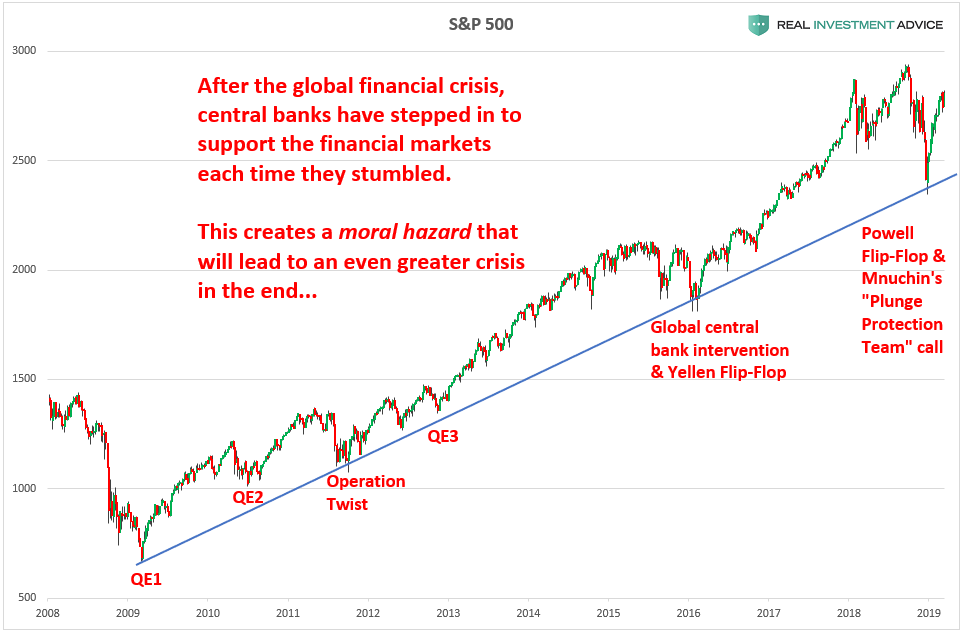
While constantly supporting the stock market may seem like a good thing at first blush, it’s creating a massive stock market bubble that is becoming riskier with each intervention. The Fed has convinced investors and speculators that they can take virtually unlimited risk because the Fed will always have their backs. This moral hazard or Fed put is enabling risk to build up to such a high level that will eventually overwhelm the Fed’s ability to control it, which is when the ultimate crash will occur.
The Fed will throw everything (including the kitchen sink) at trying to prop up the wildly inflated stock market and economy to no avail. This desperate attempt to prop up the market and economy will entail printing ever-increasing amounts of dollars, which is what will lead to the currency crisis that economist Ludwig von Mises warned about in the quote above. By demanding that the Fed keeps interest rates low forever and never normalizes its monetary policy, Jim Cramer and President Trump are inadvertently asking for a currency and economic crisis that will be orders of magnitude worse than the one they are trying to push off now. It’s mind-boggling how people can rise to such high positions in government and the financial world and not understand basic economics – that’s why a crisis is guaranteed.

Comments
Log in or sign up to join the conversation.