Software investors love predictable recurring revenue. They usually hate when a company lowers near term growth to chase a wider user base. Intuit is testing that patience this morning. The company just told Wall Street it expects fiscal 2027 revenue to grow 9% to 10%, down from 14% in fiscal 2026, as it resets pricing and customer acquisition in TurboTax and QuickBooks. Part of that slowdown is deliberate, with free and lower priced entry points designed to bring more users into the ecosystem. But part of it is less flattering, including weak Mailchimp growth and continued pressure in desktop products. The math still relies on a classic lifetime value bet. Management needs a wider funnel to produce enough paid upgrades, payments, payroll, assisted tax and Credit Karma activity to offset the lower revenue collected upfront. The catch is that Intuit is still guiding to operating income growth well above revenue growth. The market is not punishing a lack of margin realization. It is questioning whether the company’s long term growth ceiling has moved lower.
|
The Intuit INTU lifetime value bet |
|
 |
Verdict: Management is intentionally giving up some near term top line growth to widen the customer funnel, but that is not the whole story. The fiscal 2027 slowdown also includes weak Mailchimp growth and continued desktop pressure. Intuit is betting that lower priced entry points can bring more customers into QuickBooks and TurboTax, then monetize them later through paid software, payments, payroll, assisted tax and Credit Karma. Meanwhile, the company is still guiding to operating margin expansion, so the real thesis risk is a lower long term revenue ceiling, not an immediate margin collapse.
|
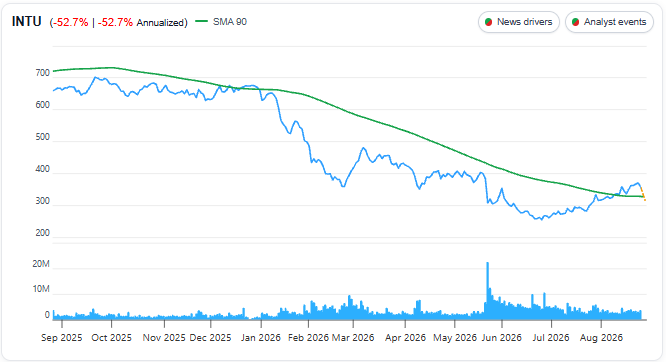
Intuit beat expectations for its fourth quarter, with revenue up 13.6% to $4.35 billion versus roughly $4.27 billion expected. The problem was the outlook. Management guided fiscal 2027 revenue to 9% to 10% growth after 14% in fiscal 2026, and its first quarter revenue range also came in below Wall Street expectations. The market reacted harshly, sending shares down about 12% in premarket trading near $314 around 7 a.m. ET.
|
This was not an earnings miss. The fourth quarter beat expectations. The selloff is about the outlook. Part of the slower growth rate is a deliberate strategic choice, including QuickBooks Free, QuickBooks Lite and more aggressive TurboTax pricing. But the guide also reflects weak Mailchimp growth, continued desktop declines and lower TurboTax revenue per customer. Investors should not treat all of the slowdown as voluntary. |
|
 |
The mechanism here involves price sensitivity, acquisition cost, conversion and product attachment. Intuit is willing to spend more and collect less upfront to bring customers into the ecosystem. In QuickBooks, free and lower priced tiers need to turn new businesses into paying accounting customers or users of payments, payroll, capital and expert services. In TurboTax, lower entry pricing needs to win back price sensitive DIY filers and create more opportunities for assisted tax and Credit Karma. If those cohorts stay engaged and buy more over time, the math works. If they remain free or churn, Intuit has simply lowered revenue per customer without fixing the volume problem.
|
What changed in the thesis
|
Investors now have to believe that Intuit can restart customer growth without giving back too much revenue per user. The old setup leaned heavily on pricing, mix and deeper adoption from existing customers. TurboTax revenue grew 7% in fiscal 2026 even though total U.S. units fell 2%, and management now says price is the top reason customers leave. The new setup asks volume, conversion and cross sell to do more of the work. Management also cut its three year Global Business Solutions growth target to 10% to 15% from 15% to 20%. If customer growth stays in the low single digits and free users do not attach to paid products, the company may still expand margins through cost control, but the long term revenue algorithm will need another reset.
|
What the market may be missing
|
The market might be overly focused on the headline growth slowdown while ignoring real strength in the mid market tier. Intuit Enterprise Suite annualized revenue surpassed $145 million, up roughly fourfold from the prior year, and new to the franchise mid market customers grew more than 30%. That is a useful proof point that Intuit can expand beyond its traditional small business base. But the business is still too small to offset weakness in TurboTax, Mailchimp or desktop products on its own.
|
Valuation and expectations
|
The multiple is contracting because estimate risk just went up. Slower top line growth naturally compresses valuation multiples for software platforms. The stock price reset means the market is pricing in the risk of an execution failure, particularly if the free user cohorts fail to convert into paying customers over the next few quarters. |
|
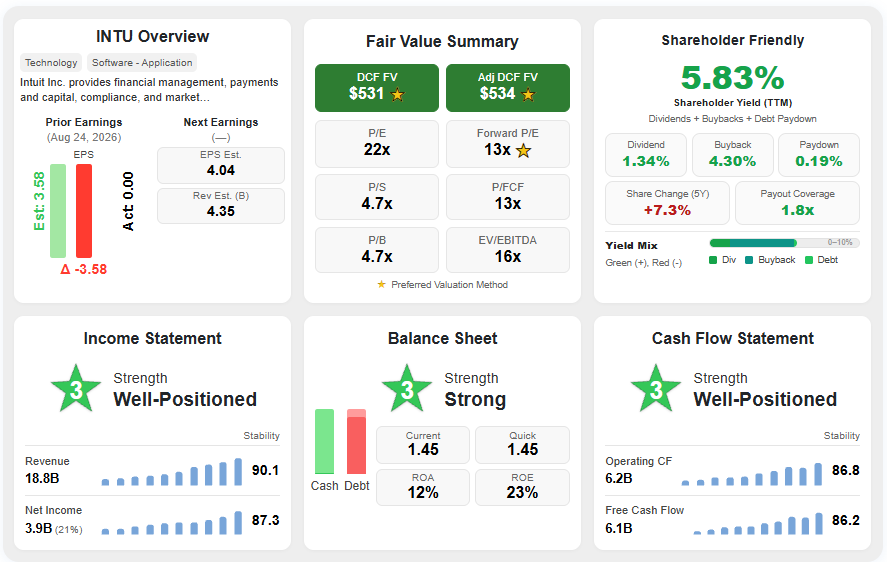 |
Intuit (INTU) Summary Scores
|
This is a classic test of management credibility. If the strategy works, the current selloff will look like a brief transition period. If customer acquisition stalls despite the free tier, the lower revenue guidance will be the start of a structural downgrade.
|
Broader software and financial technology sectors are closely watching the Intuit transition this morning. The current macroeconomic environment is largely unforgiving of platforms that lower top line guidance to invest in future growth. Intuit shares were down about 12% in premarket trading near $314 around 7 a.m. ET. That move reflects a lower growth ceiling and higher execution risk, but it tells us nothing reliable about which investors are buying or selling.
Why it matters this morning
|
The market wants immediate margins and predictable revenue. A pivot to a wider, lower priced funnel forces investors to guess whether the lifetime value math will actually work out before the market loses patience.
|
As a direct competitor in the tax space, this stock could catch a bid if investors think the Intuit pricing strategy is a sign of weakness. Alternatively, a more aggressive free tier from Intuit could steal valuable market share from traditional preparers.
|
The overlap is mainly in merchant payments and small business services, not as a full substitute for QuickBooks. A wider QuickBooks Free funnel could help Intuit attach payments, payroll and lending to more businesses, which would put pressure on Square’s seller ecosystem. The risk to Block is tighter bundling, not a broad accounting price war.
|
The broader read through is that price sensitivity is becoming a bigger issue across tax and small business software. Intuit is using free and lower priced products to widen distribution, but that does not prove customer acquisition costs are rising across the industry. The more defensible takeaway is that standalone software pricing may be harder to sustain when larger platforms can bundle accounting, payments, payroll and credit products together.
|
Total online paying customer growth. Intuit ended fiscal 2026 with 8.9 million online paying customers, up 3%, about two points slower than the prior year. That needs to improve if the wider funnel is working. QuickBooks Free and QuickBooks Lite active users, paid conversion, retention and attachment of payments, payroll or capital. Management disclosed more than 20,000 customers actively using QuickBooks Free or already converted to paid offerings, but it did not give a target of hundreds of thousands. TurboTax units and revenue per customer. Total U.S. TurboTax units fell 2% in fiscal 2026 even as revenue grew 7%, and management said price is now the top reason customers leave. Mailchimp revenue and churn. Management expects the business to be flat to down 1% in fiscal 2027 and will begin reporting it as a separate segment. TurboTax and Credit Karma cross use. Management said customers using both products generate roughly twice the average revenue of single product customers. That claim does not apply to every Intuit product combination. Operating margin delivery. Fiscal 2027 operating income is guided to grow faster than revenue, so the company needs to show it can fund customer acquisition while still delivering the promised efficiency.
The immediate proof point will be customer growth, but this will take longer than one quarter to judge because TurboTax is seasonal. If QuickBooks paying customer growth stays in the low single digits and TurboTax units keep falling while entry pricing moves lower, the lifetime value argument weakens. If conversion, product attachment and retention improve, the fiscal 2027 slowdown may prove to be a reset rather than a structural decline. |
|





Comments
Log in or sign up to join the conversation.