MongoDB's Next Test Is Customer Confidence

MongoDB faces execution risk as Dev Ittycheria returns as interim CEO following CJ Desai’s departure.

Source: DepositPhotos

A leadership change matters to a software business when it changes what customers do next. That is the useful question at MongoDB this morning. A familiar interim chief executive can help steady the company, but familiarity alone cannot deliver product launches or persuade a customer to expand. The immediate test is whether the transition changes spending decisions and execution. If those hold up, the disruption may prove manageable. If they weaken, unchanged guidance will offer little comfort. Today's Investor Day gives management an early chance to make that distinction concrete.

Main Note

MongoDB's CEO Change Puts Execution in Focus

MongoDB (MDB) Quote

Verdict: The leadership change raises execution risk, but it does not establish that the business has deteriorated. The strongest case for looking through the disruption depends on customer usage and product delivery holding up. Those are outcomes to test, not assumptions to put into a valuation.

What happened

CJ Desai stepped down immediately on September 28 to pursue a senior role at Meta. MongoDB appointed Dev Ittycheria interim CEO and began a search for a permanent successor.

Management reaffirmed its existing outlook. The full year revenue range remains $2.99 billion to $3.03 billion. That gives investors a clear reference point, but reaffirmation does not prove that the transition will leave every customer decision or future quarter unaffected.

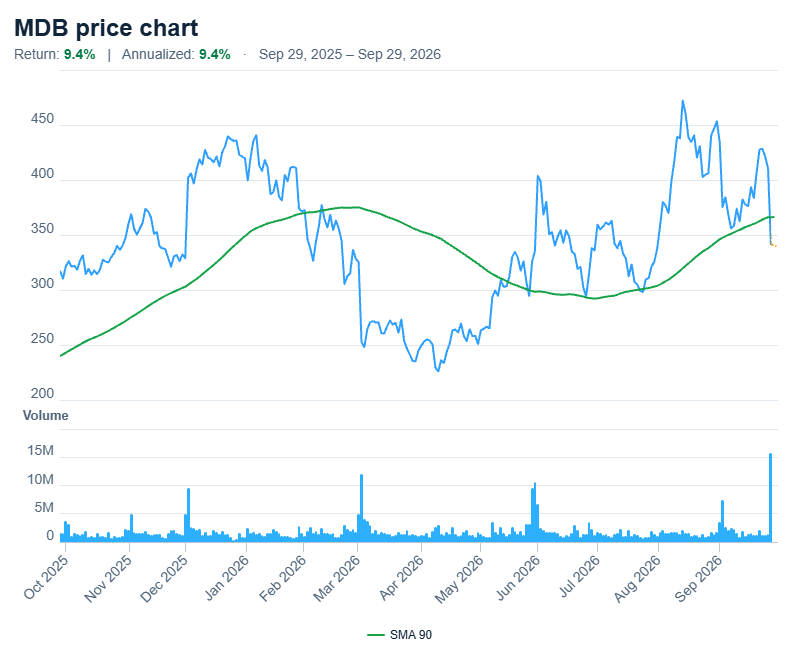
MongoDB (MDB) 1 Yr Chart

MongoDB (MDB) 1 Yr Chart

Why it matters

MongoDB's Atlas business depends on customer usage. A customer can keep running an existing application while taking longer to approve its next project. If uncertainty delays those additions, growth could soften without a dramatic wave of cancellations. The revenue question is whether customers keep expanding their use of the platform.

What changed in the thesis

There is now an additional question about who will deliver the strategy and how smoothly the handover will work. The next useful evidence is specific: delivery commitments, customer activity and accountability within the leadership team. A reassuring presentation would help, but subsequent results need to support it.

What the market may be missing

The interim appointment provides some continuity. Ittycheria led MongoDB from 2014 to 2025 and remained an executive board member. His experience could reduce the time needed to settle into the role. It cannot by itself establish that renewals, employee retention or product execution will be unaffected.

Valuation and expectations

There are two separate ways this could affect the stock. Investors could pay less for the same expected earnings because execution feels less certain, or they could lower revenue and profit forecasts if customer activity weakens. The first would be a change in confidence; the second would require operating evidence. Without a current price and comparable valuation work, the announcement alone does not establish that MDB is cheap.

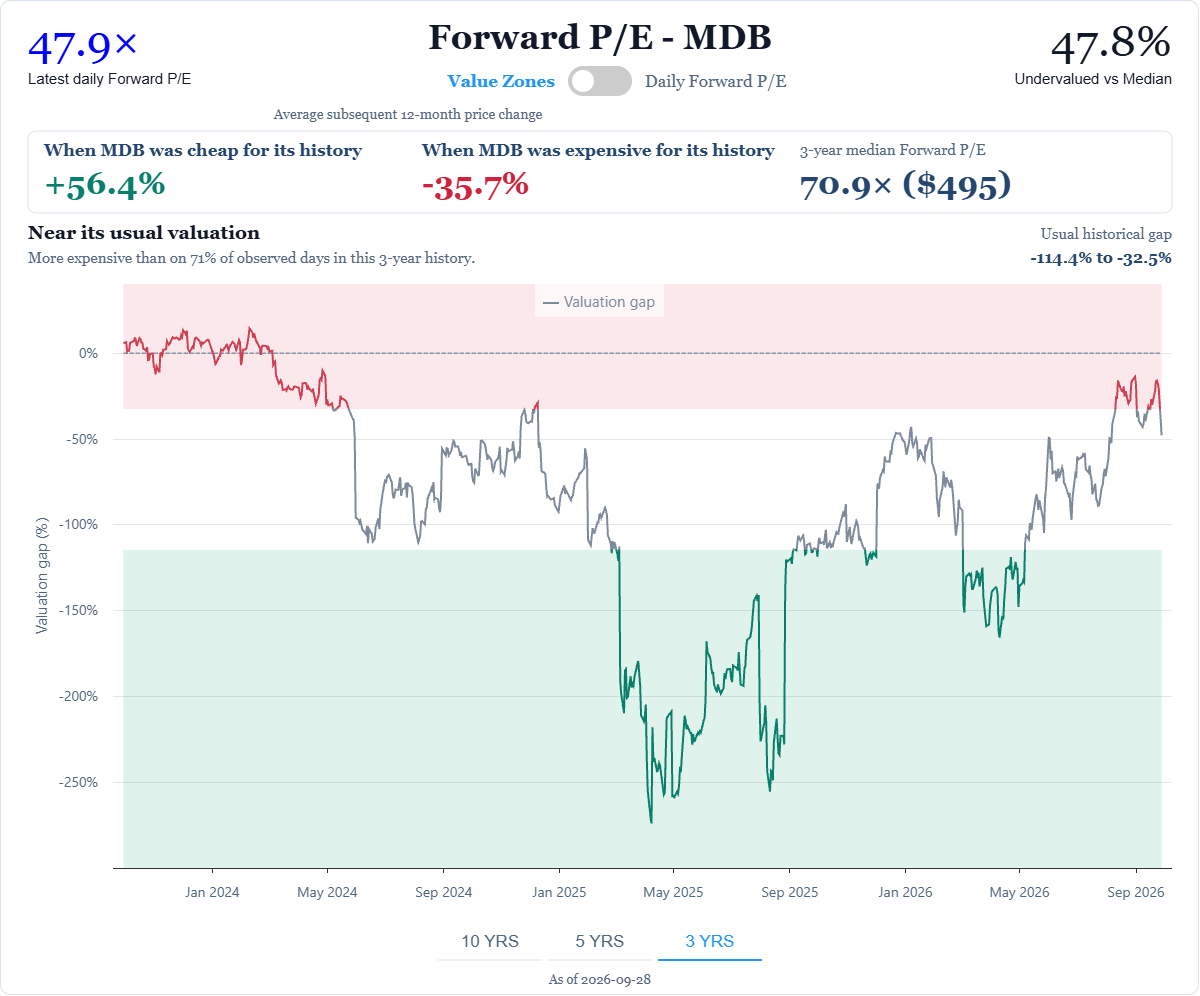
MongoDB (MDB) Forward PE Value Zones

MongoDB (MDB) Forward PE Value Zones

Bottom line

Keep the customer expansion story under review. If usage remains healthy and management delivers its commitments, the case for lasting damage would weaken. Delayed projects or softer consumption would make the concern more substantial. The next operating evidence deserves more weight than either the familiar name returning or the initial reaction to the departure.

Pre Market Pulse

  • MongoDB named Dev Ittycheria interim CEO on September 28 after CJ Desai left for a senior role at Meta.

  • The company kept its Q3 and full year fiscal 2027 guidance unchanged.

  • Investor Day is scheduled for today, September 29, from 11:00 a.m. to 3:15 p.m. ET.

Why it matters this morning

The useful development today would be evidence about execution: who owns the product roadmap, whether customer activity has changed, and how management plans to handle the transition. Reassurance matters more when it comes with specific commitments that can be checked later.

Peer Read Through

Snowflake (SNOW)

This is an adjacent cloud data platform comparison. Its consumption model makes customer spending trends useful context for Atlas, although the companies serve different workloads. Similar weakness across both could point toward broader spending conditions; divergence would warrant a closer look at company execution and product mix.

Elastic (ESTC)

Elastic's search, observability and security products provide a comparison for parts of MongoDB's search and AI offering. Product adoption and delivery are relevant checks, but Elastic's performance would not by itself establish that customers are switching away from MongoDB.

Datadog (DDOG)

This is an adjacent cloud observability business, useful for context on demand across cloud applications. It is not an equivalent operational database provider. Broader cloud activity can help frame the discussion without explaining every change in Atlas usage.

Group takeaway

These are currently public companies with different business mixes. Use them to test whether a change looks broad or specific to MongoDB. A shared customer budget does not make their products interchangeable or prove that one company's slowdown becomes another's gain.

What to Watch

  • Investor Day commitments on strategy, leadership responsibilities and any changes to financial targets.

  • Atlas revenue growth and management commentary on customer consumption in the next results. Look for evidence of expansion delays rather than inferring them from the departure.

  • Adoption of the AI retrieval capabilities already announced as generally available, including Automated Embeddings powered by Voyage AI. Separate adoption progress from future product launch promises.

  • Disclosed changes in customer retention, large customer expansion or key personnel that could indicate disruption.

  • The permanent CEO appointment and the incoming leader's priorities. The length of the search alone would not establish customer weakness.

Bottom line

The useful test is whether customers keep putting more work on the platform while management delivers its roadmap. Strong evidence on both would support confidence in the transition. Weakness on either would deserve attention even if the headline guidance remained unchanged.

STOCKS IN THIS ARTICLE

Also Mentions:

Comments