Costco’s Earnings Beat Needs A Closer Look

Costco posted a Q4 earnings beat supported by a $184 million tariff windfall and surging digital sales.

Source: DepositPhotos

The standard retail playbook says that when consumers feel squeezed they trade down. Costco (COST)’s membership model gives it a different way to compete, but that does not make the stock immune to valuation risk. Today we test that premium against a strong fourth quarter. The headline profit got a lift from tariff refunds. But the real question is how much growth remains after taking that benefit out, and whether investors are paying too much for it.

Main Note

The One Time Windfall Hiding Inside Costco Earnings

Costco Wholesale (COST) Quote

Verdict: Costco posted strong sales growth and another solid quarter online. Its earnings received a temporary lift from tariff refunds, while membership fee growth slowed. Both deserve a closer look, but neither is enough on its own to say the underlying business is losing strength.

What happened

Costco reported fiscal fourth quarter revenue of $95.7 billion, with comparable sales up 9.4% across the business. Excluding changes in gasoline prices and currency, comparable sales rose 6.7%. The digital side was even stronger, with digitally enabled comparable sales up 19.5%. Those are strong results, but the adjusted sales figure gives a cleaner view of the underlying growth.

The complication sits further down the income statement. Costco received $184 million in tariff refunds during the quarter, but some of that money went back into better prices for members. The net benefit added $0.15 to earnings per share. Take that out and reported earnings of $6.75 become about $6.60, still above the $6.54 analysts expected. The refund helped the beat. It did not create the entire beat.

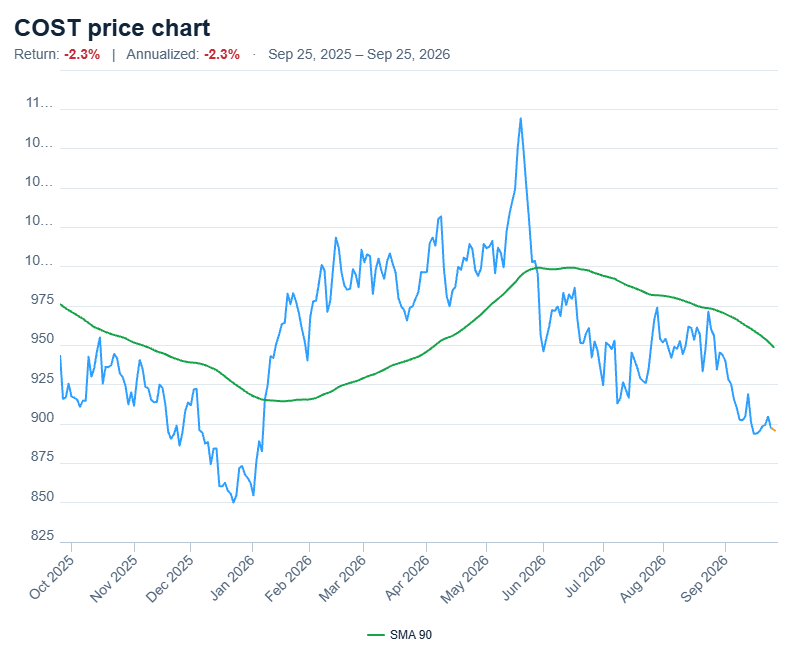
Costco Wholesale (COST) 1 year chart

Costco Wholesale (COST) 1 year chart

Why it matters

Membership fees are central to Costco’s economics, but they are not its only source of profit. Merchandise sales and its other businesses matter too. For investors, the useful exercise is to separate lasting improvements in the operation from the temporary refund benefit. Better execution can support a premium valuation, but it does not automatically mean the stock deserves an even higher multiple.

What changed in the thesis

The slowdown in membership fee growth is worth watching. Revenue from those fees rose 7.3%, compared with roughly 10.7% in the previous quarter. But fee revenue is not a pure measure of new members or customer loyalty. It also reflects Executive upgrades, currency and the timing of past fee increases. The question is how much of the slowdown comes from tougher comparisons and how much comes from slower growth in the member base.

What the market may be missing

The more useful membership check is whether Costco keeps adding paying households and holding onto existing ones. Paid memberships reached 84.1 million, up 3.8%, while the U.S. and Canada renewal rate was 92.3%. Slower growth deserves attention, especially for a stock carrying high expectations. But slower fee growth and weakening customer loyalty are not the same thing.

Valuation and expectations

The refund should come out of any estimate of repeatable earnings, but that does not make the rest of the quarter ordinary. Costco’s core merchandise margin improved even excluding the refund benefit. The valuation question is whether future growth can justify today’s share price, not whether ecommerce alone can keep pushing the multiple higher. Investors should be careful about paying for temporary help as though it will last.

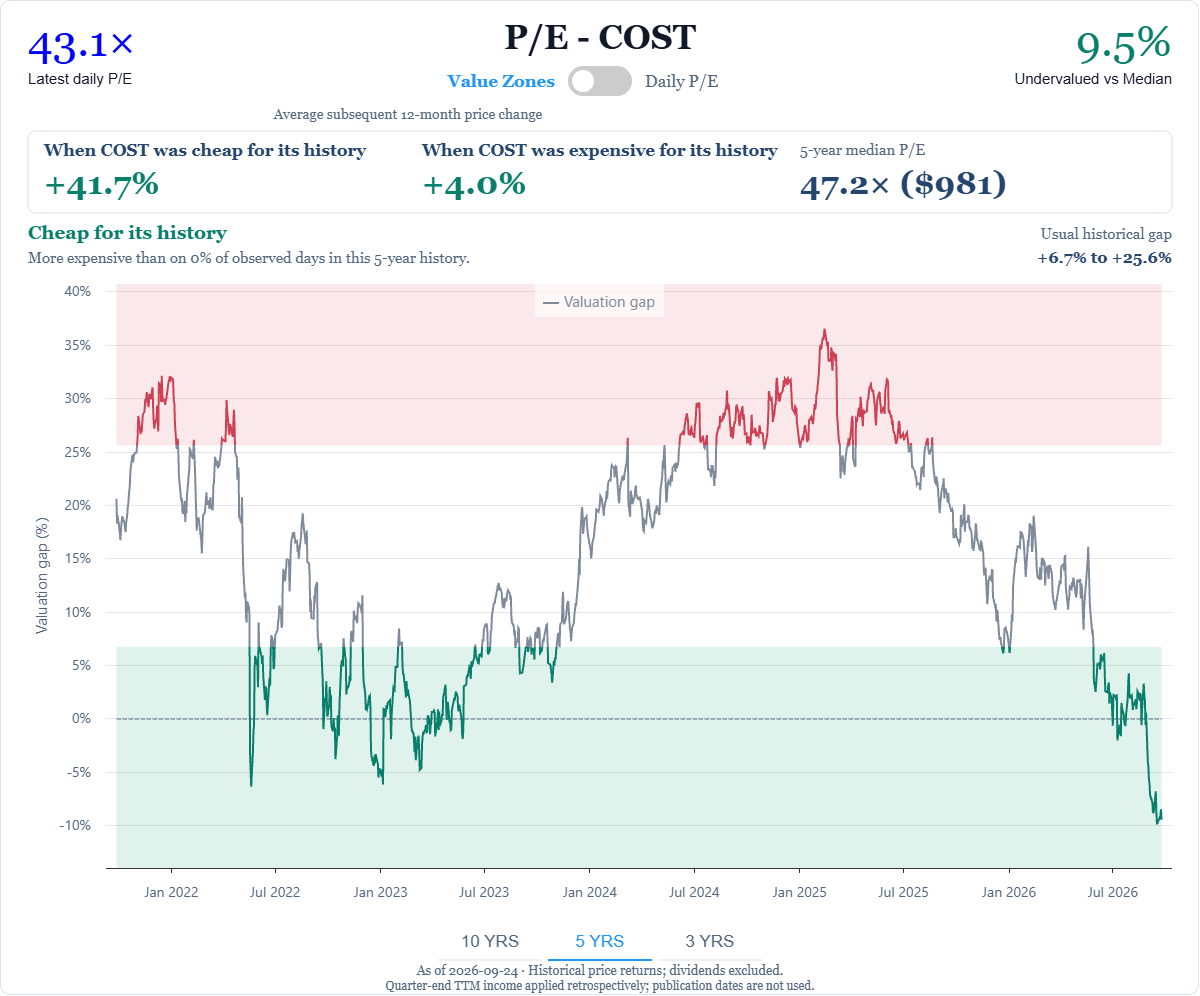
Costco Wholesale (COST) Value Zones

Costco Wholesale (COST) Value Zones

Bottom line

Costco’s latest results give investors more to work with than a refund check. But temporary earnings benefits should not become permanent assumptions, and the slowdown in membership fee growth deserves attention. The business can keep performing well while the stock still asks too much of future results.

Pre Market Pulse

  • Costco shares were little changed in early Friday premarket trading. The company had already disclosed its quarterly comparable sales earlier this month, so the fresh information is in earnings, membership trends and management’s outlook.

  • The Consumer Staples Select Sector SPDR ETF (XLP), carried a forward price to earnings ratio of about 19.4 as of September 24, according to State Street (STT). That is a broad consumer staples benchmark, not a pure measure of what investors are paying for warehouse retailers.

Why it matters this morning

When a stock trades at a premium valuation, a good quarter is not always enough. Investors still need to separate repeatable earnings from temporary help. But a quiet trading reaction does not tell us exactly what the market is thinking, especially when much of the sales picture was already public.

Peer Read Through

Kroger (KR)

The traditional grocery model is under pressure. The company recently cut full year identical sales guidance and posted second quarter identical sales growth excluding fuel of just 0.2% on $34.6 billion in total sales.

Walmart (WMT)

Competes directly through its warehouse business and standard retail footprint. Walmart reported second quarter US comparable sales growth excluding fuel of just 2.6% but saw global ecommerce surge 23%.

Target (TGT)

Faces similar consumer pressures but lacks the membership fee buffer that protects Costco margins. Target posted comparable sales growth of 3.8% in its second quarter and saw operating margin expand from 5.2% to 9.6%. That expansion was also materially boosted by a massive $994 million tariff refund.

Group takeaway

The results point to a mixed retail picture, not a clean split between winning warehouse clubs and struggling stores. Tariff refunds are helping several retailers, but the size of that boost varies. The better comparison is how sales, traffic and profits are growing after separating those benefits and other company specific effects.

What to Watch

  • Costco’s September sales report, due October 7, to see how comparable sales are holding up. Focus on the measure excluding changes in gasoline prices and currency, while remembering that it does not strip out the effects of lower merchandise prices.

  • US and Canada membership renewal rates which currently sit at 92.3% to ensure they stay elevated as the benefits of past fee increases roll off.

  • Gross margin trajectory in the first quarter of fiscal 2027 to see if heavy LIFO charges normalize.

Bottom line

The next monthly sales reports will help test whether Costco can keep growing, but they will not settle the valuation question on their own. Long term returns still depend on what investors pay for those future earnings. A great business can be a disappointing investment if the starting price assumes too much.

STOCKS IN THIS ARTICLE

Also Mentions:

Comments