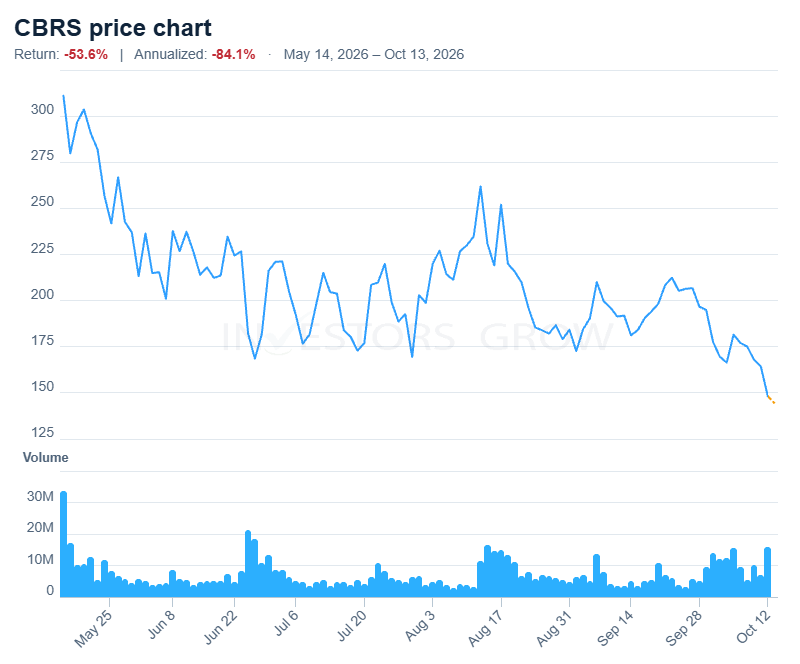
Selling speed is only the first stepCerebras Systems (CBRS)shares fell more than 10% in yesterday's regular session, October 12. Questions about OpenAI's demand and hardware choices have been part of the market narrative. In late September, SemiAnalysis reported that OpenAI's GPT 6.1 Sol Ultrafast tier ran on Nvidia GPUs rather than Cerebras hardware. October 12 coverage described that deployment as unconfirmed by either company. Those concerns could have contributed to yesterday's decline, but the report was not new yesterday. If investors think a major customer can meet more of its needs with competing hardware, they may lower their expectations for Cerebras's future sales and profit, and the price they are willing to pay today. If anything, this tells me how sensitive this AI boom is becoming.
|
There are other possible pressures, too. Monday's market coverage described broader weakness in chip stocks and concern about Cerebras's approaching share unlock. Its IPO prospectus schedules up to approximately 19.4 million previously restricted shares to become eligible for sale on October 14, subject to applicable restrictions. Investors may worry that existing holders will sell when those restrictions expire, adding to the shares offered in the market. That is a possibility, not evidence that those holders will sell, and the release of selling restrictions is not itself a new share issuance. We cannot determine how much each factor contributed to Monday's decline.
|
The business test is whether Cerebras can turn its large OpenAI agreement into dependable service at a profit. The hardware choice for one AI model cannot settle that question. Customer commitments, deliveries and costs will matter more.
|
Cerebras already earns cloud revenue. Its expansion depends on installing more systems, securing the power to run them and delivering the speed customers want at a cost that leaves a worthwhile return for shareholders. |
|
Why would a customer pay for faster answers?Cerebras sells AI computing systems and access to computing through the cloud. One important use is inference: running an already trained AI model to answer a question, generate code or perform another task.
|
Consider a coding agent that plans a change, writes code, tests it and revises it. Each step can require another model response. Shorter waits could help a customer finish more useful work, making a faster service worth paying more for.
|
But serving one user quickly and serving many users at once are different challenges. Latency measures how long someone waits. Throughput measures how much work the system handles across users. A commercially useful service needs to balance both.
|
For investors, the question is what it costs to complete a satisfactory task at the speed customers need. Faster answers could support higher prices or more usage, provided the answers remain useful and customers value the time saved.
|
A contract, future revenue and working capacityThree large numbers help explain the opportunity, but each measures something different.
|
The January 14 partnership announcement called for 750 megawatts of Cerebras systems to serve OpenAI customers, deployed in stages beginning in 2026. In its June 23 results release, Cerebras described the multiyear agreement as worth more than $20 billion. That value spans years of the relationship, rather than one year's sales.
|
Cerebras also reported $25.4 billion of remaining performance obligations as of June 30. Think of this as a measure of contracted revenue still to be recognized as the company fulfills its obligations. It indicates future business, with timing and profitability depending on delivery and the applicable contract terms.
|
Then there is the infrastructure. In its second quarter update, Cerebras reported more than 600 megawatts of data center capacity live and under contract for delivery by the end of 2027. That wording combines operating capacity with capacity expected later. Megawatts measure power capacity, so the number alone tells us little about how much revenue the facilities are producing.
|
The work ahead is concrete: secure facilities and power, install systems, meet the customer's service requirements and deliver the computing. Delays can push revenue further out while spending continues.
|
A useful next disclosure would separate capacity already operating and accepted by customers from capacity still scheduled. That would give investors a clearer view of how much of the buildout has become a working business.
|
What the OpenAI concerns actually tell usThe hardware controversy predates October 12. In late September, SemiAnalysis reported that OpenAI's GPT 6.1 Sol Ultrafast tier used Nvidia graphics processors rather than Cerebras hardware. The available evidence does not establish company confirmation of that specific deployment.
|
There is a separate, documented competitive development. In its October 1 explanation of Astra Ultrafast, Nvidia said OpenAI's GPT 6 Astra Ultrafast runs on its Blackwell graphics processors. That concerns a different model from the disputed Sol report, but it shows that OpenAI has another hardware route to a fast inference service.
|
On October 2, OpenAI CEO Sam Altman described Cerebras as a close partner, a statement subsequently reported by CNBC. His reassurance supports a continuing relationship while leaving the disputed model's hardware and the agreement's detailed economics unresolved.
|
OpenAI originally described a portfolio approach: use different computing systems for different workloads. A model running on another supplier's hardware can fit that approach. A confirmed reduction in Cerebras's capacity commitment or a change in deliveries would say more about the business than the hardware choice for one model.
|
The revenue concerns also need context. Bloomberg reported on October 8, New York time, that OpenAI had roughly $50 billion in annualized revenue at September's end and expected at least $70 billion by year end, citing people familiar with the matter. Annualized revenue extends a shorter period's sales pace over a year. These figures refer to different points in time, and the report also described differences in how estimates counted cloud provider sales. Comparing them does not establish a revenue shortfall or a reduction in Cerebras orders. OpenAI declined to comment on Bloomberg's report.
|
Customer dependence is still a real concern. Cerebras itself identifies reliance on a limited number of significant customers, including OpenAI, as a risk. A large buyer can help a supplier expand quickly, but changes in that buyer's needs or finances can have an outsized effect. The reported revenue figures are insufficient to establish either a demand collapse or OpenAI's ability to fund all its commitments.
|
Revenue is growing. How much does Cerebras keep?For the quarter ended June 30, 2026, Cerebras reported $126.0 million in cloud and other services revenue under GAAP, the standard accounting rules, up 281% from a year earlier. Total GAAP revenue was $180.1 million. All financial amounts here are in US dollars.
|
That is substantial growth in an operating business. The next question is how much of that revenue remains after costs.
|
Gross margin measures the share of revenue left after the costs classified as delivering products and services. Cerebras reported a GAAP gross margin of 14%. Its adjusted measure, called core, showed a gross margin of 41%.
|
The company says core measures exclude items including customer warrant amortization, stock based compensation and certain data center revenue and costs passed through to customers. Those adjustments make it important to compare results on the same accounting basis. Even under the company's core measure, operating margin was negative at 16%: after expenses beyond direct delivery costs, Cerebras still recorded an operating loss on that adjusted basis.
|
Growing the cloud business could improve the profit picture. But the return to shareholders depends on both the margin earned on that business and the capital required to build it.
|
When new partners become meaningful businessCerebras is building routes to customers beyond its direct OpenAI relationship. In its September 28 announcement of the Cerebras partnership, Gimlet said the partners planned 100 megawatts of Cerebras powered inference capacity, with the first facility expected later in 2026. General Compute followed with a September 29 agreement targeting service availability in the first quarter of 2027.
|
Gimlet also described combining graphics processors with Cerebras systems within a workload. Different processors can handle different parts of the same job. That offers a more useful way to think about competition than assuming every AI task must have one hardware winner.
|
These arrangements could broaden Cerebras's customer base. Their financial importance will become clearer as systems enter service and revenue follows. For now, the announcements show possible sources of growth rather than an established reduction in dependence on OpenAI.
|
The evidence that would strengthen the case is straightforward: customers accepting capacity on schedule, cloud revenue growing with improving margins, and new partners contributing meaningful business. Delays, costly deployments or a confirmed reduction in customer commitments would weaken it.
|
The opportunity is to turn demand for faster AI into a larger, profitable service. Deliveries, customer commitments and margins will tell us whether that opportunity is becoming a durable business. |
|






Comments
Log in or sign up to join the conversation.