Cracker Barrel’s Turnaround Still Needs More Diners

Cracker Barrel shares rallied on an earnings beat, though a 6.1% traffic decline and one-time tariff refund signal a fragile recovery.

Source: DepositPhotos

It is unusual to see a restaurant chain report a 6.1% drop in foot traffic and watch its stock rally. That is exactly what happened with Cracker Barrel this week. Investors got a much better earnings result than expected, but there is a catch. A tariff refund gave profits a meaningful lift, and the quarter ended before the new CEO took over. The question is whether Cracker Barrel can turn a stronger balance sheet and improving guest experience into a lasting recovery, rather than just a better looking quarter.

Main Note

Cracker Barrel tests the limits of margin over volume

Cracker Barrel (CBRL) Quote

Verdict: Cracker Barrel delivered a better than expected quarter, but it has not yet proved that the profit improvement can last. The new CEO inherits a business with less debt and plenty of work still to do. Cost savings can help, but bringing diners back remains the bigger test.

What happened

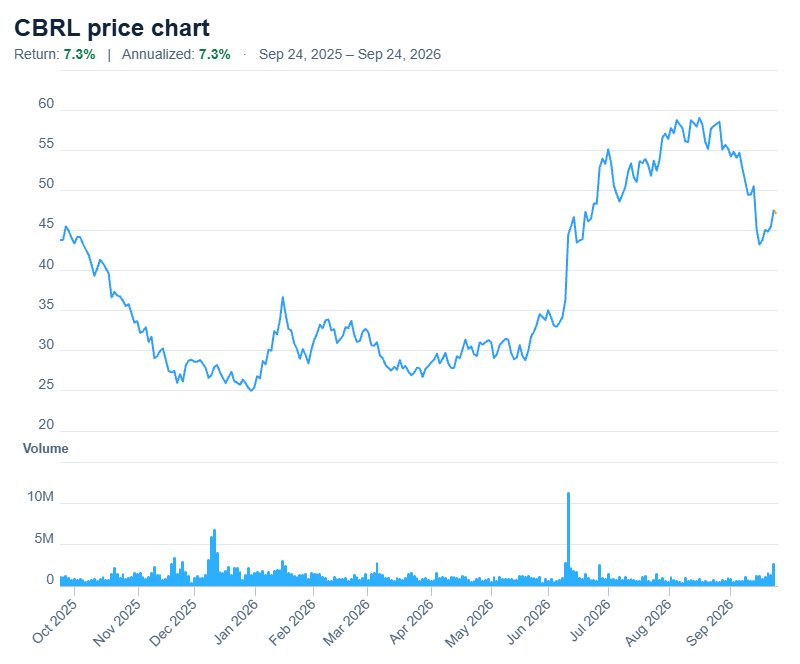
Cracker Barrel delivered adjusted earnings of $0.99 per share for its fourth quarter, easily clearing the $0.17 consensus estimate. Shares jumped roughly 8% in early trading and finished Wednesday at $47.52, up more than 4% for the day.

Back in July, the company sold the real estate at 26 stores and leased it back, bringing in about $77 million to reduce debt. That helps the balance sheet, but those properties now carry roughly $5.7 million in initial annual rent. Cracker Barrel also exited Maple Street Biscuit Company to concentrate on its main brand.

Restaurant traffic fell 6.1%, while menu pricing increased 4.4%. That helped cushion the decline, but comparable restaurant sales still fell 2.1%. Management said the underlying traffic trend was gradually improving after accounting for differences in last year’s comparisons, which is more encouraging than the headline traffic number alone suggests.

Cracker Barrel (CBRL) 1 Yr Chart

Cracker Barrel (CBRL) 1 Yr Chart

Why it matters

Higher prices helped cushion the loss of visits, but fewer customers still make it harder to cover a restaurant’s everyday costs. The important question is whether Cracker Barrel can protect profits while giving people a reason to come back.

Management’s stated plan is to improve food quality, especially at dinner, strengthen service and make better use of its loyalty program. Those investments are included in the outlook. This is a plan to rebuild demand, not evidence that the company has deliberately decided to serve fewer customers.

What changed in the thesis

The setup shifted from a pure turnaround story to a margin execution play. Investors must now bet that the leaner cost structure is durable enough to support cash flow while the company attempts to win back diners.

If the margin floor is real, the company has breathing room to fund its strategic overhaul.

What the market may be missing

The earnings beat came with an important boost. Cracker Barrel recorded a $15 million tariff refund benefit and reinvested $5.9 million in the business, leaving a net benefit of $9.1 million. That benefit remained in the company’s adjusted results, so the word “adjusted” does not mean the refund was already stripped out.

Backing out that net benefit puts adjusted EBITDA, a profit measure that excludes interest, taxes and several other expenses, at about $53 million rather than the reported $62.1 million. That is roughly 5% below last year’s $55.7 million. The profit margin on that same basis would be about 6.2%, versus 6.4% a year earlier. The quarter beat expectations, but this simple adjustment does not support the idea that underlying margins have already moved to a higher level.

Valuation and expectations

Analysts will likely have to raise near term earnings estimates to account for the new cost baseline. However, if the market decides the traffic loss is structural rather than a deliberate shedding of bargain hunters, valuation multiples will stay compressed no matter how much costs fall.

Bottom line

Paying down debt and simplifying the business give the new CEO a better starting point, but those moves were already underway before he arrived. The next test is whether Cracker Barrel can stabilize visits and generate dependable profits. A stronger balance sheet buys time. It does not finish the turnaround.

Pre Market Pulse

  • US equity futures pointed slightly lower this morning ahead of the opening bell.

  • The 10 year Treasury yield reached roughly 5.14% amid rising oil prices and escalating geopolitical tensions.

Why it matters this morning

Higher yields and rising energy costs put direct pressure on discretionary spending. For a brand heavily reliant on lower income diners, these macro forces make a full traffic recovery much harder to achieve.


Peer Read Through

Texas Roadhouse (TXRH)

This competitor represents the gold standard for volume driven growth in the casual dining sector. They have largely avoided the traffic trap by focusing heavily on perceived value and execution.

Dine Brands (DIN)

The parent company of Applebee's and IHOP faces a very similar struggle with a lower income consumer pullback. Their ability to manage promotional activity without crushing margins offers a direct parallel.

Darden Restaurants (DRI)

The owner of Olive Garden and LongHorn Steakhouse reports before the market opens this morning. Its results will offer a fresh comparison for restaurant spending. Watch whether sales growth comes from more visits or larger checks, and whether that growth is translating into better profits.

Group takeaway

Casual dining operators are splitting into two camps. Brands with strong perceived value are winning on volume, while legacy chains are forced to pull pricing levers to protect cash flow as foot traffic fades.

What to Watch

  • First quarter comparable sales to see if the forecasted 3% to 5% full year growth actually materializes.

  • Operating margin sustainability without the help of tariff refunds.

  • Penetration of the loyalty program, which recently surpassed 12.5 million members.

Bottom line

The next quarterly report will give us a better read on whether the recovery is gaining traction. The loyalty program already has a large membership base. What matters now is whether it and the menu improvements bring people back more often, without relying too heavily on higher prices to support sales.

STOCKS IN THIS ARTICLE

Also Mentions:

Comments