What The WBD Settlement Means For Streaming

Warner Bros. Discovery and Paramount cleared legal hurdles for their $110 billion merger, securing a $31 per share buyout. Success now hinges on managing $80 billion in debt while meeting strict production quotas.

Source: DepositPhotos

Mega mergers usually promise massive cost cuts to justify their massive debt loads. The planned combination of Paramount (PARA) and Warner Bros. Discovery is no different. Management is targeting roughly $6 billion in annual cost savings, while reported estimates put the combined company’s net debt near $80 billion. The settlement, clearing a major hurdle for this roughly $110 billion deal, including assumed debt, also sets minimum production spending and film release requirements. Those commitments limit some options without ruling out savings elsewhere. The focus is shifting from getting the deal approved to whether the combined business can generate enough cash to make the debt manageable.

Main Note

The Burden Shifts to Paramount

Warner Bros Discovery (WBD) Quote

Verdict: The settlement removes a major obstacle to the transaction and leaves WBD shareholders mainly weighing the remaining upside against the time and risk involved in reaching closing. That is a much narrower investment question than owning the combined business, but it is not risk-free. Paramount shareholders face the bigger long-term challenge of making the integration work while carrying substantial debt.

What happened

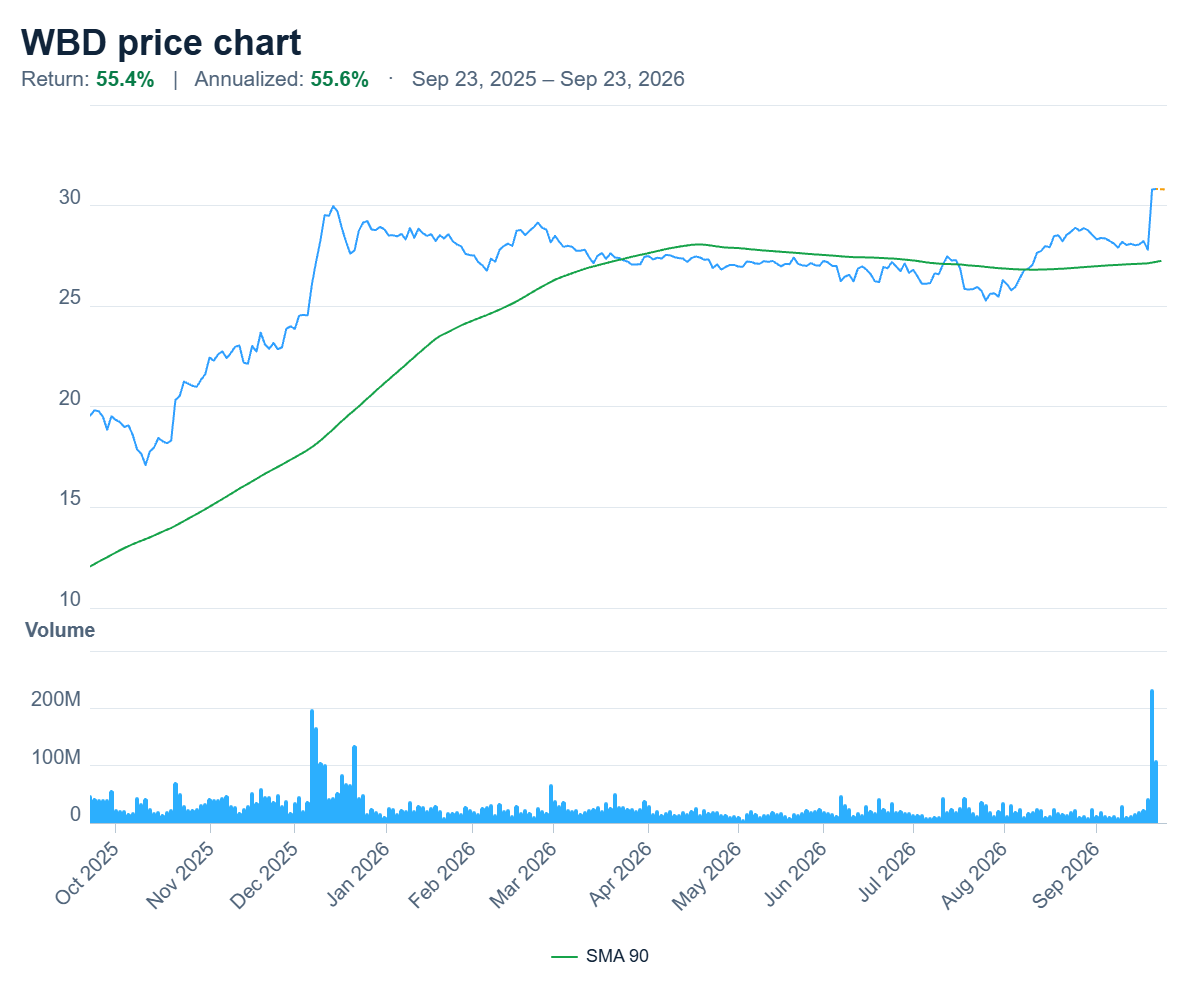
On Monday, a coalition of state attorneys general and the Writers Guild of America agreed to settle their antitrust lawsuits, removing a major remaining hurdle to Paramount’s acquisition of Warner Bros. Discovery. The agreement calls for WBD shareholders to receive $31 per share in cash when the transaction closes, plus any applicable payment for a delayed closing. WBD rose 10.8% on Monday to close at $30.80 and finished Tuesday at $30.83. Most of the gap to the base buyout price has now disappeared.

As part of the agreement, Paramount accepted strict behavioral commitments. The company must spend an additional $1.5 billion on US domestic film production over five years and release at least 30 films annually for the first two years. These are mandatory production quotas backed by financial penalties for missed targets.

Warner Bros Discovery (WBD) 1 Year Chart

Warner Bros. Discovery (WBD) 1 Year Chart

Why it matters

The combined company is expected to carry a heavy debt load, making the actual cost of its financing important. But multiplying an estimated debt figure by the Treasury yield does not tell us what its annual interest bill will be. Management’s savings target also needs to be weighed against the cost of combining the businesses. The settlement protects minimum US production spending and film output, but it does not freeze every studio budget. Investors need to see where the savings will come from and how much cash they will actually produce.

What changed in the thesis

For WBD shareholders, the settlement substantially reduces the risk that the litigation prevents the sale, although the transaction still needs to close. For Paramount, attention shifts toward the operating challenge. The combined library could strengthen streaming and content licensing, but a larger collection of channels does not guarantee greater pricing power. The settlement generally requires separate negotiations for the two companies’ basic cable portfolios for five years. Management still has to offset shrinking traditional TV revenue while turning the promised savings into cash.

What the market may be missing

Settling the case improves Paramount’s chances of avoiding extra payments for a delayed closing, but the settlement itself does not stop that clock. The deal must close by September 30 to avoid the daily payment that begins accruing afterward. Paramount shares finished Tuesday at $10.11, up about 2%. That price also needs to be compared with the revised equity financing terms, not a fixed $16.02 backing price. The revised terms use a pre-closing trading price formula with a $12 floor and a $16.02 ceiling, making the final share count another important part of the valuation.

Valuation and expectations

Paying down debt needs to be a major priority alongside the spending required to combine the businesses. S&P’s published merger assessment pointed to a BB issuer rating after closing, assuming no material change in the deal, rather than a BB+ rating for the completed combination. That would keep the company below investment grade. The financing can include both loans and bonds, so investors should focus on the interest costs, repayment deadlines, and restrictions attached to the debt rather than the rating alone.

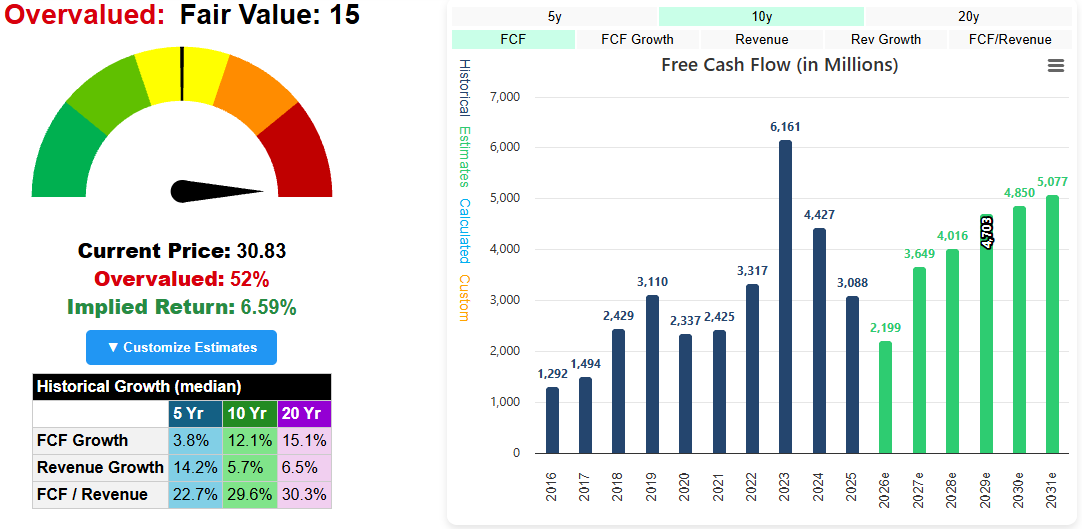
Warner Bros Discovery (WBD) DCF

Warner Bros. Discovery (WBD) DCF

Bottom line

The settlement is a clear victory for WBD shareholders who get to exit at $31 per share. For Paramount, winning the legal battle means inheriting a massive financial burden that leaves very little room for operational errors or higher interest rates.

Pre Market Pulse

  • Stocks were mixed yesterday, with the S&P 500 (SPY) essentially unchanged, the Nasdaq (QQQ) up roughly 0.5%, and the Dow (DIA) down roughly 0.4%. Warner Bros. Discovery held near its buyout price following Monday’s settlement-driven rally.

  • The 10-year Treasury yield finished near 4.95%, down slightly from Monday. Borrowing costs remain an important consideration for a deal this heavily financed with debt.

Why it matters this morning

Elevated borrowing costs are important context for the Paramount acquisition, but the entire debt load will not reset to today’s rates at once. The interest bill will depend on the financing raised for the deal, the existing bonds that remain outstanding, and how much debt carries a floating rate. That will help determine how much cash is left for streaming integration and paying down debt.

Peer Read Through

Netflix (NFLX)

Shares fell roughly 2% yesterday following an analyst downgrade, though the company stands to benefit immensely as an unencumbered competitor. Netflix boasts robust free cash flow and a relatively light debt load compared to legacy media peers.

Disney (DIS)

The company faces a stronger combined library competitor but possesses vastly superior financial flexibility. Disney operates with roughly $45 billion in total debt and generated $8.3 billion in trailing free cash flow, allowing it to weather the industry transition better than a highly leveraged Paramount.

Roku (ROKU)

A combined Paramount and WBD could become a more powerful negotiating partner for Roku, but Roku is also part of a major transaction of its own. Fox (FOX) has agreed to acquire the company in a cash and stock deal announced in June. That makes the Fox transaction and its closing conditions central to Roku’s investment case, rather than treating it simply as an independent platform facing a larger content supplier.

Group takeaway

While Paramount focuses internally on complex integration and massive debt servicing, cash-rich peers like Netflix and Disney are free to aggressively invest in new content and technology.

What to Watch

  • The formal closing of the transaction and the cessation of trading for WBD equity.

  • The pricing and final yields of the massive debt syndication package, which will immediately indicate institutional credit market appetite.

  • Management disclosures regarding the specific timeline and technological strategy for merging the Paramount Plus and HBO Max streaming platforms.

  • Any rapid decline in benchmark interest rates, which could materially lower debt servicing costs and change the solvency math.

Bottom line

The immediate focus shifts to completing the transaction and understanding the final financing. Investors need the actual interest bill, the debt repayment schedule, and a credible path from promised savings to cash left over after running the business. That will tell us far more about Paramount’s financial room to maneuver than applying today’s Treasury yield to the headline debt number.

STOCKS IN THIS ARTICLE

Also Mentions:

Comments