


A great quarter and a durable business are different things. Memory makers can earn extraordinary profits when supply is tight, then lose pricing power as factories catch up. Micron’s latest results give that familiar question a fresh test. Revenue is rising sharply, and longer customer agreements offer more visibility into future sales. But how much of today’s profitability can those agreements protect? This morning, we look at what the earnings release establishes, what remains exposed to the cycle, and which measures will tell us whether AI demand is producing a stronger business over time.
Main Note
Micron’s Profits Face a Durability Test
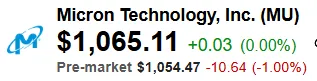
Verdict: Micron’s results add strong evidence of demand for memory, and longer customer agreements may make part of its revenue more predictable. The case for more durable profits is stronger when customers commit in advance. It still depends on the prices Micron realizes, its manufacturing costs, and the capital needed to expand.
What happened
The September 30 release covered the fiscal quarter ended September 3. Revenue reached $54.23 billion, up about 379% from a year earlier. The fiscal first quarter 2027 revenue outlook points higher again, to a midpoint of $61.5 billion. Those figures are total company revenue, not a measure of high bandwidth memory sales alone.
The durability argument also rests on 26 strategic customer agreements. Management estimates that these agreements will account for more than 35% of revenue through 2030. About three quarters of that estimated agreement revenue has a defined pricing framework, mostly with floors and ceilings. The remainder is periodically priced against the market.
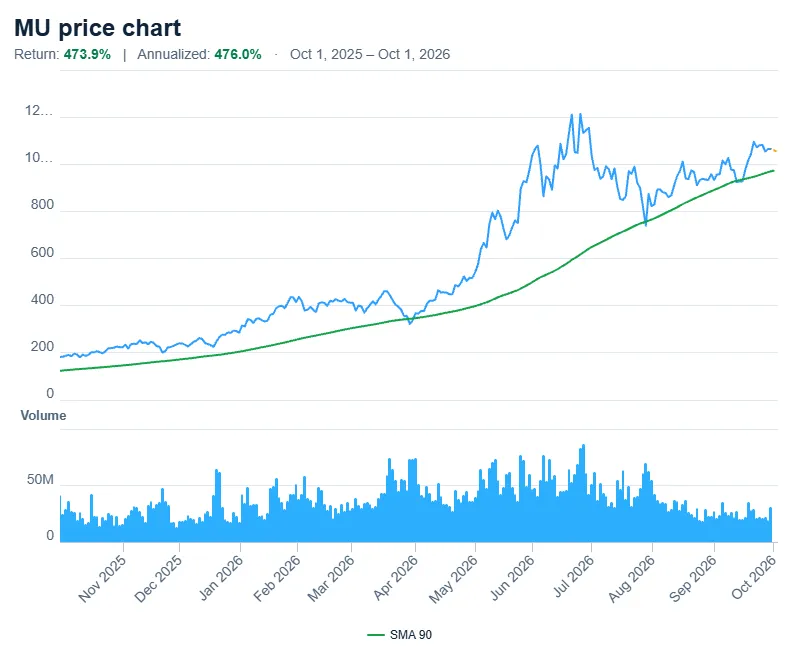
Micron Technology (MU) 1 yr Chart
Why it matters
High bandwidth memory places substantial memory capacity close to advanced processors so they can move data quickly. That makes it an important part of AI systems. Longer customer commitments can help a manufacturer plan production and investment before it builds the capacity. Pricing floors can also reduce some downside within the agreements’ terms. The benefit depends on how much business is covered and whether both sides perform.
What changed in the thesis
The question is whether Micron can earn more predictable returns through a cycle. Agreements covering a meaningful share of expected sales are evidence in that direction. They leave a substantial portion of the business exposed to future market conditions, however. Customers can still face deployment delays, competitors can add supply, and enforcing commitments can carry costs. More visibility should earn consideration without being treated as a guarantee.
What the market may be missing
It is easy to bundle every cost into one explanation. The expected decline from 87.0% to approximately 86.25% in non GAAP gross margin partly reflects higher manufacturing incentive compensation flowing through inventory. Capital spending is a separate cash demand. Planned net capital spending is about $25 billion in the first half of fiscal 2027, with higher spending in the second half. Factories affect cash when built and earnings over time through costs such as depreciation.
Valuation and expectations
A price to earnings ratio can look attractive when the earnings denominator is unusually high. That arithmetic says little about value until we decide what profits are likely to persist. A stronger case would combine reliable customer commitments with healthy realized pricing and cash generation after investment. If future supply catches demand more quickly than expected, today’s earnings would be a weaker guide to normal profits.
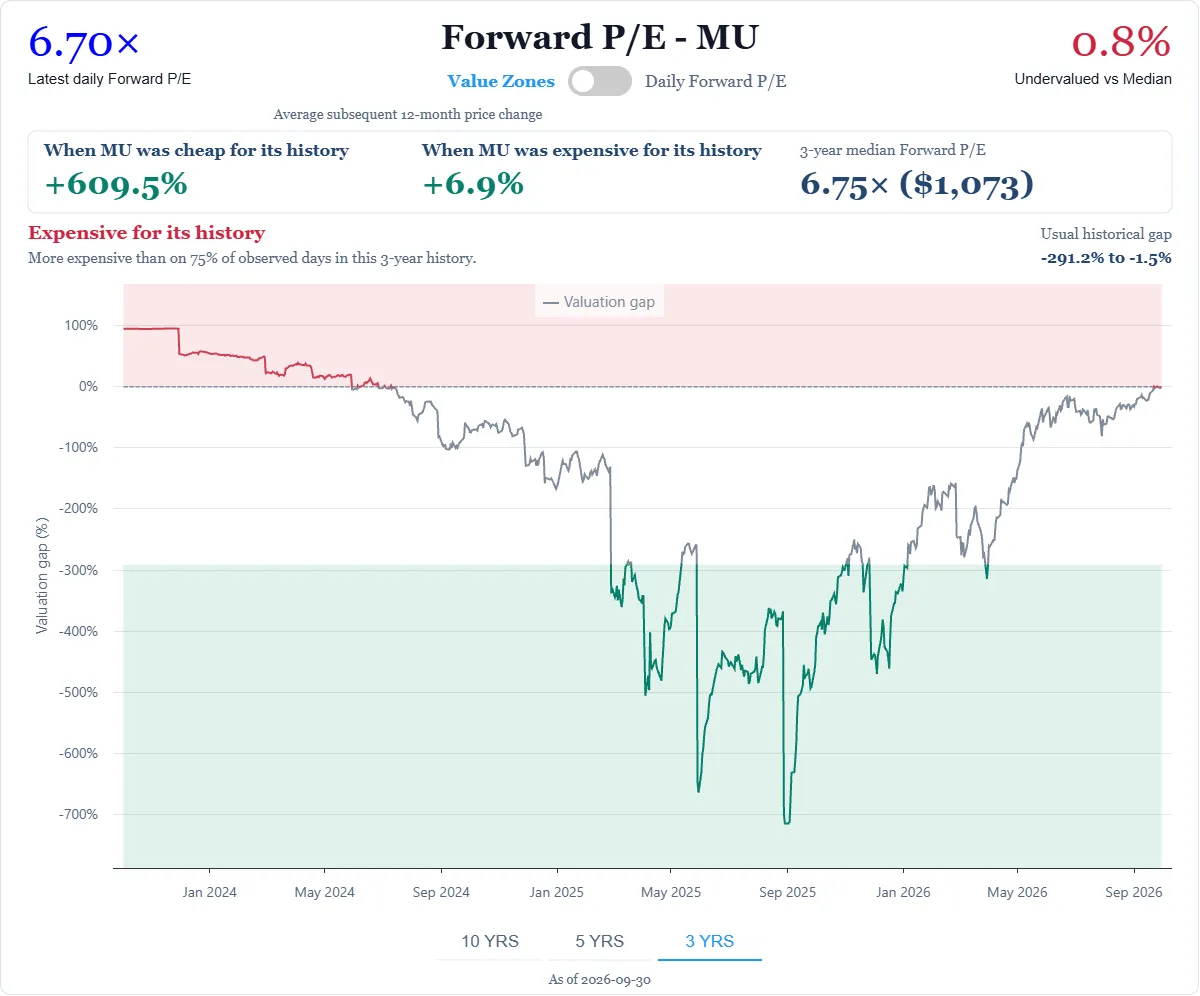
Micron Technology (MU) Forward PE
Bottom line
The new evidence supports researching a more durable Micron. Customer commitments matter, but they protect only part of the business and do not set every future margin. The next test is whether strong demand continues to produce cash as investment rises and competitors expand.
Pre Market Pulse
Micron reported fiscal fourth quarter revenue of $54.23 billion on September 30, compared with $11.32 billion a year earlier.
Revenue guidance for fiscal first quarter 2027 is $61.5 billion, plus or minus $1.5 billion. That is a forecast, rather than revenue already earned.
The next quarter’s non GAAP gross margin outlook is approximately 86.25%, compared with 87.0% in the reported quarter.
Why it matters this morning
The new outlook gives readers a way to test the durability argument. Sales can keep growing while margins ease. The important question is what is driving each change, and how much cash remains after the investment required to serve that demand.
Peer Read Through
SK hynix (SKHY)
This is a direct DRAM and high bandwidth memory competitor, with ADRs trading on Nasdaq. It reported HBM4 mass shipments beginning in the second quarter of 2026. Its progress is a reminder that a growing market can support several suppliers while competition for future business continues.
Samsung Electronics (KRX
005930): Samsung’s memory business directly competes in DRAM, high bandwidth memory, and NAND. It reported expanding HBM4 sales in its second quarter results. Its wider business mix means that Micron’s results should not be used to infer the same profit outlook for Samsung as a whole.
Sandisk (SNDK)
Sandisk is an independent public NAND and flash storage company following its separation from Western Digital. It offers a comparison for Micron’s NAND business, rather than a direct comparison for DRAM or high bandwidth memory. Strong demand in one memory product does not establish identical pricing or margins across all storage products.
Group takeaway
The relevant comparison is between products, capacity, and realized pricing. Demand growth may benefit several suppliers, but Micron’s customer agreements and product mix will determine its own results. The evidence does not establish equal gains for every company.
What to Watch
Pricing versus shipments: Separate changes in DRAM and NAND selling prices from changes in bits shipped. Revenue growth driven mainly by pricing carries a different risk from growth supported by both.
Customer commitments: Track the share of expected revenue covered by agreements, the pricing terms disclosed, and evidence that customers are meeting their commitments.
Margins: Compare the next reported non GAAP gross margin with the approximately 86.25% outlook, then examine the effects of pricing, product mix, and manufacturing costs.
Cash after investment: Follow adjusted free cash flow alongside net capital spending. Customer deposits are reported in financing cash flows and should not be counted as free cash flow.
Supply reaching customers: Watch actual production ramps and customer qualifications across major memory suppliers. Factory announcements alone do not establish when usable supply will arrive.
Bottom line
A more durable business should show up in realized pricing, contract performance, and cash after investment. Those measures will tell us more than a single record quarter or a confident forecast.


Comments
Log in or sign up to join the conversation.