Why Corning Shares Tumbled 14%

Corning shares plummeted 14% after a $2 billion equity raise sparked dilution fears amid the AI hardware buildout.

Source: DepositPhotos

The simplest model for investing in a technology infrastructure boom is that supplying the essential hardware acts as a license to print money. But building that hardware takes massive up front cash. When a major supplier announces a surprise equity raise, it tests that basic assumption. The immediate question is whether the company is funding guaranteed growth or simply struggling to keep up with the capital demands of the buildout. A massive influx of new shares can easily undercut a surging stock price, forcing the market to reprice the cost of growth.

Main Note

The Dilution Cost of Infrastructure Growth

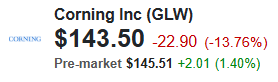
Corning (GLW) Quote

Verdict: Supplying components for massive data center buildouts takes real money. Corning’s new program allows it to sell up to $2 billion in stock over time, but that does not tell us how much it will actually raise or prove that existing funding sources are insufficient. For shareholders, the real test is whether any new capital creates enough additional value to justify a larger share count.

What happened

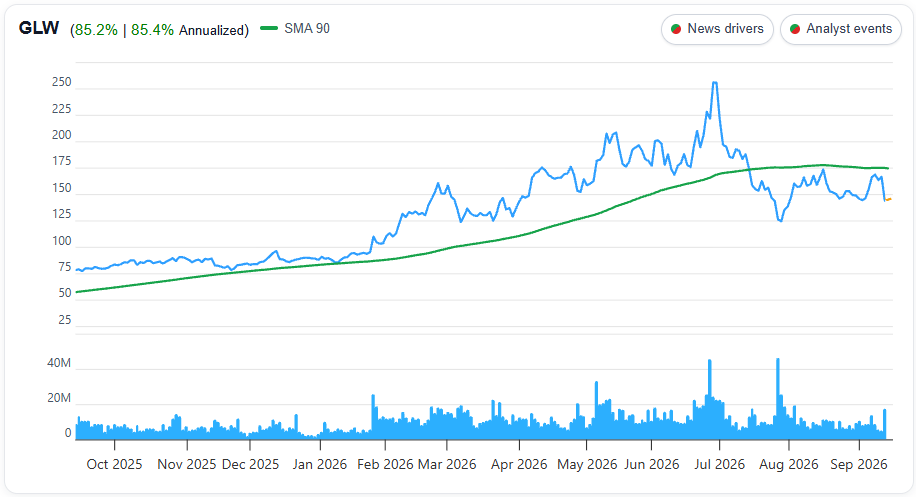
Corning shares dropped 13.7% on Monday to close at $143.60. On Friday, September 11, the company disclosed a program allowing it to sell up to $2 billion in stock over time. That added a company specific concern, but Corning was also caught in a broader selloff in AI related stocks following calls to slow AI development.

An at the market program allows Corning to sell shares gradually at market prices. The announcement establishes that option; it does not tell us that the full $2 billion has already been raised. The important questions are how much stock management actually sells, at what price, and what shareholders get in return.

Corning (GLW) 1 Yr Chart

Corning (GLW) 1 Yr Chart

Why it matters

Hardware manufacturing is capital heavy, and expanding production can require spending well before the new capacity starts earning money. Corning’s latest quarterly report put expected 2026 capital spending at about $2 billion. But it also reported roughly $2.5 billion in cash and an unused $1.5 billion revolving credit facility at the end of June. That does not settle every future funding question, but the stock sale program alone does not prove that internal cash flow is insufficient.

What changed in the thesis

The basic bet was that surging demand from network operators would flow cleanly into higher profits and a rising stock price. Now the market has to factor in the specific risk of share dilution. If a company issues new shares to fund operations, existing shares become a smaller slice of the eventual profit pie.

What the market may be missing

The dilution math is worth putting in perspective. At a share price around Monday’s $143.60 close, selling the full $2 billion would add roughly 14 million shares, or about 1.6% to the latest reported share count. That is a scenario, not a confirmed increase. The bigger question is whether the money helps produce more profit and cash flow for each share over time, not simply whether revenue grows faster than the share count.

Valuation and expectations

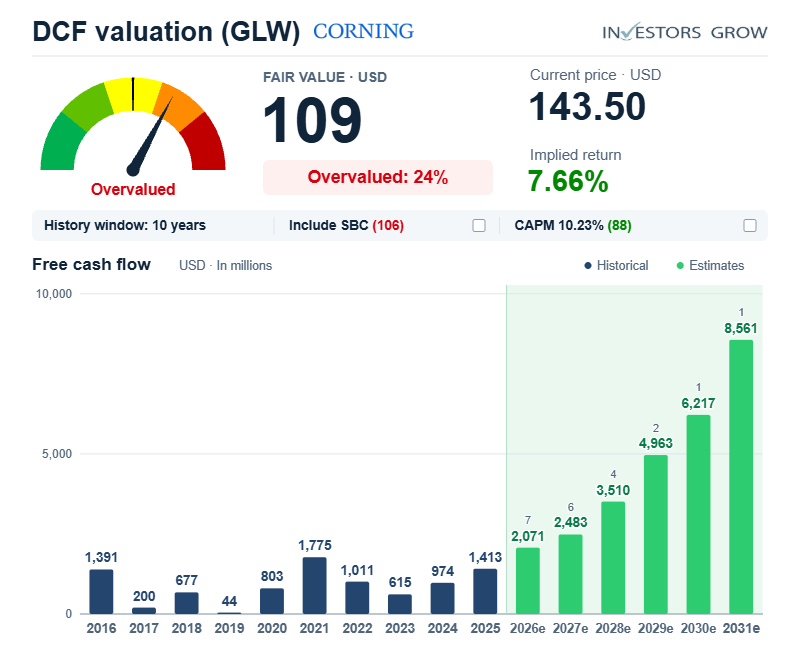
Investors still need a clearer picture of how Corning plans to use any money raised. The filing allows for broad corporate purposes, including capital spending, debt repayment and acquisitions, rather than naming one specific project. Mizuho (MFG) cut its price target from $210 to $180 on Monday while keeping its Outperform rating. That is a real change in valuation expectations, but we should watch actual earnings revisions rather than assume a larger share count automatically leads to a lower valuation.

Corning (GLW) DCF Fair Value

Corning (GLW) DCF Fair Value

Bottom line

High growth targets mean little if they do not eventually produce more profit and cash flow for each share. But issuing stock is not automatically a bad trade for existing owners. It depends on the price of the shares sold and what the company does with the money. That is what Corning needs to explain, rather than leaving investors to guess.

Pre Market Pulse

  • The 10 year US Treasury yield was around 5.03% in early trading, keeping pressure on richly valued growth stocks.

  • Brent crude futures traded just above $108 per barrel, adding to concerns about energy costs and inflation.

  • Corning shares were around $145.20 in pre market trading, up about 1.1% from Monday’s $143.60 close. That is a modest bounce, but only a small recovery from yesterday’s decline.

Why it matters this morning

Higher Treasury yields raise the bar for stocks, especially companies whose valuations depend on strong growth years from now. For a capital heavy business, that puts more focus on the returns from new factories and equipment. It does not automatically make selling shares a bad decision, but it does make the price of that funding, and what the company earns from it, worth watching.

Peer Read Through

Applied Optoelectronics (AAOI)

As a smaller player in optical networking, any sign that capital requirements are accelerating could pressure its balance sheet and force a revaluation of its cash runway.

Coherent (COHR)

Supplies crucial optical materials and lasers. If the cost of keeping up with data center demand is rising across the board, free cash flow estimates here could face heavy scrutiny.

Lumentum (LITE)

Operates in a similarly capital intensive segment of the communications infrastructure market and often moves in tandem with broader sector capital expenditure trends.

Ciena (CIEN)

Supplies optical networking equipment that moves data across telecommunications and cloud networks, alongside routing and switching products. Customer spending matters here too, but its own orders, margins and cash generation are more useful guides than assuming Corning’s financing decision applies to Ciena.

Group takeaway

Corning’s offering is a reason to check funding needs across optical and networking companies, not a reason to assume they all need to sell stock. The useful comparison is how much each company must spend, how much cash its business generates, and how firmly customers have committed to future orders. Those differences matter more than treating every company in the group as though it faces the same financing problem.

What to Watch

  • The actual share issuance rate disclosed in upcoming Securities and Exchange Commission filings to see how aggressively the company is tapping the $2 billion facility.

  • Third quarter core sales data, which management expects to land between $4.9 billion and $5.0 billion.

  • Capital expenditure guidance from major cloud service providers like Meta (META) and Google (GOOGL), which will dictate the demand trajectory for the entire optical component industry.

  • Analyst revisions to future earnings per share estimates that factor in the expected increase in outstanding shares.

Bottom line

The debate now shifts from raw demand to capital efficiency. The market needs hard proof that the cash going out the door is buying revenue that will actually flow to the bottom line without destroying per share value.

STOCKS IN THIS ARTICLE

Also Mentions:

Comments