The simple model for drug companies is that they invent treatments, sell them, and use the cash to fund the next wave of research. Reports that AstraZeneca held preliminary talks with Bristol Myers Squibb put that model under pressure. The key question is not whether AstraZeneca is spending $400 billion, because that figure is the companies’ combined market value, not an announced purchase price. The question is why a company that is still growing and publicly backing its pipeline would consider a combination this large. Shareholders must weigh the potential value of scale and a larger United States footprint against the risk of disrupting a strategy that was already working.
|
The organic growth problem hiding behind a massive acquisition |
|
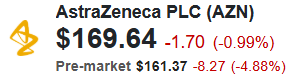 |
Verdict: Investors appear to view the reported talks as a possible warning, not a confirmed confession. AstraZeneca has not announced a bid, Reuters could not determine whether the discussions are ongoing, and no price or financing mix has been disclosed. The sharp share decline shows that shareholders dislike the idea of a transformative merger. It does not prove that management has lost faith in the pipeline.
|
Shares of AstraZeneca fell roughly 6% to 7% after reports that it had held preliminary discussions with Bristol Myers Squibb. Together, the companies were worth nearly $400 billion at Friday’s close. That is their combined market value, not an announced transaction price. No formal offer, cash and stock mix, or other deal terms have been disclosed, and Reuters could not determine whether the talks are still active.
|
Bristol Myers shares rose sharply in United States premarket trading while AstraZeneca shares fell in London. That split suggests investors currently see Bristol Myers shareholders as the likely beneficiaries and AstraZeneca shareholders as the group absorbing more of the execution risk. The market reaction is real, but the transaction remains only a possibility. |
|
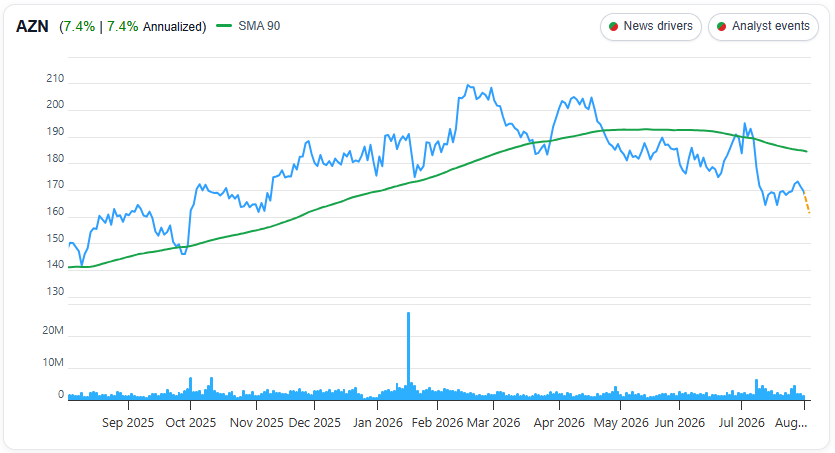 |
AstraZeneca (AZN) 1 Year Chart
|
The core economic question is organic revenue growth versus the cost of buying additional growth. Pharmaceutical companies face patent cliffs as their best selling drugs lose exclusivity. To bridge that gap, they either develop new medicines, license them, or acquire other companies. A merger this large could reshape AstraZeneca, but the financial risk cannot be measured until the price and financing are known. Management could use cash, debt, shares, or some combination of the three, and each structure would create a different risk for existing shareholders. A deal could add United States scale, neuroscience exposure, cell therapy assets, and cost savings. It could also dilute AstraZeneca’s growth profile, distract a productive research organization, and force divestitures in overlapping oncology products.
|
What changed in the thesis
|
Until now, AstraZeneca’s thesis was built around its existing portfolio and pipeline. The company still says it is on track for $80 billion in revenue by 2030, and its own investor material says that ambition is not dependent on future mergers and acquisitions. That makes the reported Bristol Myers talks surprising. If the discussions advance, shareholders would have to add a second thesis: that management can buy scale without weakening the research engine that created the original growth story.
|
What the market may be missing
|
The market may be pricing in the worst version of a transaction that may never happen. The companies have only been reported to have held preliminary talks, and Reuters could not determine whether those talks are ongoing. A formal deal would face real antitrust questions because Bristol Myers’ Opdivo and AstraZeneca’s Imfinzi compete in the same cancer immunotherapy class, but it is too early to say regulators would block the combination. The more defensible conclusion today is that approval could require meaningful divestitures, which would have to be weighed against any cost savings or United States expansion benefits.
|
Valuation and expectations
|
Even if no deal is announced, the report may leave a small scar on AstraZeneca’s valuation because investors now have to consider the possibility that management explored a much more aggressive use of capital. But the evidence does not support assuming analysts will automatically mark down the entire pipeline. AstraZeneca just maintained its 2026 outlook and $80 billion 2030 ambition after second quarter revenue rose 5% to $15.38 billion, helped by strong oncology and rare disease sales. The valuation debate should focus on whether these talks reveal a strategic shift, not treat that shift as proven. |
|
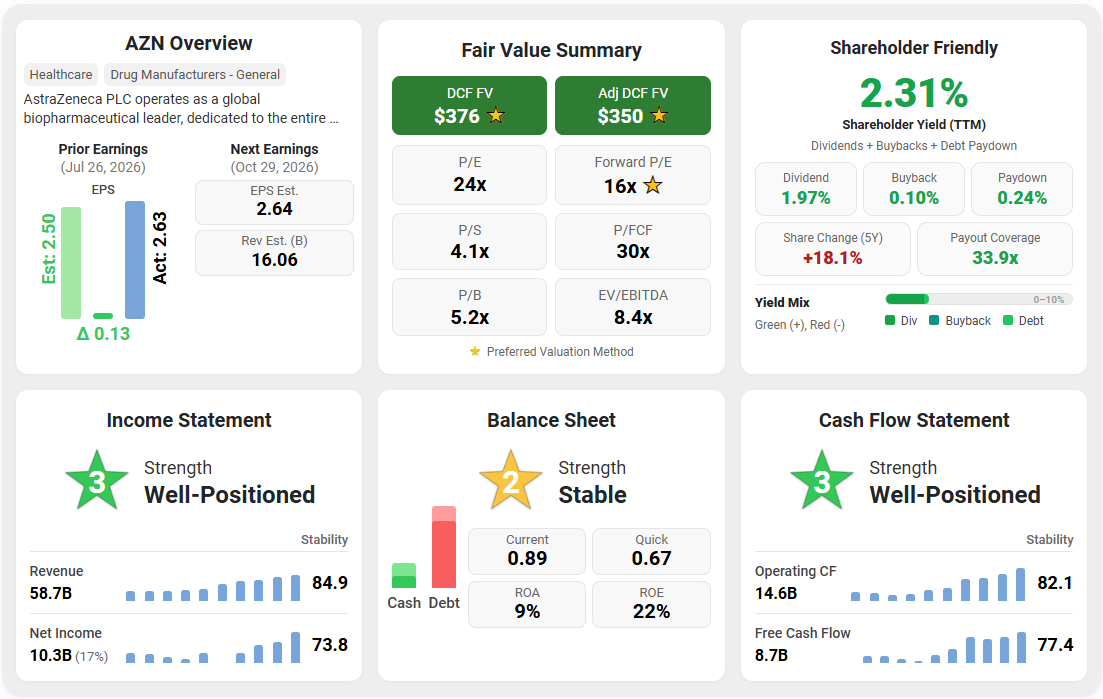 |
AstraZeneca (AZN) Summary Score
|
Scale is only valuable if it generates excess return on capital. The market is right to question a transaction that could reshape AstraZeneca, but investors should not confuse a nearly $400 billion combined market value with a $400 billion purchase price. Until there is a formal offer and financing plan, the narrower conclusion is that shareholders do not want management to disrupt a growth strategy that still appears to be working.
|
S&P 500 futures rose roughly 0.5% and Nasdaq 100 futures advanced approximately 0.2% this morning. West Texas Intermediate crude oil fell 6% to around $79.50 per barrel following reduced geopolitical tension over the weekend. Amazon shares remained in focus after surging roughly 15% on Friday based on strong cloud computing profitability.
Why it matters this morning
|
United States stock futures pointed to a risk on open while European shares traded higher. The sharp decline in AstraZeneca shares stands out against that optimistic backdrop. Investors appear to be pricing in company specific concerns about strategy and capital allocation rather than a broad market selloff.
|
As the other major British pharmaceutical champion, the company will face questions about its own scale and whether it needs to pursue defensive acquisitions to remain competitive.
|
The company executed massive deals during the pandemic era and has struggled with the subsequent integration and pipeline delivery. This provides a cautionary tale for investors evaluating new mega mergers.
|
The company relies heavily on its own blockbuster oncology drugs. A combined AstraZeneca and Bristol Myers Squibb would create a formidable direct competitor in the cancer space, potentially forcing Merck to accelerate its own deal making.
|
Patent expirations are increasing pressure for business development across large pharmaceutical companies. That supports more licensing deals and targeted acquisitions, but one report of preliminary talks is not enough to call a period of forced consolidation or predict a bidding war. A formal transaction would be a major signal. A rumor is not.
|
Any confirmation from either company that discussions are ongoing, along with the first details on price, financing, and whether AstraZeneca would issue shares or add debt. Management commentary on why a Bristol Myers combination would improve the existing $80 billion 2030 plan rather than replace it. Antitrust analysis around overlapping oncology products, especially Opdivo and Imfinzi, and whether regulators would require meaningful divestitures. Changes in credit ratings, capital allocation, or research spending that would show the financial cost of a formal transaction.
The immediate focus is whether either company confirms that the reported talks are still active. The deeper issue is what a transaction would say about AstraZeneca’s capital allocation and whether the benefits of scale could outweigh dilution, antitrust remedies, and disruption to a research strategy that has produced strong growth. |
|




Comments
Log in or sign up to join the conversation.