


It’s time for a weekend precious metals and miners update, and in this one I have exciting new mining stock and agriculture ETF picks that appear to be on the verge of breaking out. I will also discuss where the precious metals complex stands after Friday’s Fed meeting in Jackson Hole shocked the markets, with new Fed Chair Kevin Warsh striking a more hawkish tone on inflation and triggering a broad sell-off across many assets, including inflation-sensitive commodities and precious metals.
At 10 a.m. Eastern time, Fed Chair Kevin Warsh didn’t pull any punches, basically coming right out and saying, “The Fed’s predominant focus right now should be on prices.” He also pushed back against the notion that recent softer readings in the Personal Consumption Expenditures (PCE) price index and Consumer Price Index (CPI) signal a structural shift in inflationary pressures.
Warsh further stated that recent data does not show that underlying inflation trends have “meaningfully improved,” warning that if inflation does not move toward the Fed’s 2% goal “clearly and at sufficient speed,” the Fed still has “work to do.”
What was particularly notable and raised eyebrows was how Warsh began his speech (watch it here) with a punny story about hiking in the picturesque Jackson Hole, Wyoming area, ending one sentence with the word “hike” before beginning his next thought with “interest rates.”
There is good reason to believe this was intentional and designed to trigger trading algorithms, which scan headlines and the contents of speeches by government and central bank officials, into repricing expectations for future rate hikes and, in turn, pushing down inflation-sensitive assets such as commodities.
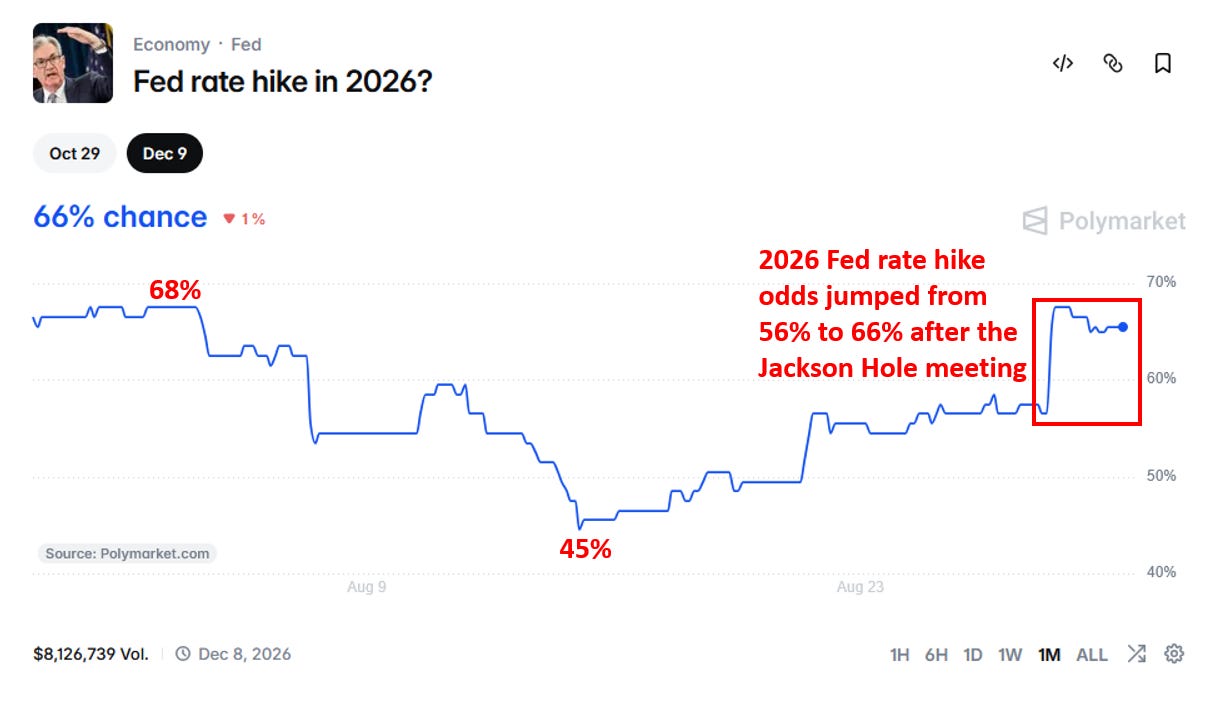
Immediately during Warsh’s speech, the odds of a 2026 rate hike surged from 56% to 66%, where they currently stand according to the betting market Polymarket.
(As an aside, I realize there are other tools and services for estimating rate hike probabilities, including FedWatch, but I prefer to show the Polymarket odds because it is much more user-friendly and shows how the odds evolve over time in a far more intuitive way.)
Warsh’s surprisingly hawkish tone caught the markets off guard and triggered a sharp selloff across many risk assets, commodities, and foreign currencies, with the U.S. dollar emerging as the key beneficiary. The reason is that higher interest rates tend to attract more foreign capital into the United States, pushing the dollar higher.
A stronger dollar, in turn, puts downward pressure on commodities because they are globally priced in dollars, making them more expensive for buyers outside the United States. In addition, higher interest rates tend to put downward pressure on precious metals, at least in the short term, because they are non-yielding assets.
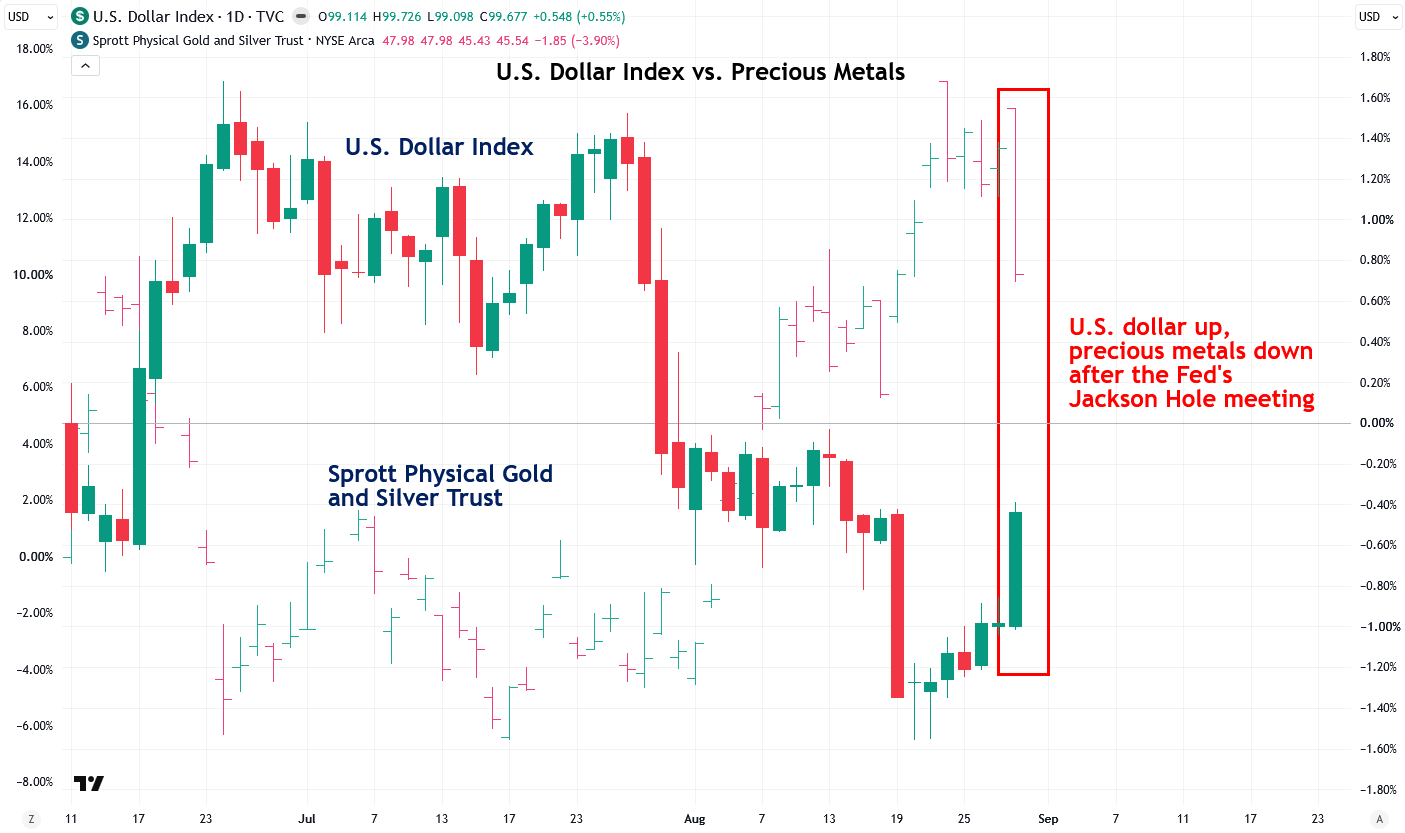
The chart below clearly shows the inverse relationship between the U.S. dollar and precious metals on Friday, as the dollar spiked while the Sprott Physical Gold and Silver Trust (CEF) fell 3.9%. I used this trust for this example because it is a proxy for precious metals prices.
Taking a broader view over the past year, the U.S. Dollar Index had fallen sharply since late July, providing a key tailwind for precious metals and commodity prices, as I expected in my July 29 analysis. The main reasons for this decline were the weakening U.S. labor market, the pause in kinetic action against Iran, and the U.S. Treasury’s surprise bond-buying announcement.
So right now, what is particularly confusing and frustrating is that the dollar, and as a result commodities and precious metals, are being ping-ponged between the U.S. Treasury, which has contributed to the weakening of the dollar, and the Federal Reserve, which pushed the dollar sharply higher on Friday.
If your head is spinning, don’t worry, you are not alone. I put the blame for this squarely on the U.S. government as well as the Fed, which is a quasi-governmental institution. My takeaway from all of this, as a longtime libertarian, is that there is far too much government involvement and intervention in the financial markets and economy, creating countless false signals and whipsaws in the process.
My prescription, again as someone who believes in limited government, is for the government to take a much smaller role than it currently does. Government intervention is increasingly overshadowing the real economy itself and is practically becoming the only game in town, with armies of economists and financial professionals sitting on the edge of their seats and parsing every word from Treasury Secretary Scott Bessent and Fed Chair Kevin Warsh, not to mention President Trump, whose every statement and Truth Social post about Iran can cause markets to surge or plunge.
It shouldn’t be this way, but we have a heavily debt-laden economy that has become completely addicted to both monetary and fiscal stimulus since the 2008 financial and economic crisis (all thanks to awful Fed and government policies in the first place), which never truly ended but was instead papered over and propped up by government support.
Incidentally, these are all reasons why I am so bullish on precious metals and commodities in the long run, but these same factors also create tremendous volatility and false signals in the short term. Again, I put the blame for that squarely on the government.
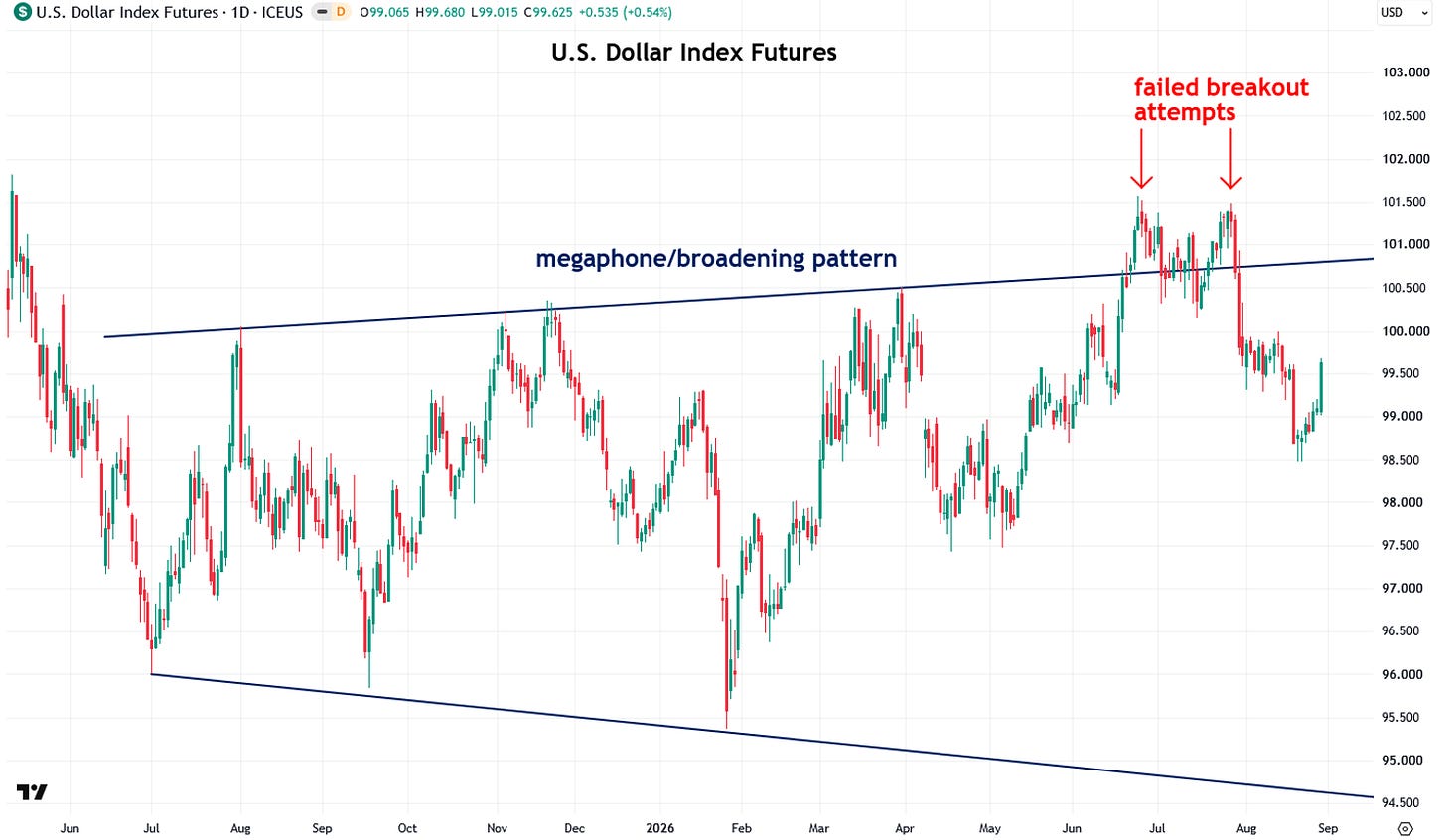
On a more tactical note, the U.S. Dollar Index is still trading within its range of the past year, the broadening pattern shown below, with much of the movement within that range simply being random chop until it decisively breaks out one way or the other.
My bias is for an eventual breakdown because of how overvalued the dollar is and how heavily indebted the U.S. government has become. Friday’s dollar strengthening did not provide any meaningful signal aside from erasing some of the decline of the past month.
Now let’s take a look at where precious metals stand, starting with gold, which leads the overall complex.
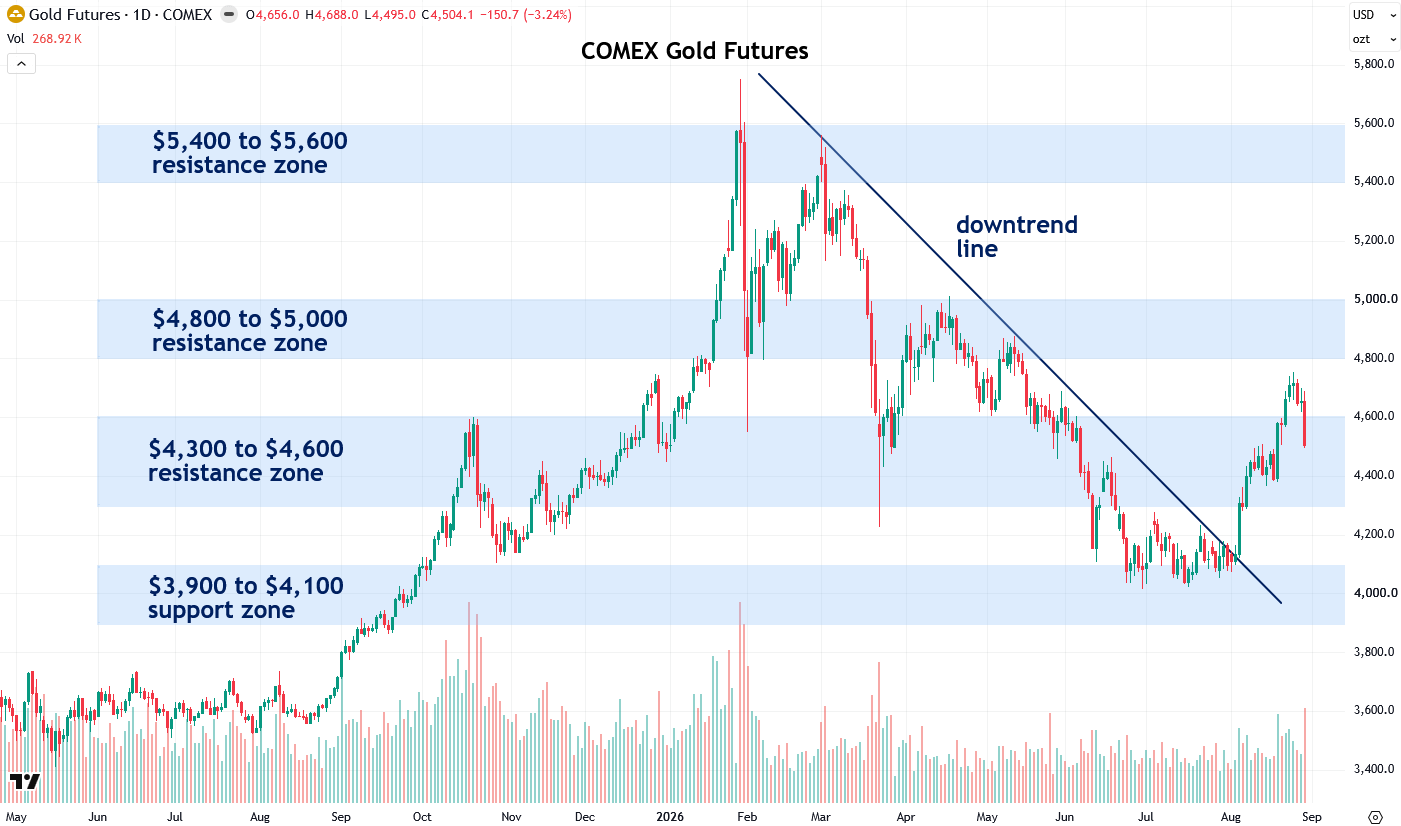
Over the past month, gold rebounded strongly from its key $3,900 to $4,100 support zone, which was formed by the major lows of October and November 2025, as well as during the sharp but brief selloff in March 2026.
To learn more about support and resistance zones, I recommend reading my two-part tutorial (Part 1 and Part 2).
Throughout August, gold also managed to chew through the $4,300 to $4,600 resistance zone, which formed over a nine-month period from the key highs and lows between October and June. Gold then broke out completely above that resistance zone last week, until the Fed hammered it back down on Friday. I have no doubt that the Fed is keeping a close eye on precious metals and commodity prices.
Right now, the key is for gold to stabilize after Friday’s Fed smackdown. The good news is that it is still trading within the $4,300 to $4,600 zone (which can be viewed as both resistance and support depending where gold is trading), and I would like to see it hold that zone as support. That is what I am focusing on for the time being.
As I have been saying in my recent updates, it is critical for all of the precious metals and mining ETFs to clear out the overhead resistance that formed during the correction since January. Until that happens, there are going to be hiccups along the way during the rebound (like we saw on Friday), as above-average amounts of supply come onto the market at each resistance zone when investors who bought near the prior peaks sell upon breaking even.
Once every last resistance zone is cleared, with the most important ones being those formed at the peaks in January and late February, the entire precious metals complex, both metals and miners, will be in blue sky territory and able to stage much more vibrant rallies to fresh highs with far fewer hiccups than during the current rebound process.
The other point to keep in mind is that, as far as the financial markets are concerned, we are still in low-volume, thin summer trading conditions until after Labor Day weekend, which falls on the weekend of September 7.
By some measures, financial market trading volume is at its lowest level since December 2004, so there simply isn’t enough fuel yet for a consistent rally in precious metals. Once summer is officially over and trading volume returns to more normal levels, we should be far better positioned for precious metals to continue the rebound process.
As a reminder, I firmly believe that precious metals and miners are in a long-term bull market that began only in April 2024 and has at least another eight years to run based on historical cycles. I believe the January-to-August correction was merely a healthy pause within that bull market rather than the beginning of a new bear market. Read my recent report, where I explained this thesis in detail.
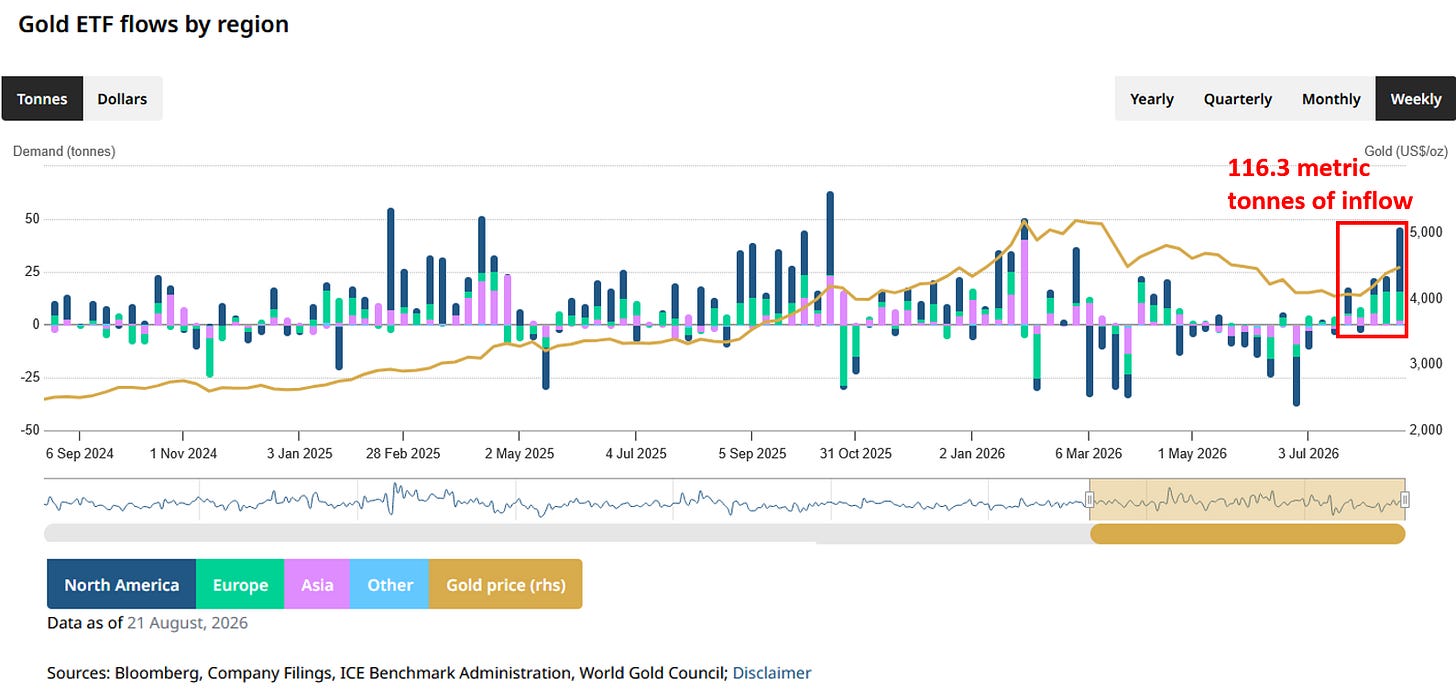
One cause for optimism in gold is that it has now experienced five consecutive weeks of inflows from global exchange-traded funds (ETFs), amounting to an impressive 116.3 metric tonnes, or $16 billion, according to the latest World Gold Council data as of August 21, though that does not include Friday’s precious metals pullback. This has been the most consistent stretch of ETF buying since the correction began in late January of this year.
Moving on to silver, we can see that it broke down from its short-term consolidation pattern, or bull flag, following Friday’s hawkish Fed meeting in Jackson Hole. This again highlights the importance of fully surpassing the $60 to $70 resistance zone, with $70 in particular having been a critical resistance level over the past year. A solid close above $70 would therefore be a key go-ahead signal.

Comments
Log in or sign up to join the conversation.