


In June 2025, I explained that the main risk to the markets might not be the rate hike itself, but rather the widespread adoption of the steepener trade. At the time, most investors were betting on a steepening of the U.S. yield curve: short-term rates were expected to gradually decline due to future Fed rate cuts, while long-term rates would continue to rise under the weight of budget deficits.
My concern was less about the direction of the curve than about the consequences of this positioning for the money market. The first signs of strain were already appearing in the SOFR, a sign that the flow of collateral was becoming more difficult despite a banking system that was still largely liquid. In hindsight, I believe that the steepener was not the problem in and of itself. It was simply the first visible symptom of a much deeper issue: the market’s ability to absorb a volume of public debt that was now growing faster than natural investor demand.
The Federal Reserve appears to have shared this assessment a few months later. In December 2025, it announced a program of regular purchases of Treasury bills, officially intended to maintain “ample” bank reserves during the April 2026 fiscal period and to prevent further tensions in the repo market. Many at the time portrayed this decision as a mere technical adjustment.
Yet, several months after the end of the fiscal season, these purchases are continuing at virtually the same pace. The Fed’s holdings of Treasury bills are now approaching $500 billion, a level higher than that seen during the exceptional interventions of 2020. A program initially presented as temporary has thus gradually become permanent, to the point that several observers are now referring to it as de facto quantitative easing, even though the Fed continues to deny this.
One of the most interesting indicators is a Federal Reserve series that receives very little attention: WLODL (Liabilities: Deposits: Other). This category corresponds to deposits held on the Fed’s balance sheet by entities other than commercial banks or the U.S. Treasury. It includes, in particular, certain government agencies, international institutions, and various financial counterparties.
This data series generally goes completely unnoticed. Yet it has often coincided with the most significant episodes of strain on the U.S. monetary system.
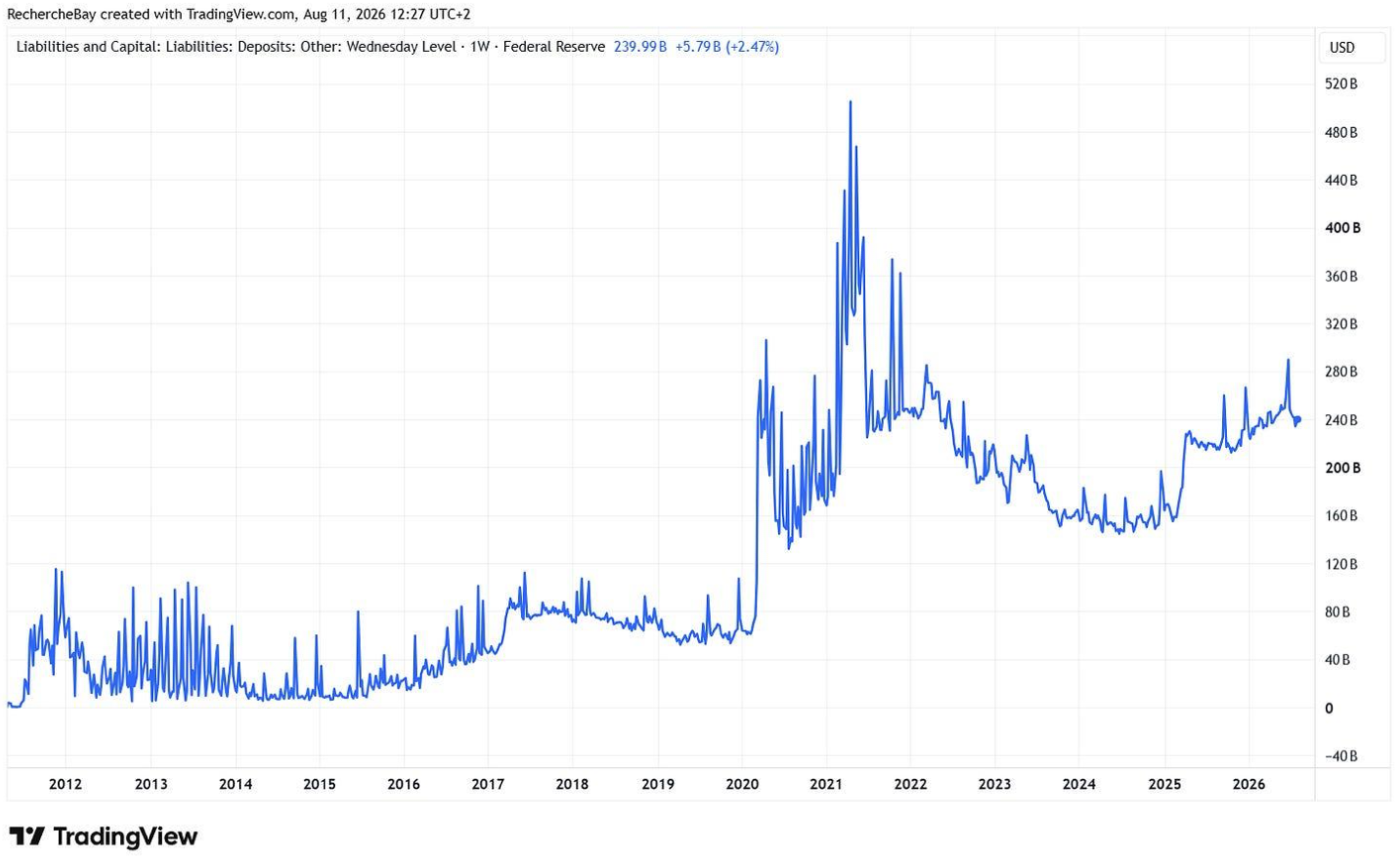
Over the past twenty years, three major accelerations have stood out clearly. The first occurred in September 2019, a few weeks before the historic repo market crisis. The second took place during the massive interventions of 2020 and 2021, when the Fed injected trillions of dollars to stabilize the financial system. The third is taking shape today. Since the beginning of 2025, these deposits have accelerated once again and now total nearly $290 billion.
This development is by no means insignificant. The U.S. Treasury is now borrowing nearly $8 billion per day, and its borrowing needs continue to rise. For the July–September quarter alone, it now plans to raise $739 billion- $68 billion more than it had anticipated just two months earlier.
These issuances are initially absorbed by Primary Dealers, whose role is specifically to participate in Treasury auctions. Under normal circumstances, these intermediaries then gradually resell the securities to private investors. But when demand is no longer sufficient to absorb the entire issuance, their balance sheets quickly become saturated with Treasuries.
It is precisely at this point that the Fed steps in by purchasing a portion of these Treasury bills. The securities are then removed from the dealers’ balance sheets and replaced by bank reserves — that is, immediately available cash. This mechanism restores balance sheet capacity to financial intermediaries and frees up new liquidity that can be redeployed into other assets.
The more Treasury bills are purchased, the more bank reserves increase, and the greater the amount of liquidity injected into the financial system.
This money creation is now clearly reflected in the monetary aggregates. The M2 aggregate, which primarily measures the money held by households and businesses, is up 5.6% year-over-year and has reached a new all-time high of more than $23 trillion.
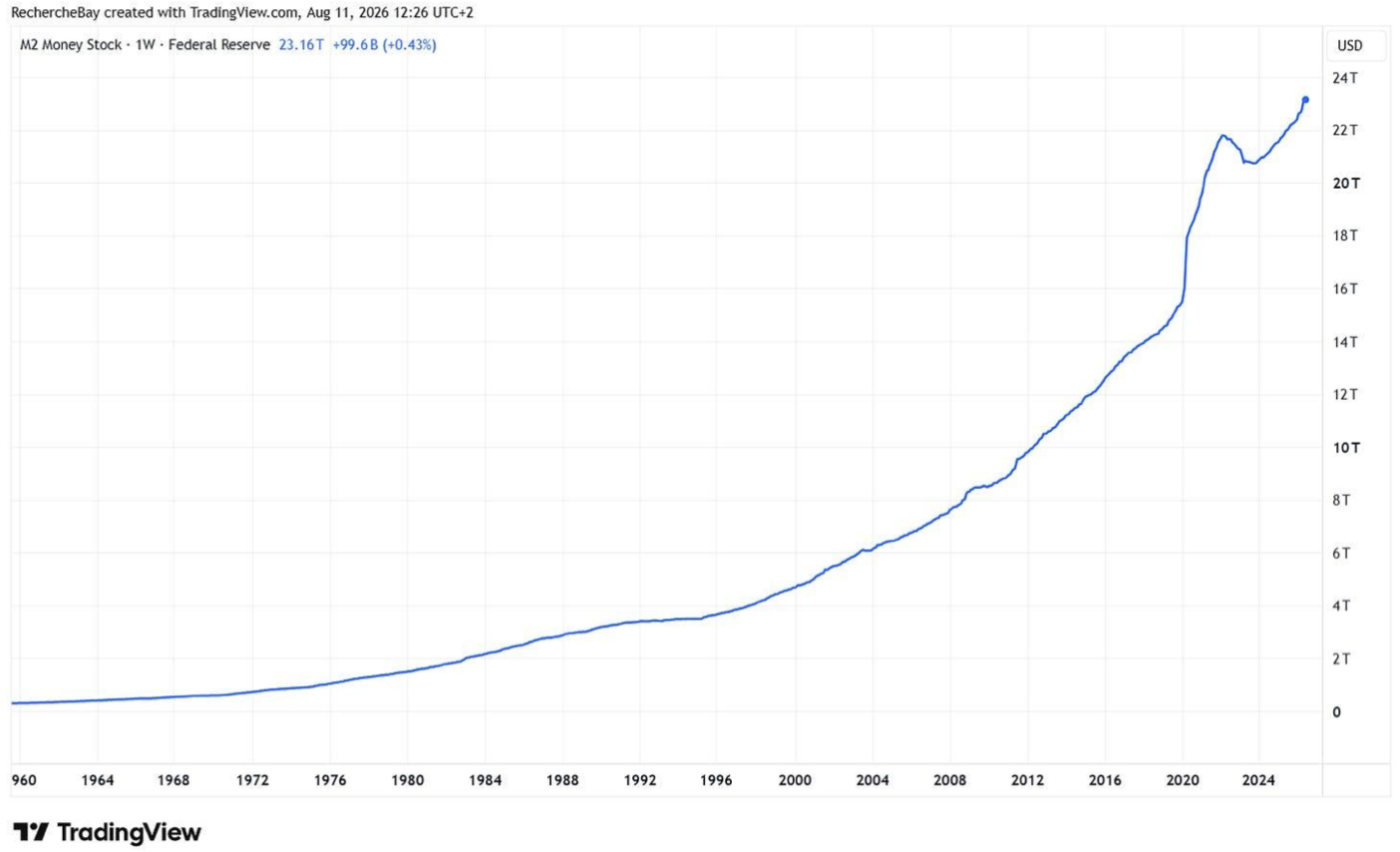
The M4 aggregate — which is even broader, as it also includes several financing instruments used by financial institutions — is now growing at a rate of 6.5%. This trend helps explain why equity markets continue to show such resilience despite a gradually deteriorating macroeconomic environment. The liquidity created by Treasury bill purchases is not confined to the money market; it eventually flows into the financial markets as a whole.
But this abundance of liquidity does not solve the underlying problem. While the Fed is facilitating the absorption of short-term debt, long-term bonds are facing increasing difficulties. Banks are gradually reducing their exposure to Treasuries, several foreign central banks are slowing their purchases, and private investors are demanding ever-higher yields to continue financing U.S. deficits.
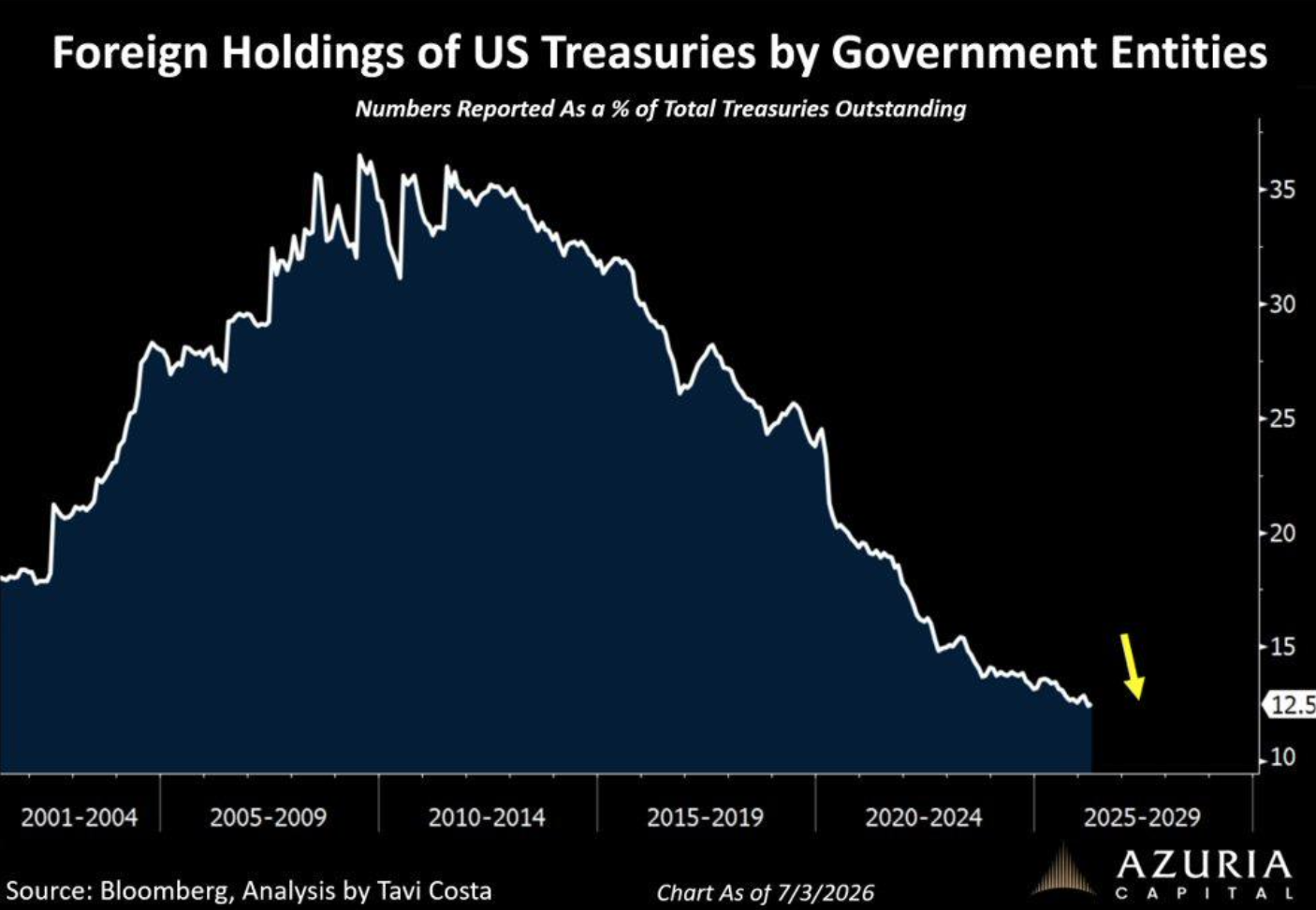
Scott Bessent’s recent comments on the yen have likely reinforced this trend. By encouraging Japan to use the FIMA Repo rather than directly selling its Treasuries, the U.S. Treasury implicitly acknowledged that certain sales of sovereign debt were now significant enough to warrant government intervention. Although this strategy buys time and limits the risk of a disorderly unwinding of the yen carry trade, it profoundly alters market perception. Investors now understand that the question is no longer just who will buy new Treasury issues, but also under what conditions major holders will be able to resell their bonds when the time comes. This development naturally contributes to an increase in the risk premium demanded on long-term maturities.
In this context, it is ultimately not surprising to see that certain private bond issuances are now attracting more demand than U.S. sovereign debt.
The paradox is striking. The risks associated with the artificial intelligence sector have never been more apparent: competition from Chinese open-source models, questions about financing structures, regulatory uncertainties, return on capital expenditures, and risks related to autonomous agents. Yet investors continue to rush to buy bonds issued by hyperscalers.
Why? Because, despite these uncertainties, corporate risk is now perceived as more manageable than U.S. sovereign risk. For now, major technology companies have solid balance sheets, abundant cash flow, and a strong ability to adapt. In contrast, U.S. federal debt is facing soaring deficits, a continuous increase in issuance, and increasingly frequent interventions by authorities to ensure the market functions properly.
Since Scott Bessent’s comments on the yen, an additional doubt has arisen: Are Treasuries truly still the most liquid asset in the world if their major holders are implicitly encouraged not to sell them? In other words, U.S. Treasury bonds seem to be gradually losing one of their essential qualities: their perfect liquidity. In the minds of some investors, they are becoming increasingly “sticky” assets — ones that can be freely purchased but from which exiting could become more complicated during times of stress.
This trend is now even evident in the financing of artificial intelligence.
The announcement of a $500 billion financing vehicle backed by Nvidia (NVDA), Apollo (APO), Blackstone (BX), BlackRock (BLK), Brookfield (BN), Goldman Sachs (GS), and KKR (KKR) likely marks a turning point in this financing crisis. By way of comparison, this amount represents nearly twice the total bond issuances made this year by Amazon (AMZN), Alphabet (GOOGL), Meta (META), Oracle (ORCL), Nvidia, and SpaceX combined.
A few weeks earlier, Nvidia had already raised $25 billion in bonds, even though the company had only $8.5 billion in financial debt and generated nearly $50 billion in free cash flow in a single quarter. A company generating that much cash does not normally borrow $25 billion for mere “general purposes.” The question, therefore, is no longer whether Nvidia can repay its debt, but what this new borrowing capacity will actually be used for.
There are several indications that this funding will increasingly be used to support the entire AI ecosystem. Nvidia’s direct investments in private companies have risen from $3.2 billion to over $42 billion in just twelve months, while the company now guarantees certain real estate commitments made by its partners and indirectly participates in financing its own customers.
At the same time, OpenAI has committed to a $300 billion computing contract with Oracle, even though its revenue was only about $10 billion, while Anthropic has signed more than $100 billion in commitments with Amazon. Together, these two players — which still generate only a few tens of billions in revenue — have already committed to more than $500 billion in future computing capacity.
This dynamic is inevitably reminiscent of the 2000 telecom bubble. At the time, companies like Lucent, Nortel, and Cisco (CSCO) were indirectly financing their own customers in order to artificially sustain order growth. When credit dried up, the entire system collapsed.
But the comparison is almost flattering to the dot-com bubble. According to McKinsey, cumulative vendor financing by telecom equipment manufacturers totaled approximately $25.6 billion at its peak. Today, a single announced deal involving Nvidia amounts to $500 billion — nearly twenty times that amount. We are simply no longer in the same risk category.
What is probably most surprising is that these deals are nonetheless being well received. Just a year ago, such a structure would undoubtedly have been much more difficult to place on the market. Investors would naturally have favored U.S. Treasury bonds, considered the benchmark risk-free asset.
However, the situation has changed dramatically. The surge in federal deficits, the Federal Reserve’s repeated interventions in the Treasury bill market, and, more recently, Scott Bessent’s intervention aimed at preventing Japan from selling Treasuries have altered perceptions of U.S. sovereign risk. Some of the capital that historically would have flowed into federal bonds is now being drawn to infrastructure related to artificial intelligence.
This is likely where the real paradigm shift lies. Investors do not necessarily view AI projects as having become low-risk. They simply believe that, in the current context, U.S. sovereign risk has deteriorated enough to make massive financing for data centers appear comparatively more attractive.
In other words, it is not so much confidence in AI that explains these historic fundraising rounds as the gradual erosion of Treasuries’ status as a safe-haven asset. It is precisely this reallocation of capital flows that now makes it possible to envisage financing operations on a scale far exceeding anything the market had experienced during previous tech bubbles.
It is probably in this context that the recent reaction in the price of gold should be interpreted.
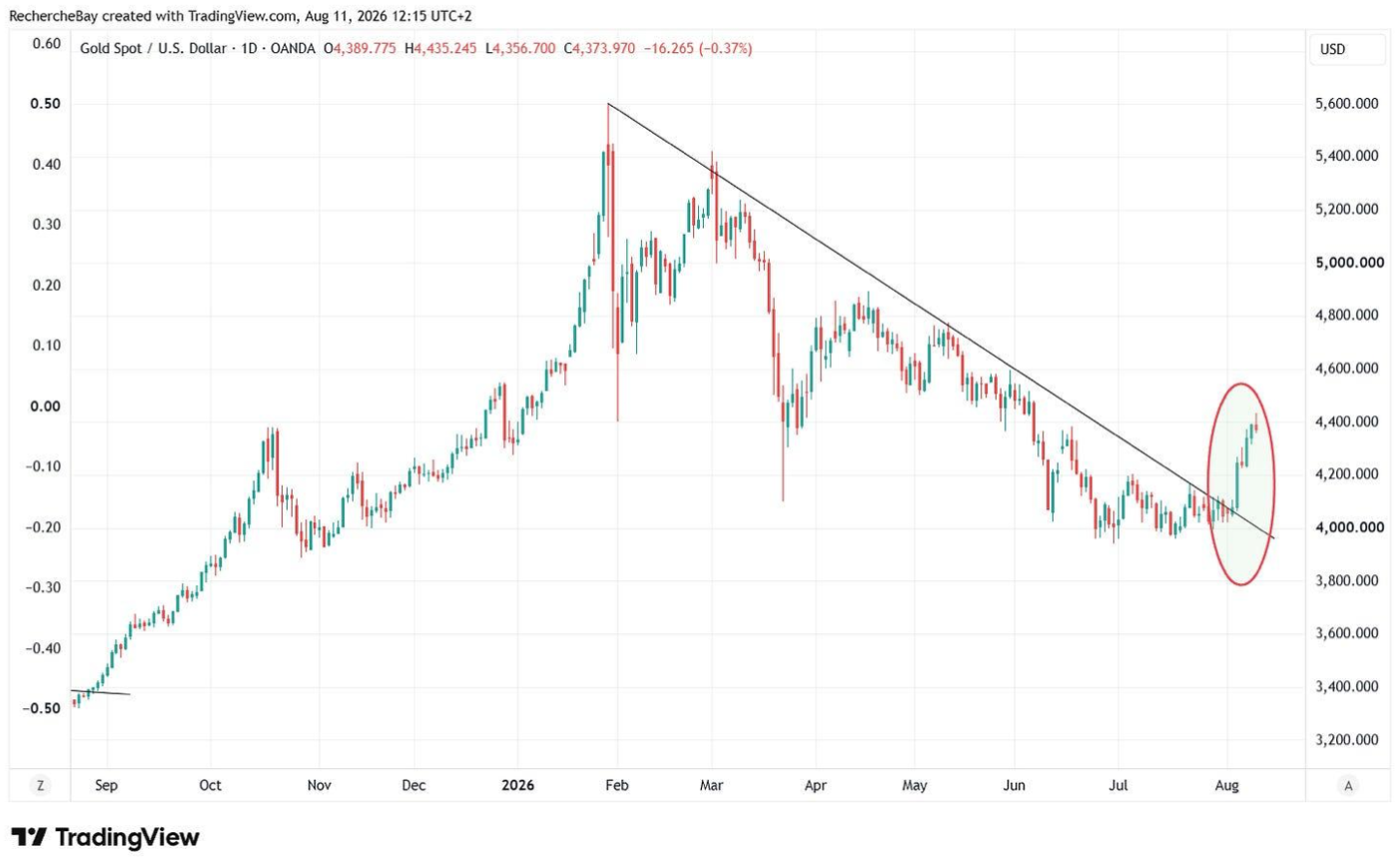
Precious metals do not react solely to interest rates or movements in the dollar. Above all, they react to the credibility of monetary and fiscal policies.
For several months now, interventions have been on the rise: continuous purchases of Treasury bills by the Fed, an acceleration in monetary aggregates, Treasury intervention in the yen, and increasing use of the FIMA Repo to prevent sales of Treasuries. Taken in isolation, each of these events may have a technical justification. Taken together, however, they paint a far more troubling picture: that of a bond market whose proper functioning depends increasingly on intervention by public authorities.
Under these circumstances, it is perhaps not surprising that gold accelerated its upward trend precisely after the intervention of the yen. Precious metals seem to have realized, ahead of most investors, that the true asset whose price the authorities are now seeking to manage is no longer just oil or currencies, but the U.S. sovereign bond market itself.



Comments
Log in or sign up to join the conversation.