

The tension that has built up in the U.S. bond market is changing in nature. It is no longer simply a matter of adjusting expectations regarding the Fed’s upcoming decisions, nor even a mechanical reaction to rising oil prices and inflation expectations. The movement is now directly affecting the long end of the yield curve: the 10-year Treasury yield reached 5.293%, its highest level since 2007, while the 30-year yield rose to 5.6206%, a level not seen since 2002:
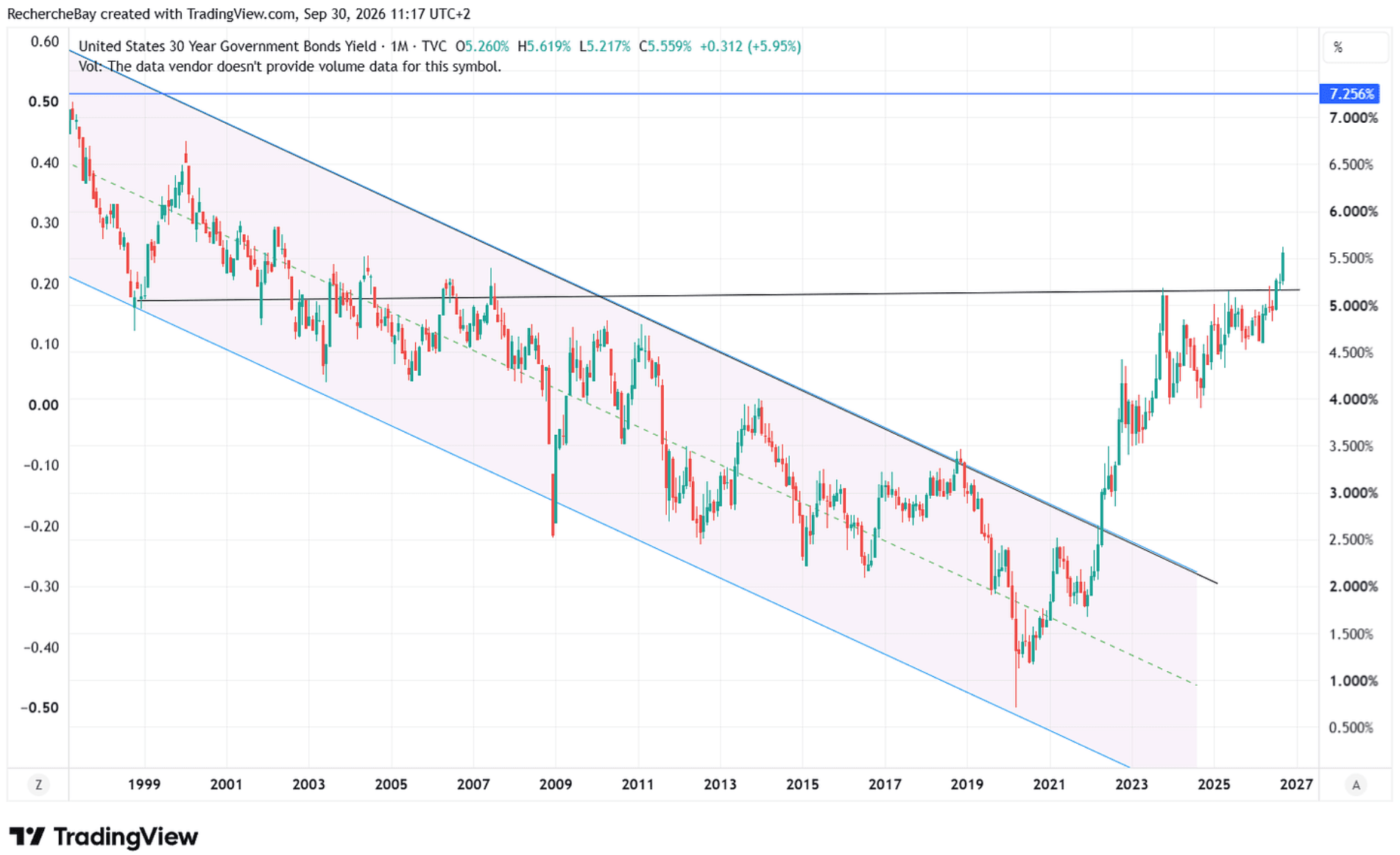
Even more significantly, yields have remained close to these highs despite the decline in oil prices, weak U.S. job market data, and John Williams’ relatively cautious remarks on the need for another immediate rate hike.
It is undoubtedly this last factor that deserves the most attention. When poor economic data or a less hawkish tone from the Fed are no longer enough to drive long-term rates significantly lower, it means that part of the movement is no longer driven solely by monetary policy expectations. The market is beginning to demand an additional premium for holding duration. The rise in the 10-year yield is now approaching 50 basis points in the month of September alone, in a trend that, incidentally, is no longer limited to the United States: Japanese yields are also trading near multi-decade highs, while German and French sovereign yields reached their highest levels in seventeen and eighteen years, respectively, this week. We have gradually shifted from a Fed-related issue to a much broader problem of sovereign debt valuations.
This is precisely what makes the current situation very different from that of April 2025. At that time, the sharp rise in U.S. interest rates had been triggered largely by the tariff shock and could therefore be mitigated by a political decision. Today, the market must simultaneously absorb substantial government deficits, energy inflation that has once again become a concern, massive refinancing needs, and a growing volume of new private-sector issuance. There is no longer a single “button” that Washington could press to make all these constraints disappear at once.
In this context, the rise of the MOVE to 106.6 is likely an even more significant signal than the 10-year yield breaking the 5% threshold. The MOVE is, in a sense, the VIX of the U.S. bond market: it measures the implied volatility of Treasury yields based on option prices. The higher it rises, the more investors anticipate significant and rapid movements in rates, and the more costly it becomes to hold duration:
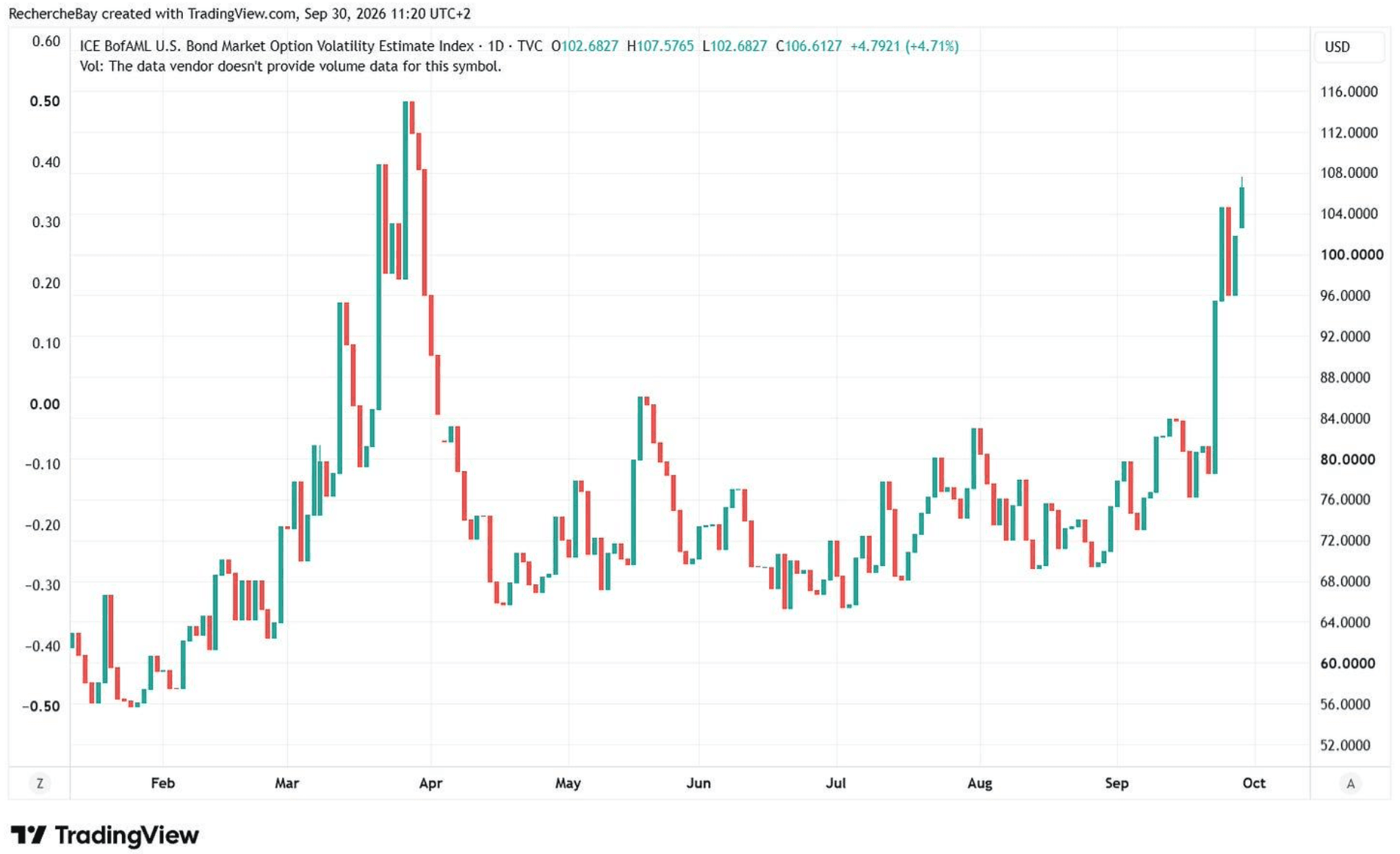
The index was hovering around 64 at the beginning of the year; it has therefore risen by about 67%. This increase means that it is no longer just the price of duration that is deteriorating, but also the risk associated with holding it. A long-term bond whose yield rises steadily results in a loss for its holder; a bond whose yield can suddenly fluctuate by several tens of basis points over the course of a few trading sessions also becomes much more costly to hold on a balance sheet.
That is when bond market dynamics can become nonlinear. Banks, hedge funds, insurers, and dealers all have limited risk budgets and balance-sheet capacity. When volatility rises, the potential losses calculated by VaR models rise along with it; hedging requirements increase, margin calls may rise, and the same bond position consumes more capital. An investor may well continue to view a 10-year Treasury as fundamentally attractive at 5.2%, yet be forced to hold fewer of them. Rising volatility thus reduces the system’s capacity to absorb duration precisely at the time when the Treasury needs to sell more.
This is how a rise in interest rates can gradually turn into a liquidity problem. Falling bond prices cause mark-to-market losses; these losses increase volatility; volatility reduces risk budgets and the capacity of intermediaries; this reduction in capacity diminishes market depth; and a less deep market, in turn, amplifies every rate movement. The market is still functioning, and it would be premature to speak today of a liquidity crisis comparable to that of March 2020. But what is gradually emerging are precisely the conditions likely to transform a valuation crisis into a liquidity crisis.
The behavior of investors registered in the Cayman Islands is particularly interesting in this regard:
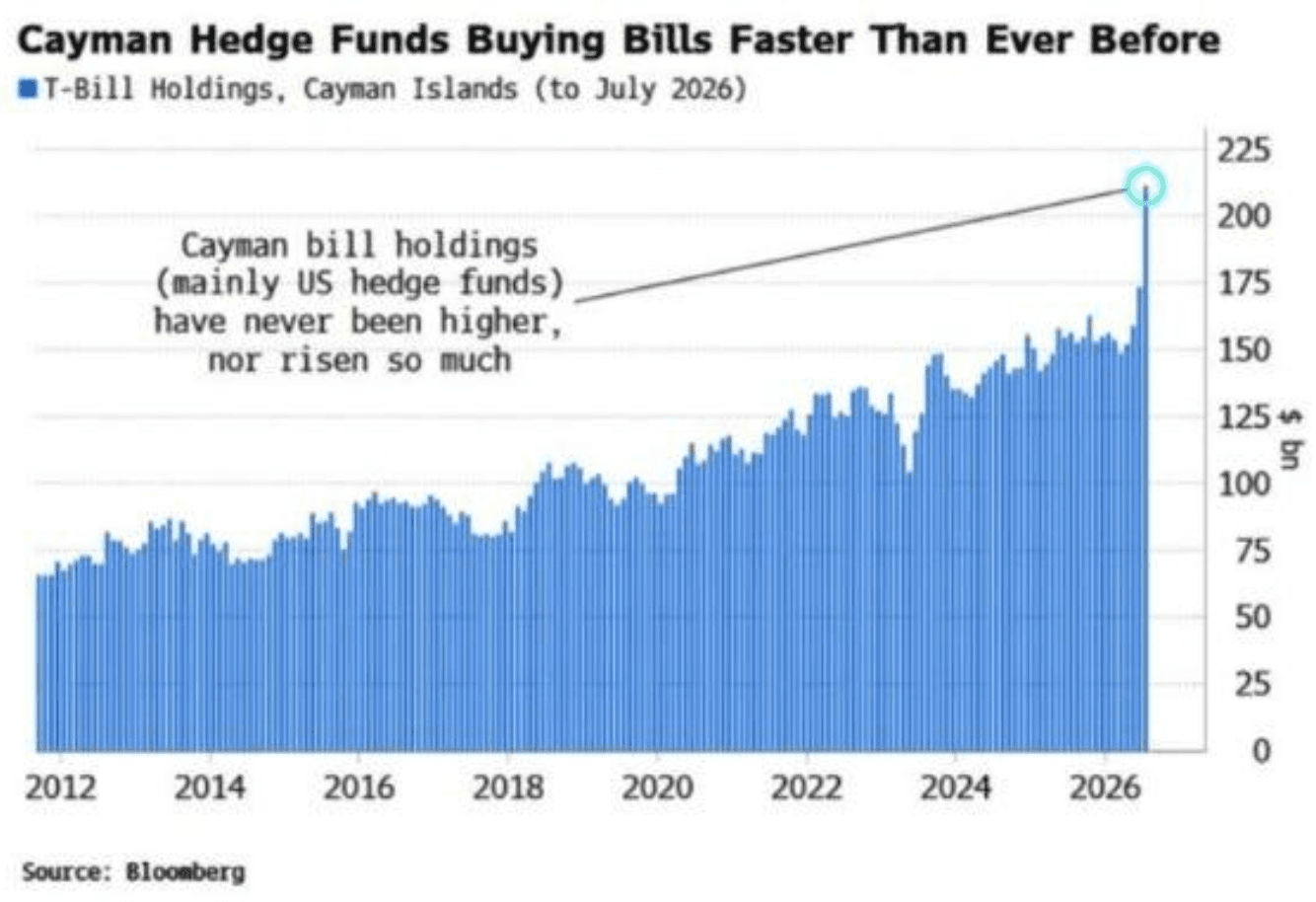
Their holdings of U.S. T-Bills have just reached a record high of around $210 billion, according to data reported by Bloomberg. A significant portion of these positions is linked to hedge funds domiciled in the Cayman Islands. At first glance, this graphic may be presented as evidence of continued extremely strong demand for U.S. debt. However, it tells a much more ambiguous story: these investors are buying heavily in the shortest end of the yield curve.
They are willing to hold interest-bearing dollars for a few weeks or months; they seem much less eager to take on the duration risk associated with a 10- or 30-year bond. This is a fundamental distinction. The U.S. Treasury does not necessarily lack buyers for T-bills. The problem is finding enough investors willing to tie up their capital for ten or thirty years, given that inflation, deficits, future issuances, and interest rate volatility make the real value of this debt extremely uncertain.
This focus on short-term maturities merely shifts the problem elsewhere. The more Treasury financing relies on T-bills, the more frequently Washington must return to the market to refinance its debt. The system thus maintains the appearance of abundant liquidity, but at the cost of a growing dependence on constant refinancing. This is exactly the paradox we observed with T-Bill purchases: liquidity can remain abundant in the very short term while financial conditions tighten sharply at the long end of the curve.
This distinction is essential to understanding what is currently happening. Monetary liquidity has not disappeared. The problem is that the cost of capital is rising much faster than this liquidity. The Fed can add reserves by purchasing short-term assets, the Treasury can adjust the composition of its issuances, and investors can continue to accumulate T-Bills; none of these actions guarantees that a buyer will voluntarily agree to finance the U.S. government for thirty years at 5%, 5.5%, or even higher.
And now it is the credit market that is beginning to send the following signal:
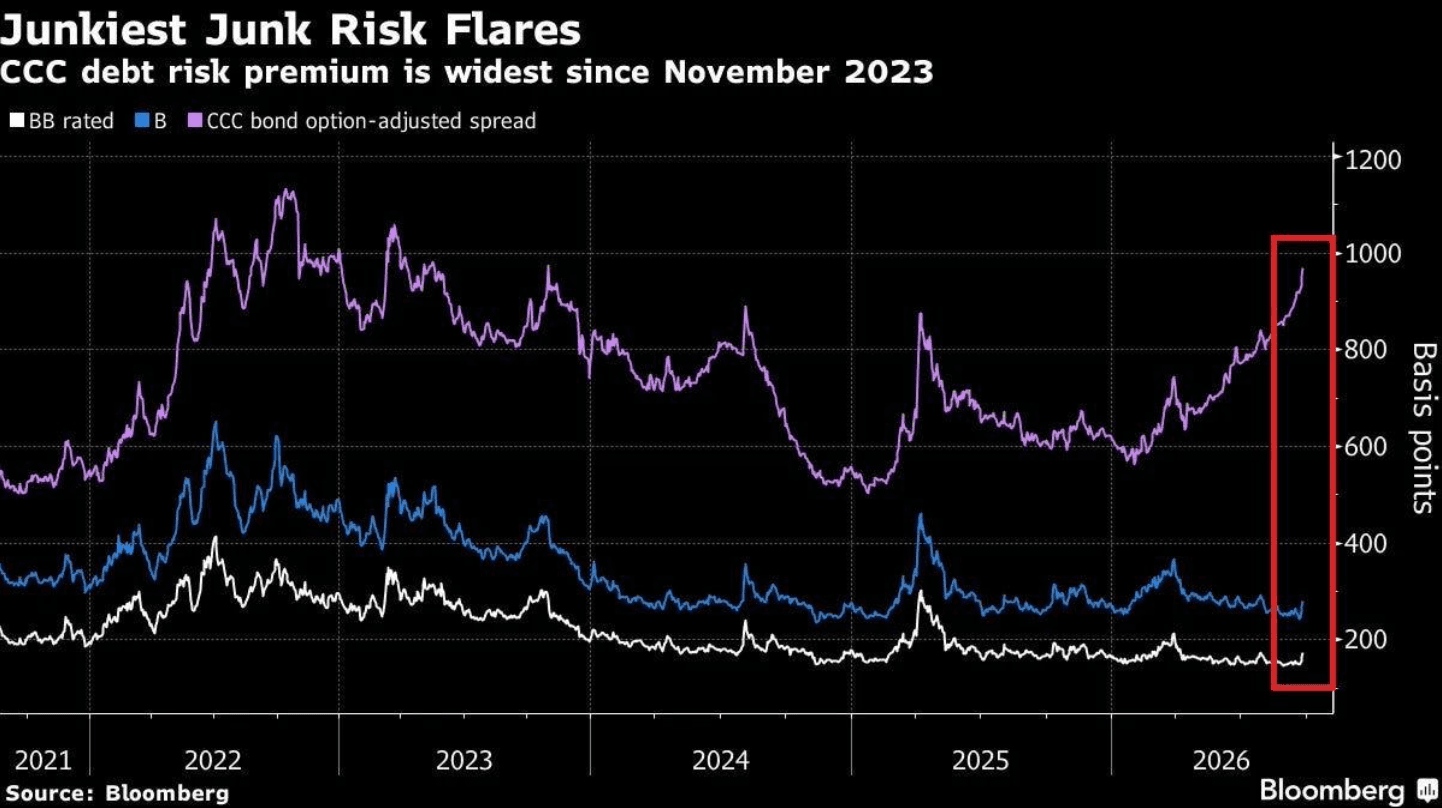
U.S. high-yield spreads reached about 294 basis points, their highest level since April, while September issuances have already totaled $38.51 billion, making it the busiest month of the year.
The trend is even more dramatic at the very bottom of the credit scale: the spread on CCC-rated bonds is now approaching 1,000 basis points, while spreads on BB- and B-rated issuers remain much more contained. This does not yet constitute a widespread credit crunch. Rather, it represents an increasingly sharp distinction between borrowers capable of absorbing the new cost of capital and those who can no longer do so.
This deterioration comes at the worst possible time, as companies are also seeking to raise substantial amounts of capital in the bond market. In particular, financing for artificial intelligence is beginning to compete directly with sovereign bond issuances for the same pool of global savings. Bond issuances by hyperscalers are estimated at around $220 billion this year and could rise sharply again next year; Reuters has already noted that investors are becoming more selective in the face of the volume and unpredictability of these financing needs.
This is a significant shift. Until now, the bet on AI was primarily reflected in stock market valuations and in the capital expenditures of major technology companies. It is now beginning to directly impact the credit market. A growing portion of newly issued bonds represents a claim on the very same future cash flows that already justify the high valuations of technology stocks. The financial system is therefore currently financing massive spending on infrastructure, energy, and data centers by betting on productivity gains that may not become apparent for several years. This is precisely the disconnect we have highlighted repeatedly in our newsletters: the spending and debt occur immediately, while the productivity gains supposed to offset them are still in the future.
The problem in the bond market then becomes one of absorption. The U.S. government is demanding more capital. Companies are demanding more capital. AI infrastructure is demanding more capital. At the same time, existing borrowers must refinance their old debt at much higher rates. And all of them are seeking out these savings at the very moment when volatility is forcing some of the major financial intermediaries to reduce the amount of duration risk they can bear.
It is at this stage that the term “bond market crash” begins to take on a different meaning. A bond market crash does not have to resemble a stock market crash with a 20% drop over a few trading sessions. It can take the form of a gradual breakdown in the mechanism that normally allows the sovereign bond market to absorb new issuances without a sudden change in the premium demanded by investors. The risk becomes systemic when the strain is no longer viewed as temporary and investors begin to demand an additional premium — not just for inflation or monetary policy, but for holding the sovereign debt itself.
This also explains gold’s particularly interesting behavior in recent trading sessions. Its rise — even as U.S. real yields are climbing — is an anomaly compared to the usual relationship between the two assets. Gold seems to be starting to look beyond the absolute level of interest rates and focus instead on what their rise signifies: no longer simply a higher return offered by Treasuries, but an increase in the premium needed to convince the market to hold them. It is precisely in this type of scenario that the distinction between high interest rates and a decline in the quality of the risk-free rate becomes essential.
The paradox is that the first real easing of long-term rates may now require something far less reassuring than a shift in the Fed’s rhetoric. If investors gradually shift away from duration while inflation prevents the central bank from aggressively easing its policy, it may take a genuine “risk-off” move to rekindle sufficiently strong demand for long-term U.S. Treasuries: a credit event, the unwinding of leveraged positions, a foreign sovereign crisis, or a sharp correction in risky assets. Treasuries would then resume their traditional role as a safe haven, long-term yields would plummet, and the Fed could subsequently support the trend once the recessionary consequences of the shock became apparent.
So we are not yet seeing the intervention that will halt the trend, but rather the conditions that will eventually make it necessary. The MOVE above 100, the flight to T-bills, the 10-year yield above 5.2%, the 30-year yield above 5.6%, and the sharp widening of CCC spreads are not five separate stories. They are different manifestations of the same phenomenon: capital remains available, but it is becoming more expensive, shorter-term, more selective, and less and less willing to absorb duration risk.
And that is likely where the real danger lies today. As long as rising rates do not trigger a breakdown, they themselves continue to tighten financial conditions, increase refinancing needs, weaken the most vulnerable borrowers, and reduce balance sheets’ ability to absorb new issuance. The mechanism that could ultimately cause rates to fall may therefore be the same one that, first, will push the system to its breaking point.
In this context, the behavior of the gold price becomes particularly interesting. Normally, such a sharp rise in U.S. yields—and even more so in real yields—would be a powerful headwind for gold. A Treasury now offers a much higher real return with no apparent credit risk, which automatically increases the opportunity cost of holding a zero-coupon asset. It is this relationship that has long helped explain much of gold’s price movement.
However, this relationship is becoming less and less reliable. In recent trading sessions, gold has continued to rise even as the 10-year U.S. Treasury yield surpassed 5.2% and real rates climbed. This behavior is significant because it suggests that investors are beginning to look not only at what a U.S. Treasury bond yields, but also at why it must now yield so much.
This distinction is fundamental. A rise in long-term rates driven by a stronger economy, higher productivity, and better growth prospects is normally negative for gold. But a rise driven by an increase in the term premium, ever-greater financing needs, investors’ reduced willingness to hold duration, and growing concern about the U.S. fiscal trajectory is gradually producing a different effect. The additional yield offered by Treasuries is then no longer merely a return; it also becomes the price demanded by the market to absorb a risk that has become more difficult to bear.
It is precisely at this point that gold changes its role. It no longer simply competes with Treasuries as a financial investment. It begins to compete with sovereign collateral itself. If the market gradually comes to believe that U.S. bonds must offer an ever-higher premium to attract buyers, gold’s lack of yield paradoxically becomes less of a drawback. Gold has no coupon, but neither does it need to be refinanced; it is not dependent on any future deficit, and its value does not rest on a government’s ability to continually convince new investors to absorb its issuances.
This is exactly what we observed when government interventions began to become much more visible in sovereign bond markets. Precious metals no longer react solely to interest rates or the dollar, but increasingly to the credibility of monetary and fiscal policies. The more the functioning of the bond market requires visible government intervention, the more the Treasury’s status as a naturally risk-free asset can be called into question.
The paradox is that the next phase could become even more favorable for gold. As long as the system holds up, long-term rates can continue to rise and drain liquidity, which remains a major drag on financial assets as a whole. But if this rise eventually triggers the crisis it is gradually making more likely — a credit crunch, unwinding of leveraged positions, funding problems, or a sharp correction in risky assets — the trend could abruptly reverse. A return to “risk-off” sentiment would reignite demand for Treasuries, cause long-term rates to fall, and remove one of gold’s main headwinds.
The Fed could then intervene much more easily. As long as long-term rates are rising amid inflationary pressures, the Fed risks exacerbating the problem by easing its policy too quickly. After a financial crisis, the situation would be different: a decline in risky assets, a collapse in demand, a credit crunch, and falling long-term rates would create precisely the conditions that would allow the central bank to re-enter the fray much more aggressively. The bond market would then have done part of the groundwork itself.
It is this scenario that makes the current situation with gold particularly interesting. Today, gold is rising despite the increase in real interest rates. Tomorrow, it could benefit from a decline in those rates. In the first scenario, gold is being bought because rising yields are beginning to reflect a deterioration in confidence in sovereign credit fundamentals; in the second, it would benefit from a return of liquidity and monetary easing aimed at repairing the damage caused by that same rise in rates.
There is, of course, a dangerous transition period between these two scenarios. A genuine liquidity crisis can trigger forced sales of nearly all assets — including, temporarily, gold — as has already occurred during previous crises. But such a potential correction would not necessarily alter the underlying mechanism. On the contrary, it could mark the moment when the market shifts from a regime dominated by rising yields to one dominated by the authorities’ response to their consequences.
This is ultimately what gold’s recent behavior seems to be beginning to foreshadow. Gold isn’t telling us that rates will necessarily fall tomorrow. It may be telling us something more important: beyond a certain level, rising U.S. rates cease to be a threat to gold and begin to become a symptom of the very problem that gold is bought to hedge against.



Comments
Log in or sign up to join the conversation.