

History never repeats itself exactly, but it often rhymes. After all, haven’t we forgotten that debt crises in Athens were one of the catalysts for democracy, or that they helped precipitate the Revolution and the end of the Ancien Régime in France?
Debt is a powerful driver of history and, as such, plays out over the long term. It sometimes takes several decades for chronic imbalances to turn into a full-blown economic and social disaster. Yet debt is not always a story of blood and tears.
Depending on the era and the spirit of the times, it can also be the catalyst for profound geopolitical realignments, major innovations, and lasting transformations of society, trading systems, and monetary systems.
In a world where major currencies are gradually being suffocated by ever-growing mountains of debt, what role will alternative currencies come to play? And, looking beyond the monetary issue alone, what structural and societal changes are already taking shape in the background?
This rise in interest rates, a cause for concern among governments
Over the past year, the 10-year government bond yield has risen by about 70 basis points in both the United States and France. The increase has been even more pronounced in Japan and South Korea, where 10-year government bond yields have risen by as much as 150 basis points over the past year.
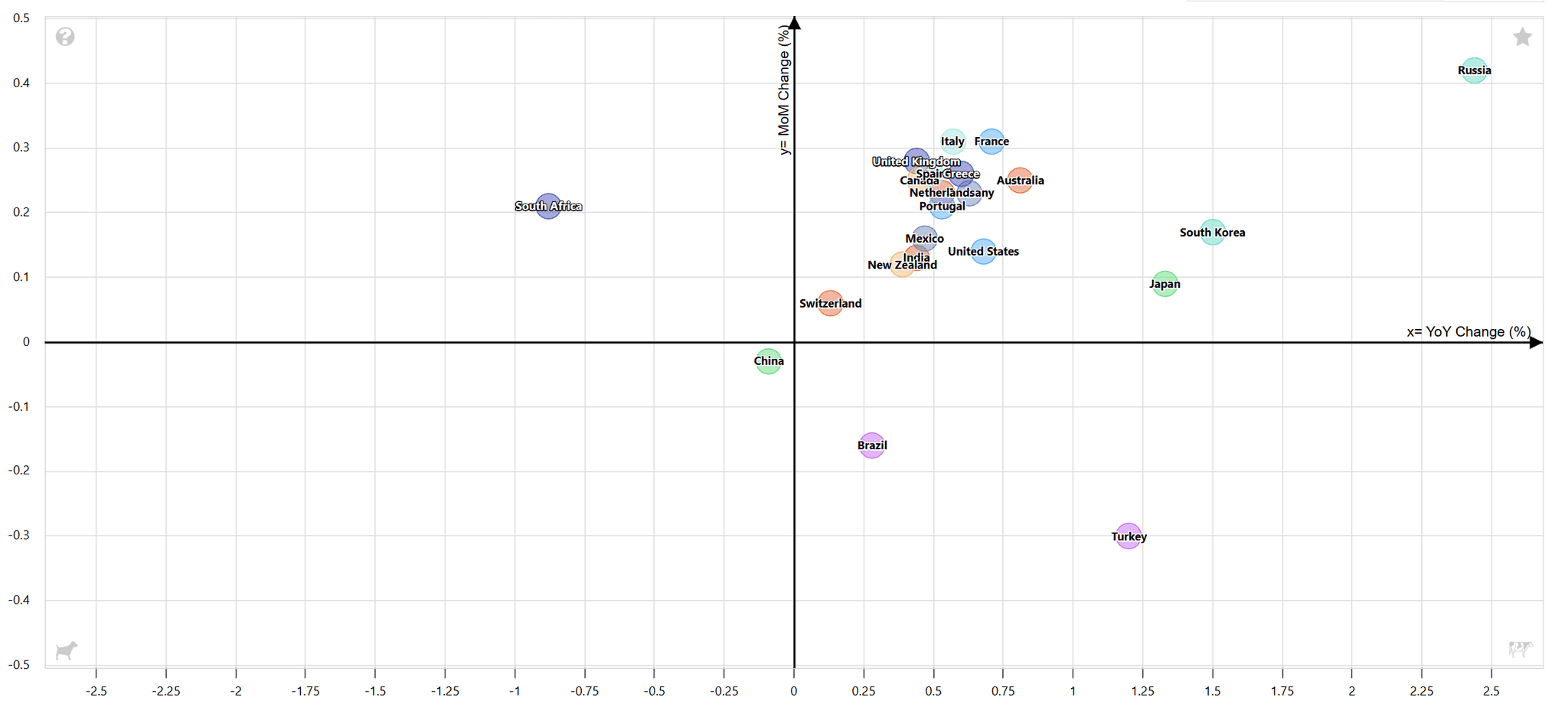
Source: Bond Yields by Country - Quotes - Scatter
Over a shorter period — the month of August alone — the trend appears more pronounced in Europe, however. France, Italy, and the United Kingdom all experienced particularly high volatility in their bond markets. French and Italian sovereign yields rose by nearly 30 basis points during the month. The French 10-year yield thus crossed the 4.20% threshold, while the U.S. yield exceeded 4.75%.
China and Switzerland, by contrast, stand out as exceptions, with remarkable stability in their sovereign yields. For the most indebted countries, this rise in rates poses a major financial challenge.
In the United States, the interest burden on public debt now exceeds $1 trillion, or about 3% of GDP. However, as long as nominal growth remains above the average cost of financing — with real growth near 2% and inflation around 3% — this burden remains within a relatively sustainable range.
In Europe, the situation appears more concerning. Weak growth, combined with rising interest rates and political uncertainties, is gradually fueling questions about the sustainability of public debt. When the cost of financing rises faster than the economy’s ability to generate revenue, the debt spiral can indeed become particularly difficult to halt.
Analysis of government debt
According to data from Agence France Trésor, the outstanding balance of the government’s negotiable debt now stands at nearly 2.9 trillion euros. The average maturity of this debt is slightly more than eight years. A significant portion of the repayments will therefore occur over the next few years, although maturities extend as far as 2050.
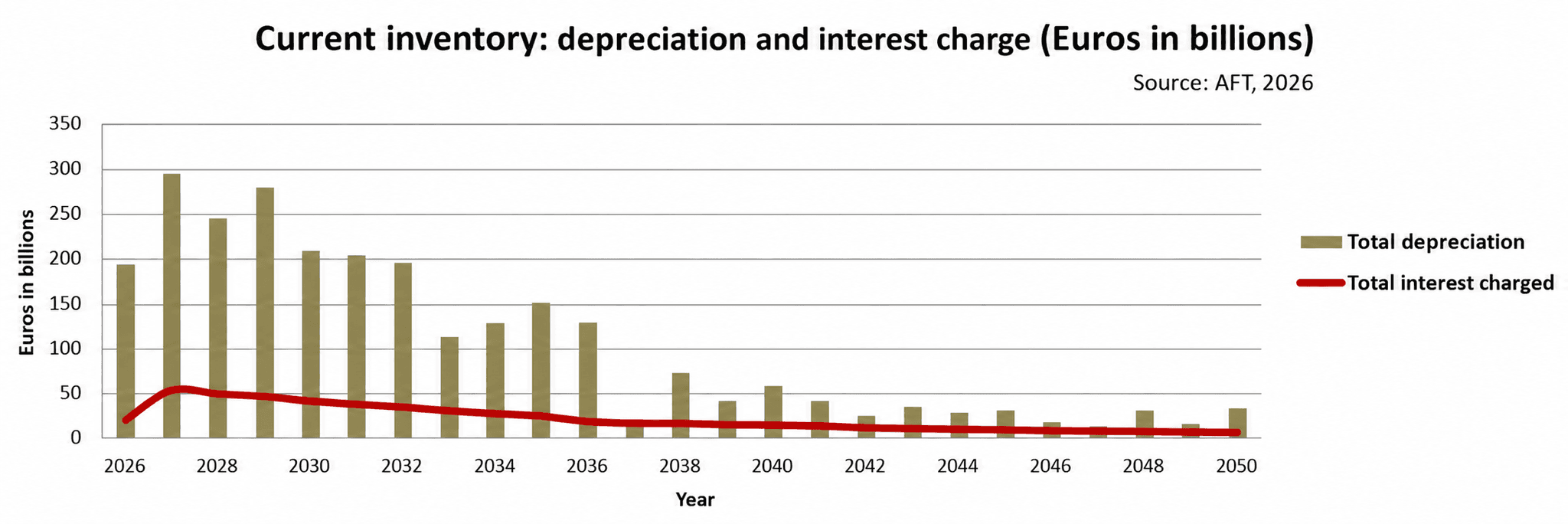
If the current debt were frozen, with no new refinancing, the government would eventually have to repay nearly 2.9 trillion euros in principal, plus approximately 550 billion euros in interest, based on current conditions.
But this scenario remains largely theoretical. In practice, the government continuously refinances its debt by issuing new securities. A relatively simple projection of the interest burden over the next few years helps illustrate the scale of the problem.
Assuming a public deficit remains around 5% of GDP, sufficiently sustained nominal growth with real growth of around 1%, and the absence of any major growth shocks, changes in the cost of debt become particularly sensitive to movements in long-term interest rates.
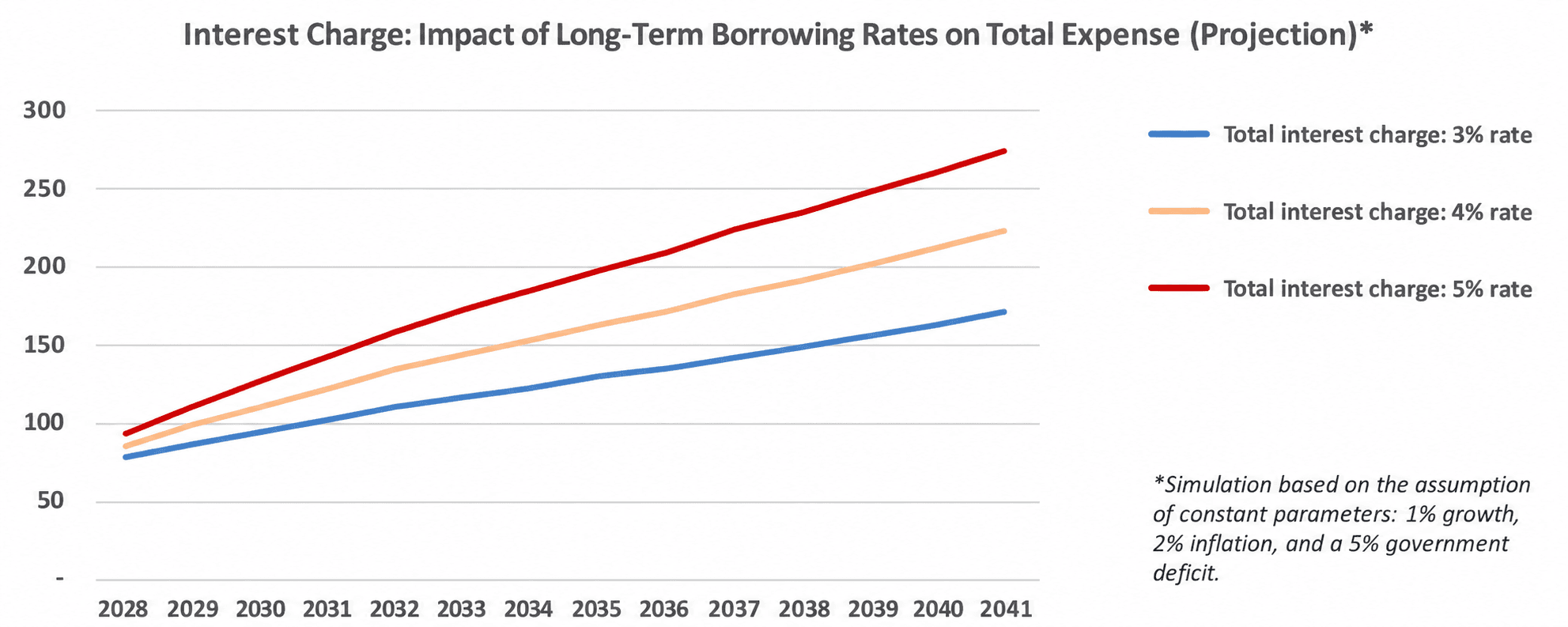
The conclusion is clear: without structural reform, the debt burden will exceed 100 billion euros by 2030, before settling between 130 and 200 billion euros in ten years, depending on whether the long-term borrowing rate moves toward 3% or 5% over that period.
Assuming a public deficit of 5%, the debt service alone could account for nearly two-thirds of the deficit in 2030 under current conditions, and up to more than 80% ten years from now. In other words, even assuming a high public deficit, the debt service could quickly reach — or even exceed — the deficit.
In such a scenario, the increase in debt becomes so significant that borrowing is required not only to repay the principal but also to cover the interest. Public debt then enters a self-perpetuating cycle of indebtedness.
Consequently, the debt burden relative to GDP would gradually converge toward the long-term borrowing rate. Over a ten-year period, the French could end up paying between 1.1 and 1.5 trillion euros in interest — nearly half of the country’s current annual revenue.
Where is the point of no return?
Such projections remain hypothetical. However, it is clear that a new recession would plunge public finances into a critical situation. This could quickly set off a runaway spiral with no turning back. This observation therefore highlights the limited room for maneuver available to public authorities.
On the other hand, if substantial and rapid efforts are made to address public finances, the debt trajectory can return to a healthier and more sustainable path. Generally speaking, we can distinguish between:
An unsustainable debt, the trajectory of which can still be corrected through austerity measures.
An uncollectible debt, when the interest burden rapidly exceeds the deficit and major expenditure items, placing the government in a state of near-bankruptcy within a few years.
In fact, public debt is considered sustainable when the nominal growth rate exceeds the apparent interest rate on the public debt. Taking inflation into account implies that growth in nominal GDP reduces the relative burden of debt and the deficit, provided that public spending does not increase at the same rate.
In the current situation, and in the absence of structural reform, public debt therefore appears to be unsustainable. However, it is not yet sufficient to cause the government to default, since its debt remains largely composed of low-interest securities issued over the past few decades.
Various factors could have a positive impact on the situation:
A structural reform of how the government operates and of the social model.
Maintaining growth at 1% or higher and the absence of any major crisis.
A rate cut should inflation subside.
However, there are other factors that call for caution:
The risk of another recession and persistent inflationary shocks in the coming years. In particular, a reduction in government spending could easily affect economic activity in France.
A rise in interest rates, against a backdrop of inflation, geopolitical tensions, rising technology costs, etc.
The absence of major political reforms aimed at restoring public finances.
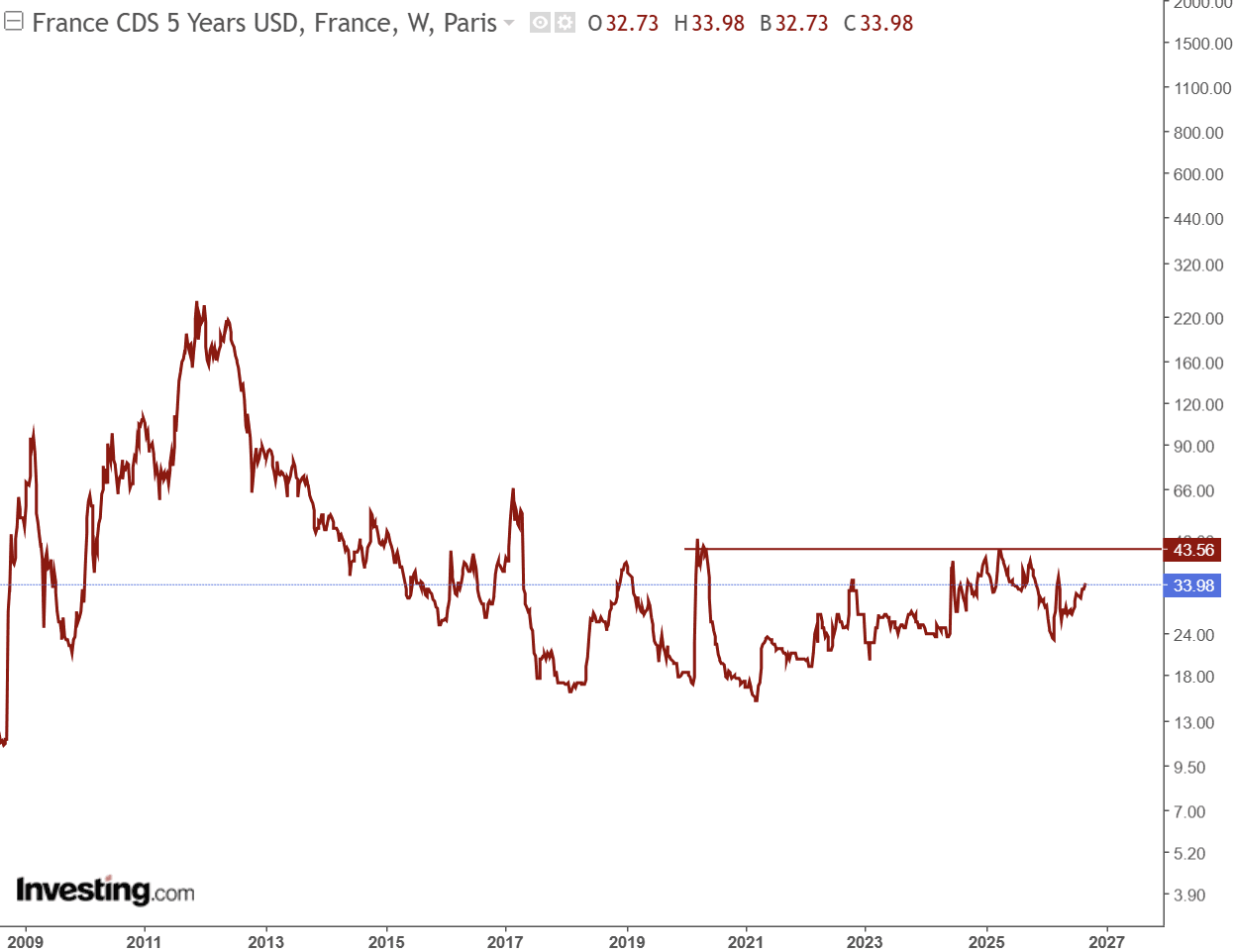
Source: CDS France 5 ans USD Graphique du Rendement de l'Obligation - Investing.com
Currently, the spread on the 5-year CDS (Credit Default Swap) for France stands at around 34 basis points. In other words, an investor wishing to hedge against the risk of a French default would have to pay approximately 34 basis points — a level that has remained broadly stable over the past year. The current rise in interest rates is therefore not accompanied by a significant increase in risk premiums.
This spread is being closely monitored, as a rise above 40 basis points could signal a loss of market confidence. By way of comparison, the previous record reached 240 basis points in 2012.
Central bank independence under severe strain
As is often the case in this type of situation, the independence of central banks is being put to the test. Some are calling for more active intervention by the central bank to ease the burden of public debt, while others are hinting at a return to money creation in the service of the government.
Persistent inflationary pressures do not make the situation any easier. Failure to raise short-term policy rates could be interpreted by the markets as a sign of weakness — or even as a sign that the central bank is being forced to accommodate the fiscal imperatives of governments, both in Europe and the United States.
This tension in the bond markets was also reflected in the intervention by the U.S. Treasury, which purchased certain securities to help calm the surge in yields. This episode illustrates, once again, the sometimes fine line between monetary policy, fiscal policy, and public debt management.
Kevin Warsh’s recent remarks are part of this debate on the credibility of institutions and the limits of government intervention in the face of a debt that has become structurally high. But Trump intends “not to let another rate hike happen”…
A source of volatility for indices and metals
This situation naturally contributes to maintaining high volatility across all financial markets.
The price of gold initially benefited from the announcement that the U.S. Treasury would buy back bonds. But this rise was then offset by the continued increase in long-term interest rates, which raises the opportunity cost of holding a non-interest-bearing asset such as gold.
Beyond short-term fluctuations, this trend nevertheless appears to be sustaining investor interest in assets that may, at least partially, be insulated from the vulnerabilities of currencies and sovereign debt.
Eroding confidence in governments’ ability to sustainably control their deficits, combined with questions about the strength of the dollar and the euro, is thus fueling an underlying trend favoring alternative assets, foremost among which are precious metals and, in a different risk category, cryptocurrencies.
In an environment marked by historic debt levels and increasingly limited monetary policy flexibility, gold and Bitcoin thus appear, to some investors, as diversification tools against the risk of currency depreciation and the gradual erosion of confidence in sovereign currencies.
Conclusion
The rise in interest rates accelerates in 2026, and governments are closely monitoring the increasing cost of financing their deficits and refinancing their debt. France, in particular, is experiencing a significant rise in its interest rates, which have now reached a level that is difficult to sustain.
The political and financial climate adds a new source of uncertainty. The difficulty many countries face in reducing their deficits — in both the United States and Europe, albeit for different reasons — is contributing to a considerable worsening of the situation.
Based on the assumptions used, France could exceed 100 billion euros in annual interest payments before 2030 and face a cumulative interest burden of 1 to 1.5 trillion euros over ten years. Such a figure will require a two-pronged effort: reducing the existing structural deficit while absorbing the deficit created by the increasing debt burden. Against a backdrop of weak growth — or even another recession — in the coming years, many countries could thus find themselves facing major difficulties.
In an inflationary environment, interest rate policy therefore becomes a new source of volatility. The significant fluctuations observed in financial markets show that debt is now a major stability risk for the years ahead. This fragility naturally favors alternative assets, foremost among which are cryptocurrencies and, above all, gold.



Comments
Log in or sign up to join the conversation.