


Bad news is building up regarding France’s public debt. On Monday, it was reported that Shinji Kunibe, a bond portfolio manager at the Japanese group Sumitomo Mitsui DS Asset Management, had decided to sell off his entire holdings of French debt securities. He explained: “French bonds offered relatively attractive income, but given recent developments, we have exited our entire position. We have shifted these funds primarily to German bonds, with a portion directed to short-term Japanese government debt.” (BFMTV)
The Japanese fund manager warns: "Judging from the European debt crisis, France’s 10-year government bond yield could rise as high as 7%.” Such a rate would signal a crisis: refinancing the debt would become extremely difficult and would reflect massive investor mistrust. Another portfolio manager — this time American — Mike Bell, head of market strategy at RBC BlueBay Asset Management, is also sounding the alarm: “It looks like it's got the potential for a French government bond crisis in the making.”
The key indicator to watch closely is the spread—that is, the difference between the interest rates on 10-year French and German bonds. As explained in the latest report from the Terra Nova think tank (The Social Cost of “Debt on Fire”): “Historically, when the yield spread relative to the zone’s safest debt approaches or exceeds 200 basis points (2%), governments tend to resign. It’s a sort of vote of no confidence by the bond markets. This was the case with the Italian populist coalition (200 basis points at the time of Conte’s resignation). Liz Truss also found herself in a similar situation. As for Berlusconi in 2011, he lasted only three months before the Europeans forced him to resign, during which time the yield spread had widened from 200 to 500 basis points.”
What is that spread today?
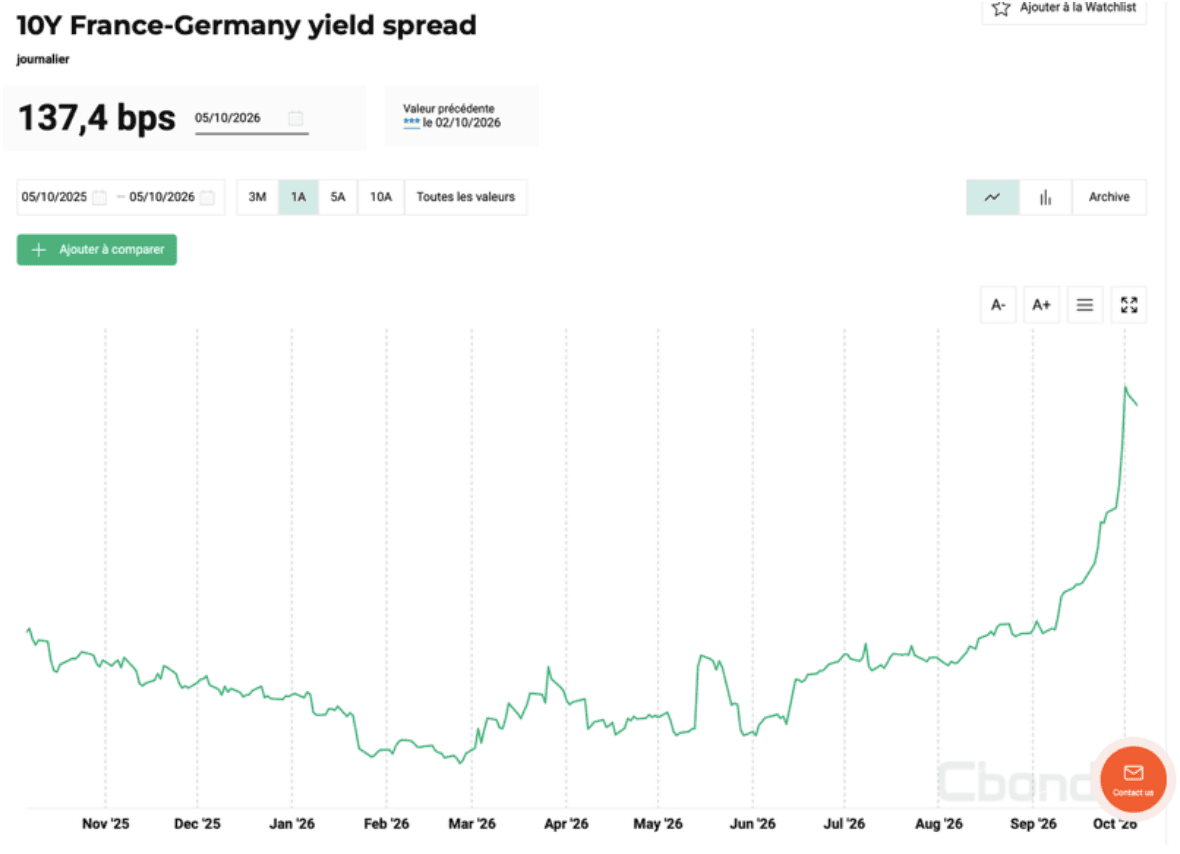
Almost 140 basis points, following a sharp rise since September 8. Never before has the spread between French and German yields widened so much in a single week — between September 28 and October 1 — since the Bloomberg data series began in 1990. It was practically a bond flash crash.
This is certainly cause for concern. In keeping with our efforts to anticipate what might happen — as we did in our previous article — it’s worth reading what Terra Nova has to say in its note. The think tank leans to the left, identifies as Keynesian, and is, as a result, widely heeded.
Don’t worry, according to the author of the memo, Guillaume Hannezo, a former advisor to François Mitterrand: France could overcome a debt crisis. He develops his argument based on what is known as the “Ricardo effect,” which has been empirically verified time and again: when the government increases its budget deficit, households anticipate future tax increases and consequently increase their savings. Not without a certain degree of cynicism, Hannezo concludes that all that is needed is to tap into this windfall to balance the books. In short, the government always comes out ahead, even by shamelessly plundering those who make the effort to set money aside.
Let’s read it: “So, addressing the French case is much simpler. All that’s needed is to simultaneously reduce, on the one hand, income transfers to people who save, and, on the other, the government’s financing needs, the former enabling the latter, which has no recessionary impact. In other words, basically, cut pensions and raise taxes on savers. This, in principle, has no negative impact on the economy. And as for the portion of the effort that will have to be made by everyone, at the risk of a recessionary impact, there is a margin of five percentage points in the VAT rate compared to the highest rates in Europe. ”
Cuts to high pensions, a tax on the “rich,” and a massive increase in the VAT: this is a bitter pill.
On the other hand, we appreciate his critique of life insurance: “There is therefore no very rational reason to put one’s assets into life insurance, other than pressure from account managers and the well-documented preference of clients to pay fees to their bank rather than taxes to the government. Moreover, it is well documented that wealthy savers, who writhe in agony when a wealth tax takes 0.5 or 1% from them, have no problem with their bankers and insurers taking twice as much.” Very well put.
In short, the crisis is looming, and with it, the ingenuity in fleecing those who have saved money is intensifying…
Comments
Log in or sign up to join the conversation.