


The capital flows observed in recent weeks paint a fairly clear picture. A growing portion of the U.S. market is betting on a decline in long-term interest rates. This bet is not limited to bonds; it is also evident in the increasingly concentrated flow of capital toward large-cap technology stocks.
The TLT ETF, which tracks U.S. Treasuries with maturities of more than 20 years, attracted $1.7 billion last week. It had already recorded $5.6 billion in inflows in August, its best month on record. More broadly, funds invested in Treasuries received $11 billion in a single week. Investors are thus taking advantage of current yield levels to increase their duration.
The same phenomenon is evident in the stock market. The MAGS ETF, which tracks the “Magnificent Seven,” has seen inflows in twelve of the last thirteen trading sessions. In September, inflows reached $1 billion, a record since the fund’s launch in 2023.
These two trends may seem unrelated. However, they are largely based on the same scenario. Buying TLT is effectively a bet on a decline in long-term rates. Buying large-cap tech stocks is also, to a certain extent, a way of buying duration: their valuations depend heavily on expected profits far into the future, whose present value increases as the discount rate decreases.
The market is therefore simultaneously accumulating bond duration and equity duration.
And it is doing so even as long-term rates remain extremely tight. Investors are not yet seeing yields ease; they are anticipating that this will happen.
“I am the house”
This is where Scott Bessent comes in. For several months now, the U.S. Treasury Secretary has been seeking to regain control of the long end of the yield curve. Buyback operations have been stepped up, and the Treasury has shown that it is prepared to intervene further to ensure the market continues to function smoothly.
His catchphrase, “I am the house”, sums up quite well the conviction that seems to be gradually taking hold among investors: when it comes to the U.S. Treasury, it’s becoming risky to remain a net seller of bonds over the long term.
However, Bessent has not yet won. Long-term yields remain high, and the Treasury’s interventions have not prevented the long end of the yield curve from continuing to rise. But inflows into the TLT indicate that many investors now view these levels as an opportunity rather than the beginning of a sustained period of high rates.
So the bet isn't that rates have already fallen. The bet is that Washington will eventually bring them down.
It's a form of “Bessent put” on maturity.
U.S. banks, however, are doing the opposite
However, one factor complicates this interpretation. While investors are flocking to Treasuries, U.S. banks sharply reduced their holdings of Treasuries and agency securities in September:
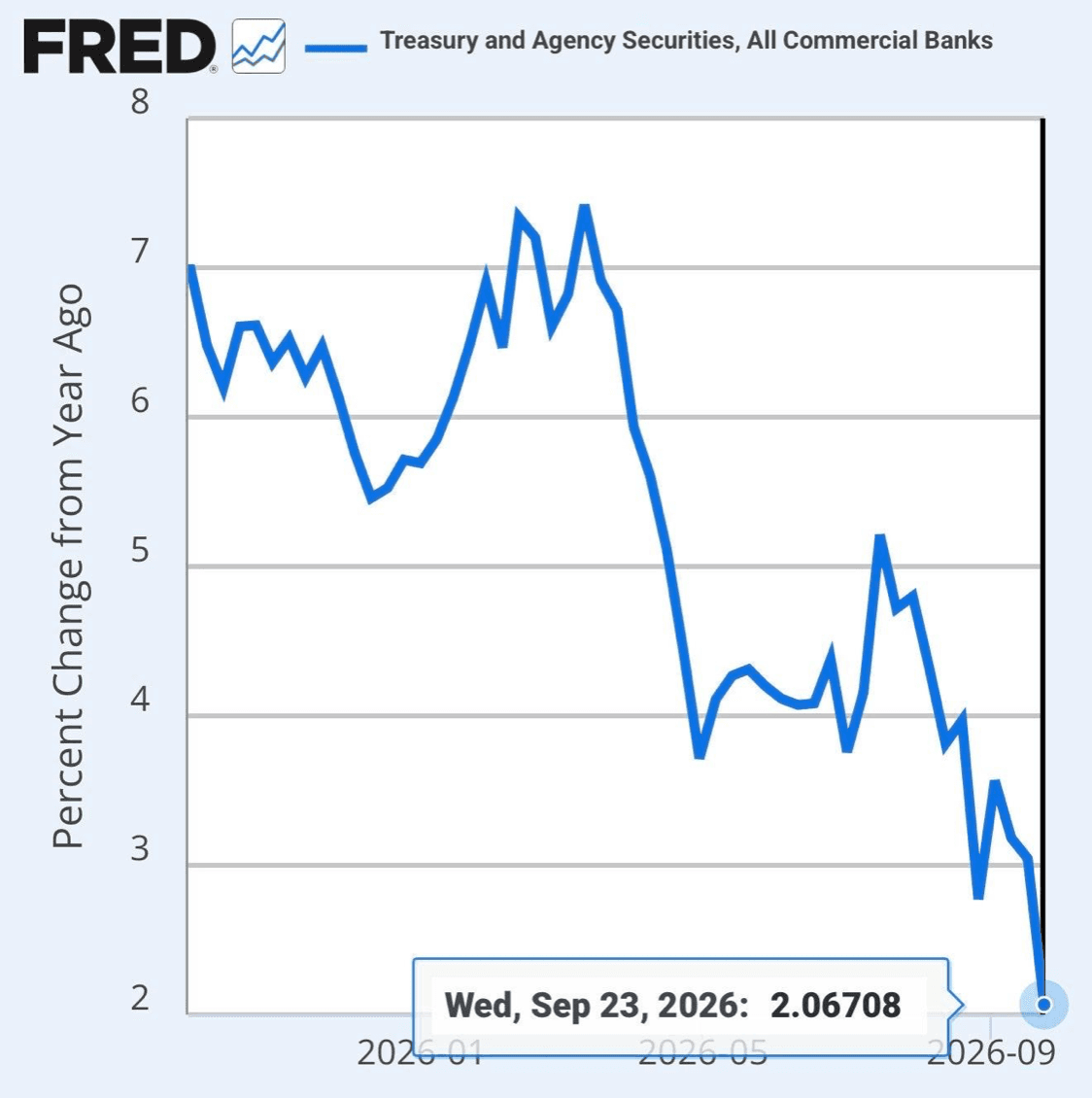
The Fed's chart speaks volumes: the annual growth rate of these portfolios, which was still above 7% at the beginning of the year, fell to about 2.1% at the end of September.
This trend is significant because banks do not look solely at the yield offered by a bond. They must also consider the impact of a further rise in interest rates on their balance sheets. When yields rise, the value of the bonds they hold decreases. For securities classified as AFS (Available For Sale), these unrealized losses appear in AOCI (Accumulated Other Comprehensive Income) and reduce accounting equity. Under applicable rules, they can also weigh on capital adequacy ratios and thus limit banks’ ability to take on new risks.
The market thus presents an interesting divergence: investors are buying duration at the very moment when banks are becoming more cautious about it.
Credit is starting to draw a line
But the most important signal right now is likely coming from the credit market.
At first glance, the U.S. high-yield market does not appear to be experiencing a widespread crisis. However, this assessment changes significantly when borrowers are categorized by credit quality.
Spreads for companies rated CCC and below have reached approximately 1,200 basis points.
The effective yield for this category is now approaching 17%. In contrast, spreads remain much more contained for companies rated B and BB:
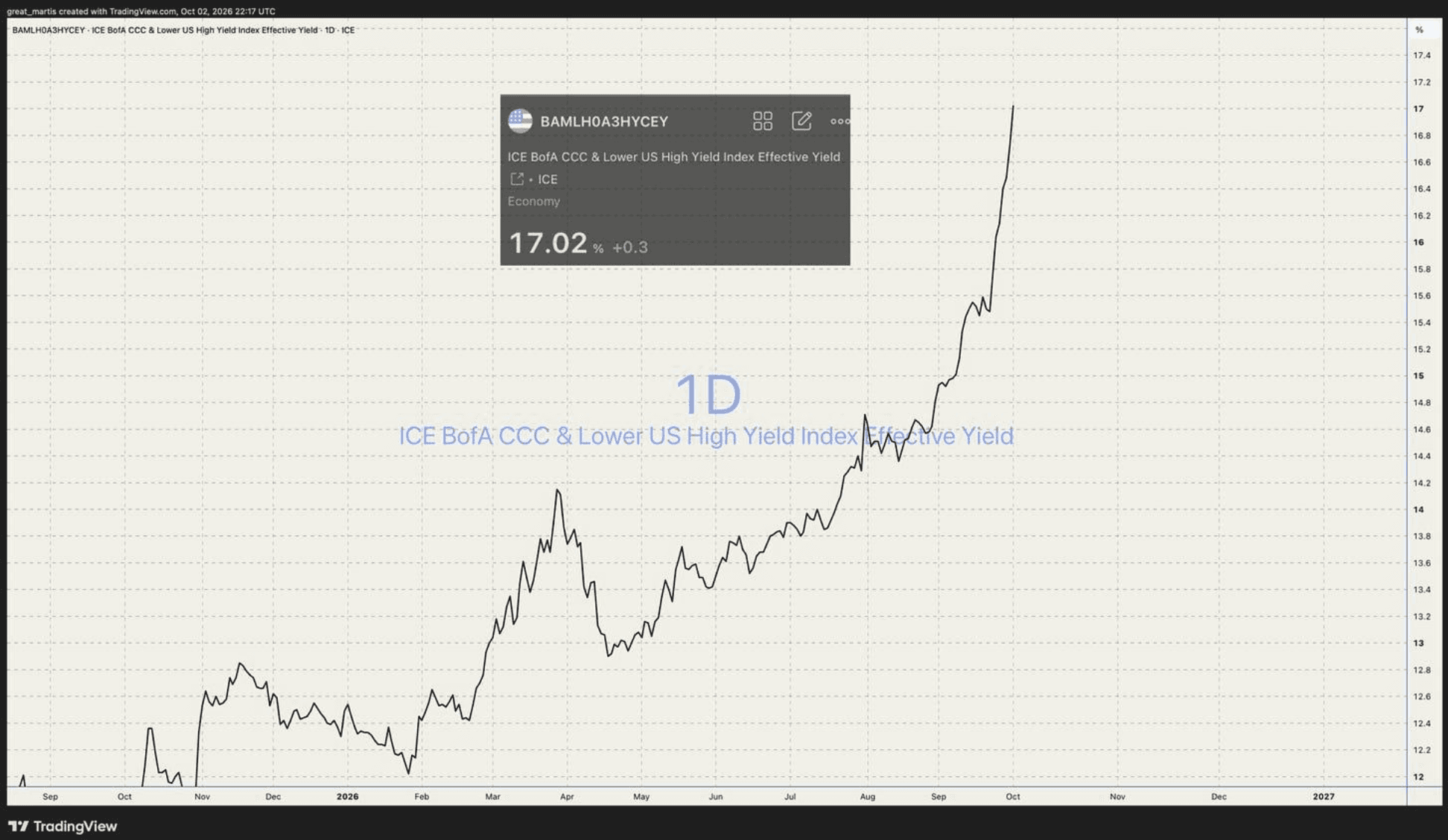
The market is therefore beginning to draw a very clear line.
It continues to finance companies deemed sufficiently sound. On the other hand, it now demands an almost prohibitive premium to finance the most fragile business models.
This is a key difference from 2008. At that time, the problem had become systemic because the banks themselves had been weakened. Borrowers were deteriorating at the very moment that the institutions responsible for financing them were losing capital and seeing their own access to financing deteriorate.
The current situation more closely resembles, for now, certain episodes of sector-specific stress. In 2015–2016, for example, CCC spreads had skyrocketed because part of the energy sector had built its balance sheets on assumptions about oil prices and financing conditions that were no longer valid. The rest of the economy, however, had continued to function.
Today, the problem is different. It stems from refinancing.
The wall doesn't need to arrive to cause pain
A company doesn’t need to see its revenue plummet to find itself in trouble. A company that had been borrowing at 5% or 6% and now has to refinance its debt at 12%, 15%, or 17% can see its business model collapse very quickly.
This is precisely what the CCC credit market is telling us.
The key point, therefore, is not the exact date on which the bonds mature. The market anticipates difficulties well before the actual refinancing takes place. As soon as investors begin to doubt a company’s ability to roll over its debt, they demand higher yields. This rise in the cost of financing then makes the process even more difficult.
Credit thus has its own reflexive dynamics.
Risk increases the cost of financing. The cost of financing increases risk.
At a 16–17% cost of debt, the problem becomes particularly evident. A company must now generate a substantial return on its capital simply to justify its financing. Since the cost of its equity is normally higher than that of its subordinated debt in the capital structure, its WACC becomes extremely high.
Many business models that worked perfectly well with funding at 4 or 5 percent simply no longer work with a double-digit cost of capital.
Personal loans can mask the problem
This is where the significant growth of private credit is changing the dynamics of the cycle.
Private credit offers struggling companies an additional lifeline. A lender can extend a maturity date, restructure repayment schedules, or agree to capitalize a portion of the interest — the PIK (Payment in Kind), which involves adding the interest to the debt rather than paying it immediately in cash. This provides short-term cash flow relief, but increases the debt that must be repaid later.
In some cases, this flexibility can effectively save a viable company that is going through a rough patch.
But it can also simply delay acknowledgment of the problem.
A company that can no longer service its debt is not necessarily declared in default immediately. It may be granted an additional two years, capitalize its interest, and reach the next maturity date with even greater debt.
Private credit can therefore delay the appearance of defaults in the statistics without necessarily resolving the solvency problem.
This is probably one of the most important issues to watch today. Default statistics may remain relatively reassuring even as the financial situation of some borrowers is already deteriorating sharply.
The real sign would be contamination spreading toward B
For now, the market is still drawing a distinction.
CCC-rated bonds are under stress. B-rated and, especially, BB-rated bonds continue to be treated much more favorably.
This is the line we need to watch.
If B-rated spreads start to widen sharply, and the trend then spreads to BB-rated bonds, the message changes completely. The market would no longer simply be weeding out the weakest companies. It would begin to call into question the refinancing of companies that are normally viable.
It is generally at this point that a relatively slow-moving solvency problem can turn into a much more rapid liquidity problem.
The exact level — whether 1,000 or 1,200 basis points on CCC — is therefore less important than the potential spread of the movement to higher ratings.
And meanwhile, AI is absorbing more and more capital
This credit crunch comes at a time when the U.S. economy is experiencing one of the largest capex cycles in its recent history.
Construction spending on data centers has risen from approximately $9 billion on an annualized basis in 2021 to nearly $85 billion today — a nearly tenfold increase in five years:
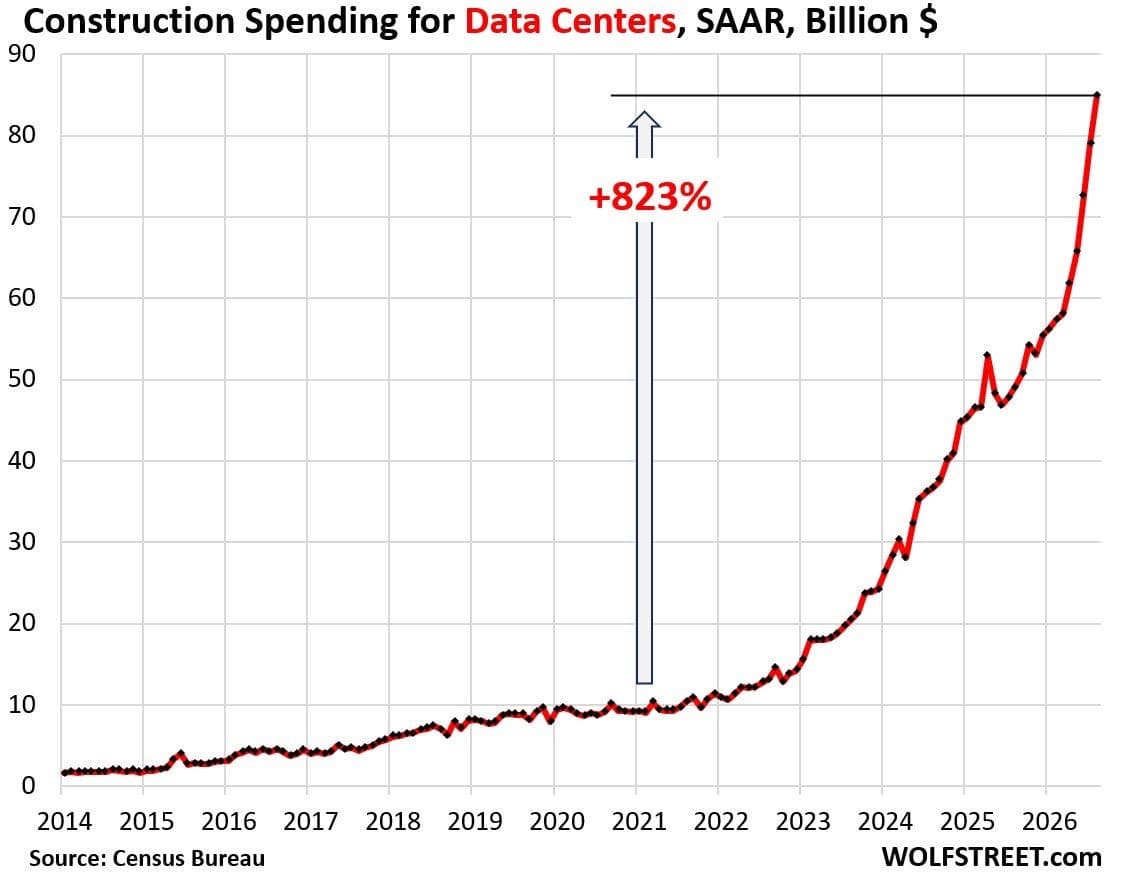
This acceleration is dramatic.
It also means that the AI boom is gradually becoming much more sensitive to the cost of capital. The early phases were financed primarily by the massive cash flows of the hyperscalers. But as investments increase, the system draws on more external financing, debt, energy infrastructure, and capital from suppliers.
This is where credit and AI ultimately converge.
A project creates economic value only if its return on capital remains higher than its cost of capital. The higher interest rates and spreads remain, the more stringent this requirement becomes.
Rising capex + rising cost of capital = higher required ROIC.
And if, at the same time, the explosion in investment in data centers ends up driving down the price of computing capacity (compute), the equation becomes even more demanding.
The stock market currently values AI as if future returns on capital were going to remain exceptional. The credit market, on the other hand, is beginning to remind us that capital is no longer free.
Oil further complicates the challenge
Oil, too, tells a different story from the one TLT buyers and tech investors are banking on.
Brent continues to trade at a significant premium to WTI. Strategic reserves are being tapped in both the United States and Europe. Freight and insurance costs remain extremely high, and the diesel market remains tight.
The problem has shifted in part from the availability of crude oil to its logistics. Aramco asserts that its upstream facilities are intact and that its maximum capacity of 12 million barrels per day can be mobilized quickly. But producing a barrel and successfully getting it to the consumer are now two very different things.
Oil therefore continues to send a potentially inflationary signal at the very moment when a growing portion of the financial market is betting on an easing of interest rates.
This brings us to a rather surprising scenario.
The tech sector is betting on a decline in the discount rate. TLT buyers are betting directly on a decline in long-term rates. The CCC credit market tells us that the cost of refinancing has already become unsustainable for the most vulnerable borrowers. Banks are reducing their appetite for bonds. Oil continues to fuel inflationary pressures.
All these markets cannot tell different stories indefinitely.
And gold?
Finally, there is one signal that doesn’t fit the prevailing scenario.
If the “I am the house” strategy actually works, gold should normally begin to benefit from it. A decline in long-term rates — achieved while oil prices remain high — would lead to an easing of real interest rates. And if this decline requires increasing intervention by the Treasury to contain tensions in the bond market, the signal should be even more favorable for gold.
Yet gold is not confirming this scenario.
After its sharp correction in September, it remains lagging just as investors are piling into TLT and the major tech stocks.
This divergence is significant. TLT and the Magnificent Seven suggest that rates will eventually fall. Oil suggests that inflationary pressures are not over. The CCC shows that current rates are already causing damage. And gold, for now, does not yet support the scenario of an easing in real interest rates.
Perhaps this is ultimately the best indicator to watch over the coming weeks.
If gold rallies sharply while the TLT continues to attract capital, the “I am the house” scenario will begin to receive much broader confirmation: the market would then anticipate a decline in nominal rates significant enough to drag real rates down with it.
If, on the other hand, gold continues to stagnate, another possibility must be considered: TLT and tech stocks may simply be two different manifestations of the same massive bet on falling rates — and the credit market is already beginning to show what happens if that bet takes too long to pay off.
The lack of confirmation from gold ultimately leaves a more important question unanswered.
The market is piling into TLT and large-cap tech stocks as if it already knew how the story would end: financial stress will eventually become severe enough to prompt the Fed to intervene, which will drive rates lower.
But this time, there’s no guarantee the scenario will be that simple. The Fed can provide liquidity and lower its policy rates; it cannot make an oil shock go away. And if it intervenes while energy prices are still fueling inflation, long-term rates might not react the way the market hopes.
So perhaps the real bet right now isn’t just that the Fed will intervene. It’s that it will still be able to simultaneously rescue the bond market, the credit market, and tech stock valuations.
Gold, for now, isn’t telling us whether this bet will pay off.

Comments
Log in or sign up to join the conversation.