

When Nixon abandoned the gold standard in 1971, it removed all government spending restraints. Politicians prefer borrowing over raising taxes to finance their folly!
The US Debt clock projects total US debt to top $43 trillion by 2030, with “Unfunded liabilities” (political promises) topping $308 trillion.

We’ve been conditioned to expect the dollar will become worthless – eventually. Precious metal prices are soaring, a major signal to investors.
We saw this during the Carter years.
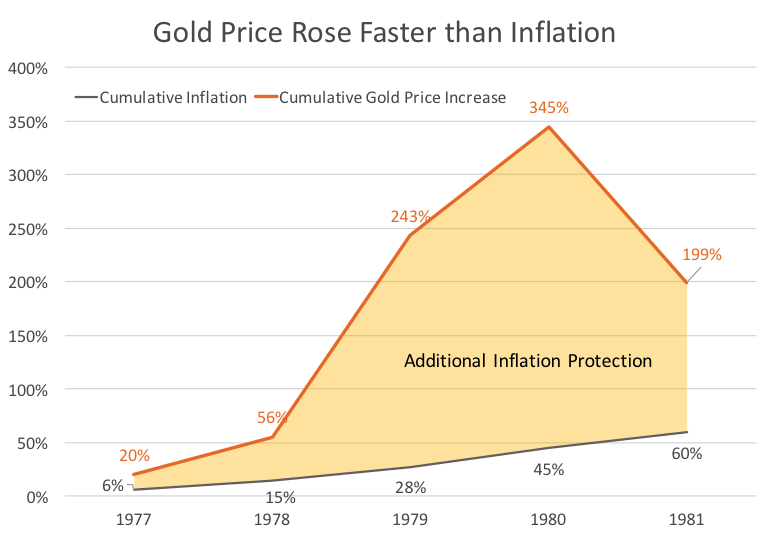
Is history about to repeat itself?
Chuck Butler explained how a dollar collapse would send shock waves throughout the world.
I contacted Urs Vrijhof-Droese the Managing Partner of WHVP, international asset managers. Urs, an expert in international banking is based in Zurich. Time for him to weigh in.
DENNIS: Urs, thanks again for your time.
While the “America first” trade renegotiations are not making a lot of friends, the world still holds trillions in USD. You constantly emphasize the need for international diversification as inflation protection.
Do you see the recent metals price surge as an indication of dollar collapse? Might it be a yellow flag instead of the big red one?
URS: I would definitely call it a yellow flag — while it gets your attention, it’s not a stop sign. It’s a slow, steady vote of no confidence – not in America as a country; but rather the world dependency on the USD.
Moving away from the U.S. dollar has been happening quietly for years. Central banks don’t shout; they reposition. Prudent investors don’t either – they hedge first, explain later.
We are not experiencing a red flag signaling “stop.” It’s a slow erosion of purchasing power, slowly punishing savers and rewarding debt. Holding precious metals and international diversification is no longer an exotic idea — it’s common sense.
A sudden collapse of the dollar would be catastrophic for the entire world. Anyone cheering for that outcome does not understand how interconnected the world really is.
DENNIS: Since 2008, it appears the world central banks are colluding, moving together; making it more difficult for investors to trade out of dollars into another more stable currency. The US is not alone with unsustainable debt.
SBC gold explains:
“Currently, no countries operate on a pure gold standard. …. This once-universal economic system has been replaced by a fiat currency experiment.
Without tangible backing, paper money derives value from more abstract factors such as governmental strength, economic stability, and consumer confidence. The shift to a free-floating fiat system…introduces the risk of overspending which leads to inflation, currency devaluation, and economic weakness.”
Do you see any major yellow flags, other countries heading for trouble?
URS: There are plenty, but they don’t always wave where you may expect. Japan is the classic example. While its debt levels look terrifying, they haven’t collapsed. Markets have revolted, were calmed, and life goes on.
Why? Most of Japan’s debt is held internally — by its own institutions and its own central bank. That doesn’t make the situation healthy, but it makes it survivable. A country owing money to itself is very different from a country dependent on foreign creditors losing patience.
China is a different story. Official numbers look somewhat manageable; however, when including local governments and state-owned enterprises, things become very murky. The real issue is, does anyone really know how high it is? Markets hate uncertainty.
Realistically debt alone rarely destroys a country.
The real damage is when governments rely on central banks to solve political problems. When monetary policy becomes a political tool, inflation follows.
This pattern has repeated across continents for centuries. Argentina or Zimbabwe are current examples.
DENNIS: Despite the warts, the US market is still huge. Millions of workers throughout the world depend on selling their good to the US consumer.
Should the US have another Great Depression, what do you see as the ripple effect?
What countries (or continents) would also be severely affected?
URS: The media often declares the U.S. “finished” — and yet it keeps surprising people. The entrepreneurial energy in the U.S. is real, and it matters. You can’t model that in a spreadsheet.
The world’s reliance on the American consumer is a vulnerability. Another US Great Depression would cause worldwide shockwaves. Europe, Asia, and export-driven economies would feel it almost immediately, creating deflationary pressure as companies fight for demand — something central banks fear even more than inflation.
This is where ideology usually loses to reality. When faced with deflation or recession, politicians & central banks generally choose more liquidity, more debt, more intervention – because it’s politically survivable.
Those predicting “the big crash” will eventually be right. Central banks have amazing ability to stretch timelines far beyond what logic suggests. Preparation matters far more important than prediction.
DENNIS: In 2009, your firm helped me invest in Swiss Francs, then worth $ .97. It briefly topped $1.30 USD by mid-2011.
Investopedia explains:
“Switzerland was an expensive place to do business. …. Exporters and service providers had a very difficult time making profits.
The solution: the Swiss franc/euro peg. …. By pegging the franc to the euro, Swiss exporters and service providers would greatly increase their odds of profitability.”
At the end of 2011, the franc dropped back to $1.06 USD.
Investopedia continues:
“It was the currency shot heard around the world. On Jan. 15, 2015, Switzerland announced that it was going to scrap its currency peg of 1.20 to the euro. The Swiss franc immediately skyrocketed 20%.”
Urs, it didn’t appreciate when compared to the US dollar. In early 2025, it rose to $1.10, and a year later it hit $1.282, up 16.5%.
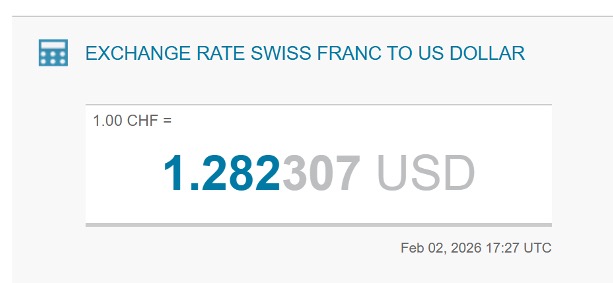
It didn’t rebound in 2015, but now has quickly appreciated over 16%. Why the rapid increase?
URS: Good question. When the Swiss National Bank removed the euro peg, many assumed Switzerland would simply “let the franc float freely.” However, the SNB never stopped intervening. It just changed how it intervened.
The SNB mandate is written into the Swiss constitution: price stability, while taking the overall health of the economy into account. That gives the SNB room to act independently, without being dragged into short-term political agendas or election cycles.
Switzerland is a small, export-driven country. Letting the currency surge too fast would have crushed competitiveness and jobs. So, the SNB played defense, even when it was unpopular internationally. America isn’t the only country that puts their needs on top of the list!
What changed? Inflation.
The SNB allowed the franc to strengthen gradually. A stronger currency made imports cheaper and helped contain inflation without extreme measures. That was not an accident — it was policy discipline.
This only works if politicians trust their institutions and resist the temptation to interfere. Switzerland has that culture. It’s not flashy, but it’s rare — and markets notice.
Mix current geopolitical tensions, fiscal excesses elsewhere, growing distrust in political promises, and the Swiss franc’s safe-haven role has intensified dramatically. While the recent move feels fast. It’s not a sudden change of heart — it’s years of pressure finally being released.
Investors are not just buying the stable Swiss franc; they are moving away from uncertainty in other parts of the world.
The franc didn’t wake up one morning and decide to get stronger. The world woke up and decided it wanted more Switzerland.
DENNIS: While Europe doesn’t appreciate president Trump’s negotiating style, NATO is good for all of us if the cost is shared fairly.
If China pulled the plug, it’s likely both the US and European markets would shrink rapidly. How do you see that playing out?
URS: Global power dynamics are rarely polite. They are pragmatic. If China were to seriously destabilize the U.S. or Europe, it would be hurting its own economy in the process. Dramatic threats are generally rhetorical rather than operational.
China still depends heavily on external demand. That reality encourages cooperation — even when tensions are high.
Despite the headlines, I remain cautiously optimistic. Historically ego, legacy, and self-preservation take priority; major powers generally do what it takes to avoid being remembered as the generation that presided over collapse.
An unhealthy system is still resilient – which buys time. What investors do with that time is what ultimately matters.
DENNIS: One final two-part question. Traders try to time the market, while investors and those with core holdings are sitting tight.
While each client is different, what are you recommending?
When the crunch finally arrives, other than the Swiss franc, what currencies do you feel will do well?
URS: Most investors don’t lose money because they lack intelligence — they lose money because emotions hijack discipline. The market doesn’t punish ignorance nearly as harshly as it punishes impatience and fear.
Our advice is boring by design: do your homework and build portfolios you can live with — even during market volatility. If you need income, focus on quality and sustainability. If your goal is generational wealth, don’t obsess over short-term noise.
Invest in assets you are willing to hold when headlines turn ugly. That mindset works, not because it’s clever, but because it’s psychologically sustainable. Wealth should reduce stress, not multiply it.
The Japanese yen may surprise people. Despite high debt, Japan has social discipline, institutional stability, and credibility, and that matters.
Central banks are still buying precious metals, supply remains constrained, and trust in paper currencies is slowly eroding. Gold is still gold, volatile, emotional, and sometimes uncomfortable – but it is still gold.
DENNIS: Thank you again for your time and insights
URS: My pleasure Dennis.
On The Lighter Side…
It was an exciting week for us. We unpacked the last box, hung the last picture and our guest room is ready for company. While we still have much to do, it’s a big relief and Jo and I can start enjoying more of what our new community has to offer.
We joined a Cubs club group which is pretty large. There are lots of Chicago Cub fans around the world and the group is a lot of fun. It was a catered dinner and the guest speaker was “Mrs. Murphy” who owned the famous tavern across the street from Wrigley Field. She told some hilarious stories. I got a cool item to add to our golf cart!
Our neighbors invited us to the Indiana club, a pot luck dinner. It was fun meeting people from “back home.” Then our doorbell rang and a sweet lady gave us an invitation to our regular neighborhood pot luck dinner at the community recreation center. Our instructions were to bring dessert. All three events were a blast; we signed up for membership and are looking forward to the next event….
The weather has been warmer and a couple nights last week we had dinner and parked our golf cart at the town square and enjoyed the live music. Not only is the music fun, we really enjoy seeing so many people dancing and having fun.
Quote of the week…
“One simple rule to follow: Determine what is best for the government and know that is what the powers are working to make happen. Inflation is what is best for a government, inflation with enormous debt.”
— Ayn Rand
And finally…
Friend Chuck Butler shares some clever quotes for our enjoyment:
I just posted a selfie and people told me to get well soon.
Getting old sucks. I used to wake up feeling like a million bucks…. Now I feel more like a bounced check.
Can I order a replacement body please, this one is constantly malfunctioning.
I’ll be posting telepathically today. If you think of something funny, it was me.
I ordered a glass of wine and the waiter asked for my ID. I asked, “Do I look that young?” He said, “No, just want to see if you get the senior discount.”
When I die I want my last words to be, “I left a million dollars under the….”
My wife texted me, “Your great.” I wrote back, “No, you’re great.” She’s been grinning all day. Should I explain I was just correcting her grammar?
It’s a shame nothing is made in the USA anymore. My new TV says “Built in Antenna.” I don’t even know where that is.
Posted a photo of my clean house and it was flagged and removed as “Fake News.”
And my favorite:
Men say women should come with instructions. Women say why? Have you ever seen a married man actually read the instructions?
Until next time…
Comments
Log in or sign up to join the conversation.