

St. George, the patron Saint of England, was executed on April 23, 303. The date of his death is commemorated as St George’s Day.
Wikipedia’s version explains:
“Saint George and the Dragon is a legend in which Saint George—a soldier…defeats a dragon. The story goes that the dragon originally extorted tribute from villagers. When they ran out of livestock and trinkets for the dragon, they started giving up a human tribute once a day. One day, the princess herself was chosen as the next offering.
As she was walking toward the dragon’s cave, St. George saw her and asked her why she was crying. The princess told the saint about the dragon’s atrocities and asked him to flee [fearing] he might be killed too. But the saint refused…slew the dragon, and rescued the princess.”
Inflation is today’s dragon, consistently extorting tribute (wealth) from the villagers. There was no inflation from 1800-1913; prices dropped over 20%.
In 1913 the Federal Reserve was established. Macrotrends shows us in 102 of the 113 years that followed, the inflation dragon’s net extortion from the villagers is almost 3,300%.
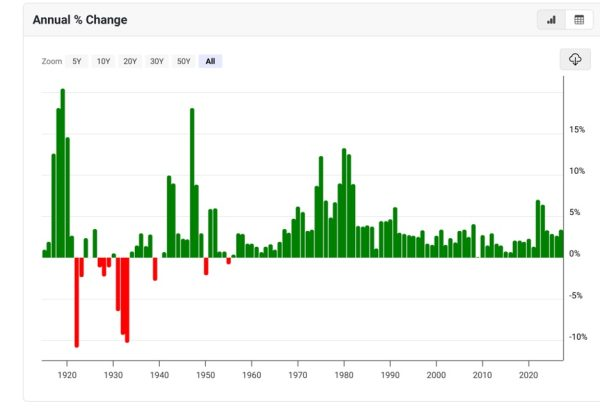
Thomas Sowell explains, “It is a way to take people’s wealth from them without having to openly raise taxes.”
Inflation is the tally of tribute the government extorts from villagers, in addition to taxation.
Former Senator Ron Paul agrees, “The most sinister of all taxes is inflation. When you create money out of thin air to pay the bills, the value of the dollar goes down, and the poor and middle class get hit with a higher cost of living.”
Don’t jump to conclusions!
Casey Research analysts constantly cautioned, “correlation versus causation.” Correlation is when two variables appear to be in synch. Causation means one variable directly influences another. “Dennis, don’t jump to conclusions.”
It’s time to call for help. I contacted Chuck Butler, author of The Daily Pfennig, and asked him to weigh in on the subject.
DENNIS: Chuck, once again, thank you for taking time to help our readers.
I look at the evidence, 1800-1913, our country went full speed ahead into the industrial revolutions and prices dropped over 20% – no inflation. The Fed was established and over the next 113 years we experienced 3,263.8% inflation – despite exponential improvements in technology and production, which should bring prices down.
If my premise is wrong, then we need to understand why. Inflation is the effect of something. What do you feel caused the dramatic turnaround?
CHUCK: Thank you, Dennis…
Well, I agree with the general consensus, inflation is caused by excess money in the economy… As Senator Paul said, the Gov’t allows money supply to grow, and grow and grow.
The Fed is owned by member banks who make profit lending other people’s money. The more money available, the higher their profit. Since the Fed/Cabal/Cartel was created in 1913, they’ve held the controls of the money supply.
Before this recent return of higher inflation, The Gov’t printed money but… just made digital entries in their books. Theoretically the banks were supposed to buy Treasuries with the funds. However, like our foreign friends (NOT!), banks have been lowering their participation in buying Treasuries. Banks can’t make money lending at interest rates that don’t come close to beating inflation, so they do other things.
Treasuries finance the ever-growing government debt, $39 Trillion right now. It won’t be long before there are not enough lenders and we’ll have to buy (monetize) our own debt. That’s creating money out of nothing; doing what Senator Paul said, devaluing the buying power of dollars in circulation. That is called inflation.
So, yes, the Fed was a major cause in the inflation turnaround, with an assist from a government who has spent $39 trillion more than it has taken in with taxes. The pace is accelerating.
DENNIS: Capitalism encourages motivation and innovation. Capital is a necessary ingredient to fuel the process.
Two-part question. Could the cheap money have helped speed up the innovation process? For banks to maximize profits, they have to lend money. The fallout of easy money is increased default. Are recessions like the 2008 mortgage bailout just part of the process?
CHUCK: Sure… cheap money makes it easier to fuel the process; however, during the industrial revolution, prior to 1913, money was available.
Dennis, I feel it is a matter of degree. The Fed was established. The Roaring ’20s followed, leading to bank failures and the Great Depression. Roosevelt addressed the cause, establishing the FDIC and passing the Glass-Steagall Act, restricting bank activities. Those worked fairly well.
While you will have normal up and down business cycles, without those banking restrictions, the highs and lows are more dramatic.
DENNIS: President Trump (and others) feels lowering interest rates will jolt the economy and reduce debt and inflation.
While theoretically, that may be correct, we just experienced more than a decade of automation, innovation, and almost negative interest rates, yet prices and debt skyrocketed.
Correlation versus causation? Socialist politicians blame capitalism, suggesting government control is better than a free market. Ron Paul disagrees:
“Capitalism should not be condemned, since we haven’t had capitalism. A system of capitalism presumes sound money, not fiat money manipulated by a central bank. Capitalism cherishes voluntary contracts and interest rates that are determined by savings, NOT credit creation by a central bank.”
In my lifetime, I can’t ever recall interest rates set by a free market.
I tried to test Mr. Paul’s premise. Nixon took us off sound money in 1971. The US inflation calculator shows during the 58 years (1913-1971), we experienced 309% inflation. In the 53 years since (1971-2026), the rate more than doubled to 727.5%.
Paul wants to do two things, return to the gold standard and dismantle the Fed. Politics aside, might that truly slay the inflation dragon?
CHUCK: It would go a long way, but the dragon won’t truly be slain until money supply is cut off… We can raise the Fed Funds rate to kingdom come, but it won’t truly slay the dragon… without a stoppage of the free flow of money supply.
DENNIS: If inflation is the dragon, the brains is the Fed chairman. While Paul Volcker was labeled an “inflation fighter” back in the 70’s, he didn’t slay the dragon. He just reduced the amount of tribute the government extorted from the villagers.
Today we have a new Fed Chairman. You wrote moving the goalposts was how he wanted to address the issue. What’s that all about?
CHUCK: The new Fed/Cabal/Cartel chairman, Kevin Warsh, wants to change the way inflation is calculated. He thinks that by doing so, it will lower inflation to a level more suited to Americans.
Warsh supports the idea of “trimmed averages”, which remove extreme high and low-price changes to better reflect the central tendency of inflation and the underlying rate of inflation. Inflation is real, and phony numbers won’t change that. As I said earlier, the free flow of money has to be addressed.
DENNIS: When the going gets tough, just change the standards….
In Trump’s first term he nominated Judith Shelton and Herman Cain, both staunch advocates of the gold standard, to the Federal Reserve. Senator Elizabeth Warren screamed they were “too radical.” They never came close. We can’t even get Congress to approve a realistic audit of the Fed.
“Congressional oversight” is an oxymoron; it doesn’t seem to happen. Why not?
CHUCK:I assume you mean in addition to the $300 million bank lobbyists spent to get Glass-Steagall repealed, the family members who may be serving on bank boards of directors, and the millions they are paid for “speaking fees” at various bank boondoggles…. <<wink-wink>>.
Dennis, most politicians have little, if any, experience in the private sector. They don’t truly understand how wealth is created. Their motivation is to extract wealth from the private sector, redistribute it which gives them power and wealth. They call the gold standard “radical” because it restricts their ability to spend money and buy votes.
DENNIS: Wow! No wonder politicians are socialists; they benefit the most.
One final question.
Since the repeal of Glass-Steagall we’ve seen banks grow to astronomical size. The top five banks control almost ½ the nation’s wealth and are deemed, “too big to fail.”
Reckless lending led to the 2008 banking crisis. Against the will of the majority, knee-jerk politicians screamed that, without an immediate bailout of the “too big to fail” banks, the nation’s economy would collapse.
A competent private sector business person would ask, “If banks are too big to fail, aren’t they too big?” Some restrictions were in the Dodd-Frank Act but they quietly disappeared.
Short of dissolving the Fed, are there any restrictions that could realistically bring down inflation to a reasonable level?
CHUCK: Thanks again for inviting me.
Similar to investment diversification, don’t allow any single investment to destroy your entire portfolio. Like Christmas tree lights, one might go out, but not all.
The Glass-Steagall Act restricted bank activities and interstate banking. By limiting the size of individual banks, no bank was “too big to fail.” A bank failure was not so large that it would do significant damage to the entire economy.
Reinstating Glass-Steagall would certainly help tame the dragon….
Dennis here. Congress ensures any potential Fed dragon slayer is deemed “too radical” – while they continue to extort tribute from the villagers. They ignored the 2008 warning. Currently, slaying the dragon is not in their interests. Maybe next time….
On The Lighter Side…
I hope everyone had a great time celebrating our nation’s 250th birthday. Jo and I headed to The Villages, FL for the week, and had a good time.
Grandson Brock played in a huge volleyball tournament at the Orlando Convention center. It was quite a spectacle.

Our local community was in the celebration mood, flags everywhere. This photo is one of dozens I could have taken in our neighborhood. The list of festivities in the community and surrounding area was large.
I wondered why so many seniors are patriotic. Baby Boomers were raised by WWII veterans in a much different world. We never locked our doors, and most of the time left the keys in the car. We saw what Hitler did, and the glaring difference between communism and freedom in Berlin. Our schools taught us to love America – yes, despite the warts which exist.
I agree with Calvin Coolidge, “To live under the American Constitution is the greatest political privilege that was ever accorded to the human race.” Our founding fathers set up a system for self-governance, and a mechanism to change things. The system is in place. The issue is when special interest groups and politicians want to govern against the will of the majority that they complain about the system.
Quote of the Week…
“We do know that the Federal Reserve System must be abolished. The creature has grown large and powerful since its conception on Jekyll Island. It now roams across every continent and compels the masses to serve it, feed it, obey it, worship it.
If it is not slain, it will become our eternal lord and master. Can it be slain? Yes, it can. How will it be slain? By piercing it with a million lances of truth. Who will slay it? A million crusaders with determination and courage. The crusade has already begun.” —G. Edward Griffin, The Creature from Jekyll Island
And Finally…
In keeping with the spirit of things, Jo sent along some patriotic puns for our enjoyment:
|
|
|
|
|
|
|
|
|
|
|
|
|
|
|
|
|
|
And my favorite
|
Until next time…



Comments
Log in or sign up to join the conversation.