

In the early 1940s, we lived in my grandmother’s boarding house. We would walk to the Jewel-T and haul groceries home in my little red wagon.
She constantly railed about rising prices, “Never in my life did I believe I could carry $25 worth of groceries home without a wagon.” My mother screamed about Brazilians burning coffee beans, creating a shortage, raising the price of coffee.
As teenagers, we regularly enjoyed coffee and a donut for less than a dollar. Today the Starbucks CEO proclaims $9 coffee is “A Really Affordable Premium Experience.” Ridiculous!
While ranting about high prices is a family tradition, “inflation” was an uncommon term until Nixon closed the gold window in 1971.
Webster defines inflation as, “a continuing rise in the general price level usually attributed to an increase in the volume of money and credit relative to available goods and services.”
Double-digit inflation loomed when Nixon resigned. CBS news explains:
“Just two months after becoming president,…Ford addressed a joint session of Congress about the urgent economic situation. “We must whip inflation right now,“ he said. “I say to you with all sincerity that our inflation, our public enemy number one, will, unless whipped, destroy our country.”
…. The speech…was short on policy. There was, however, a button!
…. ‘WIN’ was short for ‘Whip Inflation Now.’ The phrase had…been dreamed up by the same New York ad agency responsible for one of the most successful campaigns in advertising history, for Charmin bathroom tissue.
…. Ford’s top economic advisors – like future Federal Reserve chair Alan Greenspan – were deeply skeptical. Greenspan later called the idea ‘unbelievable stupidity’.”
Buttons didn’t work, inflation thrived. In mid-1979, newly elected Fed Chairman Paul Volcker eventually cooled inflation (Public enemy #1) by raising interest rates to double digits. Despite being deemed an “inflation fighter,” prices never came down; the rate of increase just slowed.
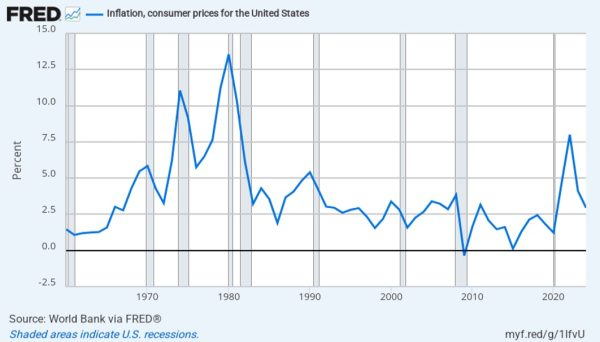
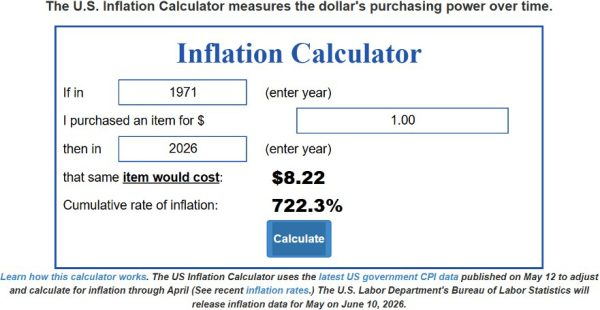
For the next several decades, inflation, like cancer, continues to grow and destroy the dollar. Since Nixon uncoupled the USD from gold, the accumulated rate of inflation increased 722% – and that’s using phony, gerrymandered government numbers.
Economic hogwash 101
My grandson, questioning the necessity of a required high school class, asked what classes I felt actually helped me through my life. I responded, “typing, driver training and 7th grade “Home Economics.” In grade school we learned basics: cooking, sewing, how to budget, write a check, and balance a checkbook. Common sense, practical skills that help us regularly.
At Northwestern, Business Economics I & II were required classes. I anticipated these classes would also be practical. It was the opposite; guns & butter, overwhelming economic theory, and little relevance to our kitchen table world.
Our night school instructor was fresh out of grad school with a PhD and no business experience. He faced a class of businessmen working real-world jobs. In a few short minutes we exchanged glances; what the hell is he talking about? We quickly bonded, taking turns asking how the gobbledygook theories related to our real-world problems. PhD be damned, the young man had no clue – math, formulas and theory were his world. When I see these highfalutin academic economists at the Federal Reserve, espousing their $2 words, I get negative flashbacks….
Nobel Prize winner Paul Krugman reinforces my bias. Five years ago, I wrote:
“Does Government Debt Really Matter?
The numbers on the US Debt Clock are spinning at a dazzling pace. US government debt is now over $21 trillion, $174 thousand per taxpayer.
…. In October 2016, anticipating the election of Hillary Clinton, Krugman wrote, ‘Debt, Diversion, Distraction’.
‘Are debt scolds demanding that we slash spending and raise taxes right away? Actually, no: the economy is still weak, interest rates still low…and as a matter of macroeconomic prudence we should probably be running bigger, not smaller deficits in the medium term.
…. My message to the deficit scolds is this: yes, we may face some hard choices a couple of decades from now. But we might not, and in any case, there aren’t any choices that must be made now.’
Shortly after the election, he reversed his position writing, ‘Deficits Matter Again’.
‘…. Eight years ago, with the economy in free fall, I wrote that we had entered an era of ‘depression economics, in which the usual rules of economic policy no longer applied…deficit spending was essential to support the economy, and attempts to balance the budget would be destructive.
…. But these predictions were always conditional, applying only to an economy far from full employment. That was the kind of economy President Obama inherited; but the Trump-Putin administration will, instead, come into power at a time when full employment has been more or less restored.'”
Eight years ago? No, 7 weeks…. What a political hack…something smells!
A decade later, with both parties having held power, relying on their favorite propeller-heads, the numbers are in:
DEBT 2016:

DEBT TODAY:

Debt has doubled, inflation remains high and politicos of all flavors are responsible. Don’t count on Trump’s new Fed chairman making any meaningful changes.
An epiphany of sorts
Friend, and former colleague, Doug Hornig shared an inflation study going back to 1800, adding:
“Many believe inflation is inevitable, and blame capitalism. Yes there are big ups and downs, but the truth is that deflation is the norm over time, as production improvements make things cheaper.
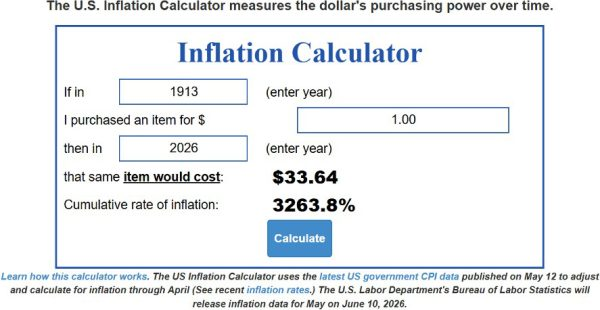
Inflation is not about rising costs, it’s about the declining value of the dollar. It only became inevitable with the creation of the Fed in 1913 and went parabolic with the closing of the gold window in 1971.”
I was shocked! Deflation is the norm? Quoting the study:
“Value of $100 from 1800 to 1913
$100 in 1800 is equivalent in purchasing power to about $78.57 in 1913, a difference of $-21.43 over 113 years.
The dollar had an average deflation rate of -0.21% per year since 1800, producing a cumulative price change of -21.43%.
This means that prices in 1913 are 21.43% lower than average prices since 1800….”
7th Grade Economics, no gobbledygook allowed….
1800-1913 we saw the opposite of “a continuing rise in the general price level….” How did lower prices happen?
ThoughtCo explains:
“The second Industrial Revolution occurred in the U.S. beginning in the mid-1800s, transforming and positioning America for its rise to a global superpower.
…. The American Industrial Revolution began in the years and decades following the end of the Civil War. …. American entrepreneurs were building on the advancements made in Britain. …. New forms of transportation, innovations in the industry, and the emergence of electricity would transform the nation….”
Famed author John Jakes wrote novels about the Civil War. His lessons are timeless:
“The significant difference between the economic systems of the North and South was not in industry versus agriculture but in motivation.
The free Yankee worked to better himself. The Southern slave worked to keep from being punished.
…. In the North, free workers were speeding into a prosperous future to the hum of machines, not dragging a load of rusty methods and ideologies as heavy as wrist cuffs and leg manacles, and fully as hampering.”
Quite a contrast; working hard to get ahead, versus just enough to avoid the whip! When the Berlin Wall came down a German friend told me it would take decades to truly unite, describing the culture of the two working classes similar to Jakes’s description.
Our nation embraced capitalism – which creates competition keeping prices down (no monopolies allowed), while rewarding innovation.
Can improved production, assembly lines, automation and now artificial intelligence combat inflation? Nividous.com thinks so:
“What’s the connection between inflation and automation?
|
|
|
Doug’s big clue.
In the 1800s there was no Federal Reserve and the gold standard helped curb government spending.
|
|
Webster added, “…. usually attributed to an increase in the volume of money and credit relative to available goods and services.”
President Ford’s prediction, “inflation, …. will, unless whipped, destroy our country,” is coming to fruition. Despite historic advancements in automation, computers and artificial intelligence, the value of the dollar has been destroyed.
Free market capitalism worked for 113 years. Capitalism fails when monopolies destroy competition. The banks own the Fed. The top five banks control half the nation’s wealth and are deemed “too big to fail.”
It doesn’t take gobbledygook to connect the failed Federal Reserve experiment and inflation. In my opinion,inflation is NOT public enemy #1.Inflation is a result of the Fed’s policies, supported by (too many career) politicians. The banking lobby spends millions rewarding politicos who ignore logic and common sense.
With all the technological advancements since 1913, how much less expensive things would be today were it not for the government?
John Jakes adds, “Just one thing is necessary for the triumph of wicked men, and that’s for good men to do nothing.”
Subscriber Craig DeForest champions a constitutional convention. Perhaps it’s time good men fix the mistakes of the past.
On The Lighter Side…
The calendar has flipped over to June and we are busy. A year ago, we left Arizona and had to get all new doctors. This month is “annual checkups.” We have ten medical events on the calendar in a two week stretch. Today, most all our doctors are younger than our children. I feel that’s positive, technology is changing so rapidly, I prefer those who are keeping up.
I’m sure we’ve all had the doctor who comes in, says hello with no smile, looks at the computer and comes off as all business. I’ve taken it as a personal challenge to lighten things up a bit. One doctor held my eye open and shined a very bright light into my eye. I immediately said, “Doc, keep talking, for a second I thought the bright light was the entrance to the pearly gates.” The nurse typing in the back broke out laughing and the doc rolled his chair back for a second grinning.
Personally, I prefer a doctor that knows my name, not just seeing me as a chart on a computer screen. Maybe old people think differently, but I feel when there is even a small connection, we certainly feel better.
I had cataract surgery several years ago and it’s time for a tune up. I have laser surgery scheduled to remove scar tissue which should clear things up. I’m told it’s painless and takes just a few seconds. Jo had it done recently, and was very pleased.
Many of our friends struggle to drive at night, but for the two of us, so far so good. One more time to count our blessings.
We also plan to head to Indianapolis to see grandson Brock in a volleyball tournament. Busy beats boredom….
Quote of the week….
“My senior citizen workouts are a success. I can now lift $100 worth of groceries with one hand.” —Dennis Miller
And Finally…
Friend Courtenay W. sent along some riddles for our enjoyment. Scroll down for the answers…
|
|
|
|
|
|
|
Hope you had as much fun with these as I did. It took awhile but I got three of them.
Answers:
|
|
|
|
|
|
|
Until next time…



Comments
Log in or sign up to join the conversation.