


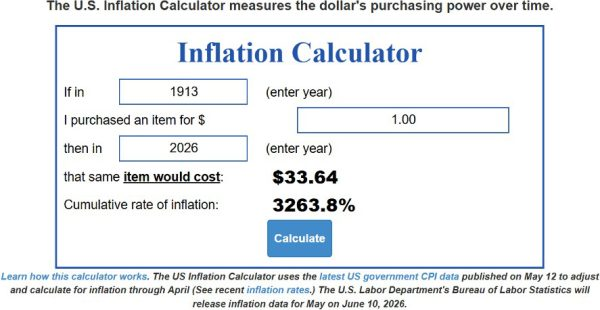
Recently Doug Hornig shared a study outlining how the industrial revolution brought prices down. In 1913 $78.57 would buy what cost $100 in 1800, 113 years earlier.
Then the Federal Reserve was established. 113 years later (2026) it takes $3,363.84 to buy what $100 bought 113 years ago.
The ink was barely dry on our article, when I received an email from friend Phil C. titled “The Lucky Generation”:
“We were born in the 40s, 50s, and 60s… Raised in simpler times, yet we lived long enough to witness a world transformed beyond imagination.
|
|
|
|
|
|
|
The rate of change has become generationally exponential, moving faster each day. Universities admit technology is advancing so quickly, they can’t graduate computer science majors with the current technology.
“It’s not a good time to major in computer science.
…. Not long ago, the software developer had their pick of jobs with six-figure starting salaries. …. But my, what a difference a few years makes. Silicon Valley has since laid off software engineers by the thousands. Generative AI can write code with better faculty every month, rendering many entry level positions obsolete.”
Warts notwithstanding, capitalism supplies the motivation for people to better themselves, spurring innovation. The Fed’s creation of phony money ignites inflation, however, easy money/credit helped turbocharge the industrial revolution into the digital age.
Rapid technological changes should continue – unless – the motivation changes.
In the early 1980’s John Jakes wrote about the civil war:
“The significant difference between the economic systems of the North and South was not in industry versus agriculture but in motivation. The free Yankee worked to better himself. The Southern slave worked to keep from being punished.
…. In the North, free workers were speeding into a prosperous future to the hum of machines, not dragging a load of rusty methods and ideologies as heavy as wrist cuffs and leg manacles, and fully as hampering.”
Quite a comparison; working hard to get ahead, versus just enough to avoid the whip!
My personal journey
In my 20s I had the privilege of working for Leighton Wilkie, a lesser-known captain of industry. He invented the band saw and built a good-sized empire.
His New York Times obituary was glowing:
“He sponsored educational exhibits in museums, including a “Civilization Through Tools” display and the Julius C. Wilkie Steamboat Museum in Winona,…featuring Robert Fulton documents and steam-driven equipment and plants.
Mr. Wilkie wrote books about machine tools and the industrial revolution. He was the co-author…of ‘The Principles of American Prosperity’ (Devin-Adair, 1975).”
Mr. Wilkie and I regularly discussed how his company was part of the industrial revolution. They made machines to make bigger and better machines. Modern machines reduced the cost of production, making goods and services affordable for the general public.
When I asked about reducing the need for labor, he reassured me that labor and human intelligence would always be necessary for manufacturing, operating and inventing the new machines and technology. At the time, “artificial intelligence” would have been considered science fiction.
A few years later I began working with many high technology and fortune 500 companies. One account, Modicon, pioneered the development of Programmable Logic Controllers (PLC). PLCs become the “intelligence” in operating the machinery. Other clients like GE and Hewlett Packard joined the game, further spurring innovation and competition.
I loved touring client’s production facilities watching PLCs operate machinery built by Mr. Wilkie’s company, thinking to myself just how pleased he would be with the continued progress. Today, artificial intelligence is helping write the programs to drive the process.
I’m continually amazed how far the technology advanced. These machines not only lowered unit costs, but also consistently produced higher quality products. I saw quality control using pass/fail guidelines with tolerances calculated in a 1,000th of an inch.
In the 113 years (1800-1913) leading up to the creation of the Federal Reserve, prices declined by over 20%. The inflation report card was a dismal failure over the last 113 years. What would it have been without the Fed and out of control government spending?
Life is much easier today because of innovation and technology. Several examples come to mind.
One client, Public Service of Indiana, was promoting a hot new technology called a microwave oven. They sold me! When I excitedly told my wife, she resisted; fearing our children would glow in the dark. Within a month, it became a staple kitchen appliance.
How easy is it to not solely rely on mirrors, instead using cameras to provide images we could have only dreamed of a few short years ago?
The first computer I saw was in 1960 at Pure Oil. It took an entire floor. Project #1 for this newfangled device was keeping the stats for the bowling league. Today we have more computing power in the palm of our hand with our cell phone.
When they introduced thePCjrI was skeptical, “Why do you need a computer in your house?” The salesman said, “You can balance your checkbook.” I recounted, “I’ll do it manually, and race you!” Then Al Gore (sarcasm intended) invented the internet and the rest is history. Over the next few decades, I’ve owned dozens of computers, each surpassing the others in speed and capacity.
Recently Jo was cleaning the floor with her vacuum/mop, complaining her back hurt. Being a “Mr. Fix it” I gave it a try. My back hurt too. I hopped on the internet, did some research and bought a Roborock.
Step one in the programming process was giving it a name. We named it Hazel after the maid in a TV comedy. The gadget mapped the house, then vacuumed and mopped flawlessly. In our Florida home, we upgraded to Ingrid. It won’t be long before we won’t need a cell phone to program it, artificial intelligence will tell her what to do and off she will go.
The great race!
President Trump suggested the US could grow their way out of debt with energy independence, technology and efficiency. Theoretically he may be correct; however, Ronald Reagan warned that no matter how much money you give congress they will spend billions more.
For the last 113 years all the benefits of technology have been outpaced by inflation. Why??? A couple famous quotes are appropriate:
“By continuing the process of inflation, government can confiscate, secretly and unobserved, an important part of the wealth of their citizens.” —John Maynard Keynes
“The most important thing to remember is that inflation is NOT an act of God, that inflation is NOT a catastrophe of the elements or a disease that comes like the plague. INFLATION IS A POLICY.” —Ludwig von Mises
What comes next?
I worry about computers and what they know. I began researching this article using a Norton search engine. Then, magically this video, popped up on my You Tube home page. I don’t suppose that connection was a coincidence…. The video outlines incredible machines that should help bring food prices down dramatically. If you want to be amazed, spend 8:49 taking a look.
The next generation will boast about leading the wave from the digital age to the robotic age. Drone technology allows us to lift and fly without a wing. How long before we see computer driven, flying cars?
Some of these new artificial intelligence robots are so lifelike they’re downright scary!
Capitalism versus all other
John Jakes’ conclusion, the main difference between workers in the north and south was motivation, makes perfect sense. Every attempt at socialism has been a failure; good intentions but the incentive to work hard to get ahead is removed.
A friend told me, “In Russia we pretend to work and they pretend to pay us.”
Capitalism has warts which must be dealt with, monopolies, wealth inequality, etc. In my opinion, the future depends on how well those issues are addressed without destroying the motivation which sparked the greatest standard of living the world has ever seen.
The tug of war between capitalist industry and an out-of-control government is reaching a crescendo. All sides need to be reined in, particularly the “too big to fail” banks, or the movie “Back to the Future” might have a sad, surprise ending.
On The Lighter Side…
Last week we began a series of routine medical visits. I’ve had swallowing issues since being treated for tongue cancer in 2019. It took five years before I was able to eat a hamburger or pizza comfortably. I was told that the side effects of my treatment would be with me for the duration – “the gift that keeps on giving!”
The combination of young doctors and new technologies are helping me realize that simple treatment and exercise can improve things quite a bit. The young therapist explained that the tongue drives the food down the line and I need to make my tongue stronger. I jokingly said, “So am I going to have to lift weights?”
Not exactly, but she showed me how to use a tongue depressor and some exercises to get the same effect. So, now I am doing my daily workouts….
Between workouts, exercises to break up scar tissue from the treatment, and surgically stretching my esophagus, I am seeing improvement. Where will the technology be a decade from now???
Quote Of The Week…
“The greatest advances of civilization, whether in architecture or painting, in science and literature, in industry or agriculture, have NEVER come from centralized government.” —Milton Friedman
And Finally…
Life long friend Tom G. shares some puns for our enjoyment:
|
|
|
|
|
|
|
|
|
|
And my favorite:
|
Until next time…



Comments
Log in or sign up to join the conversation.