

Last Friday, when the Canadian Prime Minister instructed his trade negotiators to walk out on tariff negotiations with the Trump Administration, Canadians knew that this was a major turning point in the life of its relationship with its southern neighbour. Resisting making a bad deal, Canada chose to withstand US tariffs on some additional CD$28 billion in exports annually.
This trade war has now escalated as Canada just announced retaliatory tariffs on US imports of an equal dollar amount. Canada has served notice that it has adopted a policy of matching the US tariffs, “ dollar for dollar”. The Canadian authorities chose to put tariffs on specific imports, such as steel, dairy, agricultural equipment and manufactured goods. It was touted as “ a proportional tit-for-tax “ strategy.
While not a blanket tariff on all trade, this approach will generate higher costs to Canada's industrial base and consumers. Nonetheless, polling results reveal that over 75% of Canadians overwhelmingly approved of the government’s actions, knowing full well that Canadians will endure a disproportionate burden in conducting this war. Provincial Premiers stood by that decision, but are also bracing for job losses and calling for federal government support.
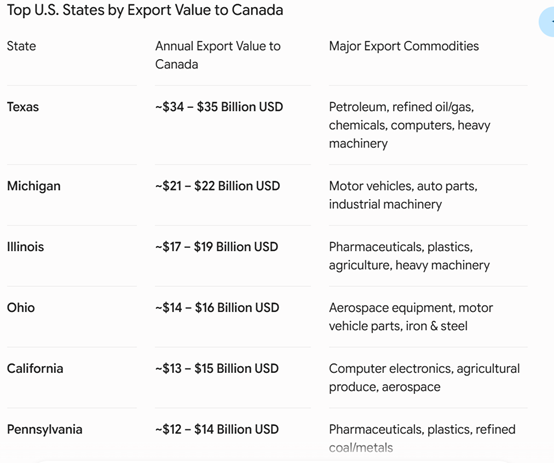
The fallout in the US is expected to be felt in the November midterm elections in several key states. The top six states export $125 billion, approximately a third of all US exports to Canada. States close to the Canadian border are the ones with the most competitive Congressional seats, and the impact of this trade fight will undoubtedly be felt on voting day. Border states such as Michigan and Maine have suffered the loss of a considerable amount of Canadian business, starting from day one when President Trump introduced tariffs about two years ago. States like Michigan and Ohio fear the loss of automotive jobs as the cost of steel and aluminum pushes up vehicle prices. More recently, Trump cannot resist further escalation. He threatened to raise the tariffs on cars, trucks, and auto parts imported from Canada to 50% from the current 25% on Jan 1, 2027. Given the high degree of integration within the North American industry, no wonder there is widespread anxiety about a possible collapse in the car industry.
Further afield, European and Asian nations have taken notice of Canada’s action. The lesson learned is that accepting US tariff demands in no way guarantees proportional US concessions will be forthcoming. The US simply believes that its negotiating strategy — ask for a lot, concede nothing — is working with Canadians, until it no longer works. Put differently, Canada signalled that a measured pushback is needed, “tit-for-tat” to preserve leverage in the talks.
How is Canada planning to offset the effects of this latest salvo in the trade war? The federal government, in the short term, created dedicated funds to be used to provide low-interest loans, working capital, and restructuring grants to heavily impacted industries like auto parts manufacturing, forestry, steel, and aluminum. To date, the Canadian government has committed an additional C$7.5 billion in emergency funding, on top of the $25 billion deployed over the last year and a half. Over the longer term, the Canadian governments, provincial and federal, are working towards trade diversion away from the US.
True to form, the EU heads of state have generally remained quiet on what happened in the Canada-US trade talks. The EU has long been scared of its own shadow when dealing with the Trump administration on trade and security issues. Outside of government, however, industry representatives have voiced support for the Canadian resolve and are coming around to seeing the need to stand up to its bullying tactics. Carney is slated to talk to the European Parliament in September, at which a lot of attention will be focused on how he sees the way forward to challenge the US trade restrictions.



Comments
Log in or sign up to join the conversation.