

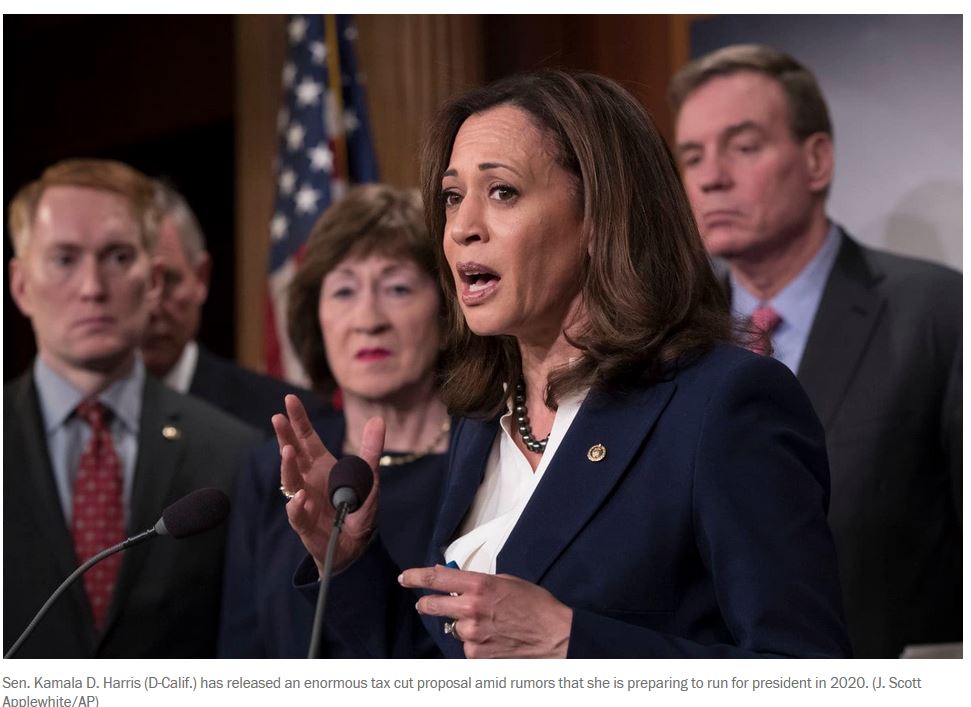
Jeff Stein's Wonkblog piece told Post readers the good news that the vast majority of Senator Kamala Harris' proposed $2.8 trillion tax cut would go to the non-rich, according to an analysis from the Tax Policy Center. What the piece did not do is give readers any sense of how much money is involved.
I will go out on a limb here and suggest that the vast majority of Post readers really don't have much idea of how much money $2.8 trillion is over the decade from 2019 to 2028. It is not that difficult to give readers some context. For example, the piece could have told readers that is a bit less than 1.2 percent of the projected $255.4 trillion in GDP projected for this period. Or, it could have indicated that it is 6.3 percent of the projected $44.2 trillion in total federal spending over the decade.
There are other, and possibly better, comparisons that could have been used, but it would be worth trying to use some reference point for the 99 plus percent of readers who don't have their head buried in budget projections.
Almost all of Sen. Harris’s $2.8 trillion tax plan would help middle and working class, study finds
By Jeff Stein, Washington Post, November 15
A proposed tax plan from Sen. Kamala D. Harris (D-Calif.) would cost the federal government $2.8 trillion over a decade but cut taxes by about $3,000 for the majority of working-class Americans, according to a new analysis.
Under Harris’s plan, the federal government would pay tax credits that match a person’s earnings up to $3,000 (or $6,000 for married couples) but phase out those credits for higher earners.
The Tax Policy Center, a nonpartisan think tank, said Wednesday that Harris’s LIFT Act would add $2.8 trillion to the federal deficit in its first 10 years and an additional $3.4 trillion in the following decade. Harris has proposed paying for the tax cut by eliminating the parts of the Republican tax law passed last fall that benefit the rich, as well as levying a new tax on large financial institutions.
Because the amount an individual or couple can receive from the tax credit would diminish as their incomes rise, “nearly all” of the plan’s benefits would go to those who earn less than $87,000, the Tax Policy Center said. Its benefits are expected to be much smaller for the poorest Americans.
“As the analysis shows, Senator Harris’s middle-class tax bill would put more money back into the pockets of millions of American families,” said Lily Adams, a spokeswoman for Harris. “One of the biggest issues our nation faces is that wages are not keeping up with the rising cost of living. Big problems require big solutions.”
Harris, a former California attorney general and first-term senator, is a potential Democratic candidate for president in 2020.
The proposed tax cut concentrates its benefits on the middle class, but it faces criticism from both the right and the left.
Fiscal hawks say that it would cost too much, even more than the GOP tax law, and that it would drive up an already soaring federal deficit. Those on the left have said Harris’s plan should also offer benefits to poorest Americans, and argued it is difficult to explain to the average voter.
Continue reading at The Washington Post.



Comments
Log in or sign up to join the conversation.