


If there is an AI bubble and it’s about to collapse, we shouldn’t worry about the debt. If there is not an AI bubble and it is about to transform the economy, we should not worry about the debt. In all other cases, we should be worried about the debt.
I’m pretty sure the full universe of cases is covered by those who think there is an AI bubble and those who think there is not an AI bubble. So, if I can make the argument here, then we don’t have to worry about the debt.
There is an AI Bubble: Should People Worry About the Debt?
Let’s start where there is an AI bubble. AI is clearly driving the economy at this point. Part of this is direct spending on AI-related investment. In the second quarter, we spent $750 billion on information processing equipment, an increase of $260 billion from what we spent in 2023 (in 2017 dollars). Spending on software was $960 billion, an increase of $240 billion from 2023. And we spent $30 billion on data centers.
If 80 percent of the rise in spending on information processing equipment and software was AI-related, that comes to $400 billion. Adding in the $30 billion spent on data centers, and we’re spending $430 billion, or 1.6 percent of GDP, on AI investment. If the bubble bursts, this will likely fall to near zero.
Then we get the consumption effect. Many of us have noted that as wage and employment growth stagnated, consumption seems to be driven by stock gains rather than wage income. Stocks are at near-record levels of price-to-earnings ratios, even as profits are reaching record-high shares of GDP.
The value of the US stock market is currently near $80 trillion. If the AI bubble bursts, it can easily lose 20-30 percent of its value. That would be a loss of wealth of $16-$24 trillion. It is quite plausible the drop would be even larger. When the tech bubble crashed, the S&P lost 50 percent of its value, and the NASDAQ lost 80 percent. It would also take a drop of around 50 percent to bring price-to-earnings ratios to their historic average.
But we can work with the 20-30 percent drop. The wealth effect on consumption is usually estimated at close to 3 cents on a dollar. That means a loss of $16 -$24 trillion in wealth would translate into a drop of $480 to $720 billion in annual consumption, or 1.5 to 2.2 percent of GDP.
Summing the loss of investment and consumption, the drop in demand associated with the collapse of the AI bubble would be 3-4 percent of GDP. That is a story of a very severe recession. It might not be as bad as the 2008-09 recession from the collapse of the housing bubble, but it would mean millions of people out of work and the unemployment rate likely increasing by 2-3 percentage points.
At that point, we will for certain see a rise in the deficit, but I suspect most people will be far more concerned about getting the unemployment rate down and the economy moving forward again. Also, the high interest rates that are prompting great concerns over the sustainability of the debt over the next hundred years will again be low as the Fed slashes interest rates to try to support the economy. There will still be people complaining about the debt, as there were when we tried to recover from the Great Recession, but for the most part they will likely not be taken seriously.
But again, just put on your thinking cap. If we think that an impending collapse of the AI bubble is about to sink the economy, destroying tens of trillions of dollars of market value, and throwing millions of people out of work, is yelling about the deficit a good use of our time or of space in leading media outlets?
The No-AI Bubble Scenario
If there is no reason to worry about the debt in the AI bubble scenario, there is even less reason in the no-AI bubble scenario. If the current price of AI-related companies makes sense, then the implication is that their profits will grow enormously in the near future. The only way that can happen is with massively more rapid growth than is assumed in most economic projections, including the ones by the Congressional Budget Office (CBO), which provides the basis for most budget analysis.
That means that if we want to assess the burden posed by the debt at some future point, we have to adjust our growth projections upwards because of the AI-driven productivity boom. In keeping with this story, I have adjusted CBO’s annual productivity growth projections upward by a percentage point, from 1.5 percent to 2.5 percent.
While this is a big increase, the rate of growth would still be less than the 3.0 percent annual rate that we saw in the tech boom from 1995 to 2005 or the long post-World War II golden age from 1947 to 1973. It’s also certainly not the job-killing labor market disaster that many people fear.
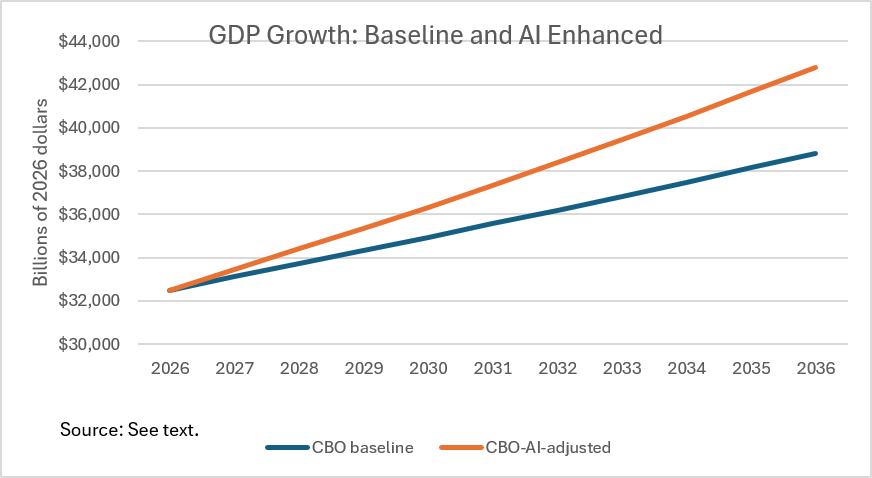
If we get this 1.0 percentage point increase to annual productivity and GDP growth, then by 2036 GDP will be approximately $4 trillion larger (in 2026 dollars) than what CBO is currently projecting. Instead of being the $38.8 trillion projected by CBO for 2036, it will be $42.8 trillion. That $4 trillion difference comes to an additional $30,000 of income per household above the growth CBO had projected.
Now let’s ask about the deficit and debt in this scenario. The faster growth by itself should lead to a smaller deficit, since it would increase tax collections more than expenditures, assuming no further changes to current policy.
But leaving that aside, let’s compare a scenario where we run annual deficits over the next decade that are close to the current $2 trillion, as opposed to a virtuous scenario where we tighten our belts and get the deficit down to $1 trillion. To be clear, a $1 trillion reduction in the size of the annual deficit would be a serious lift, especially in a context where we have a president who wants to see big increases in military spending.
After a decade, our debt will be $10 trillion higher in the $2 trillion deficit story than in the virtuous $1 trillion story. (I’m ignoring the compounding of interest, but that is not a big deal in this context.) This additional $10 trillion in debt will mean that we have to pay another $350 to $400 billion more in interest in 2036 than if we had been virtuous.
I’ll certainly grant that it’s better to pay $400 billion less in interest but is this really a nightmare story when we have $4 trillion more in income than we had banked on? To put it another way, imagine we were virtuous over the next decade and there was no AI boom, so the CBO projection is exactly right. Would anyone be happier with the baseline projection of income and $400 billion less in annual interest payments on the debt than in the AI boom scenario and $400 billion more in annual interest payments? If the AI boom story is correct, we really don’t have to worry much about the debt.
Can We Do Better on the Deficit and Debt?
While there is no serious basis for the panic we’re seeing, we can take some steps towards reducing the deficit, which would be good even apart from any panics over the debt. At the top of the list is collecting the taxes people owe. The I.R.S estimated that we had a tax gap of more $600 billion in 2022, the most recent year for which data are available.
To be clear, this is not money lost to various loopholes in the individual or corporate tax structure. This is money that people actually owe after taking advantage of all the loopholes but are not paying. The vast majority of this gap is due to businesses and wealthy people not paying the taxes they owe, not a plumber not paying the taxes they owe for fixing a neighbor’s toilet.
The tax gap would almost certainly be considerably larger today, both because the economy has grown, and also because Elon Musk and his DOGE crew fired many of the people at the I.R.S. responsible for enforcing the tax code. The fact that the Trump administration is apparently also selling pardons for things like tax evasion, virtually guarantees that more rich people will opt not to pay their taxes.
We can also alter the tax code, and especially the corporate tax code, to eliminate many of the tax avoidance schemes that cost the government revenue and support foster a useless tax avoidance industry. The obvious route on the corporate side is to replace the corporate income tax with a requirement that companies turn over non-voting shares to the government. This would mean that if the government is targeting a tax rate of 25 percent, companies would be required to turn over non-voting shares equal to 25 percent of the total.
These shares would be treated just like voting shares, getting the same dividends and share buybacks. In this case there is no way to cheat the government out of its taxes, unless the company also cheated its shareholders.
A third way to reduce the deficit would be to get our health care costs in line with other wealthy countries. We currently pay twice as much per person as the average for France, Germany, and other wealthy countries. A big part of that story is that we pay hugely more for drugs and medical equipment. If we could get the price of these items down by not giving them patent monopolies. In a free market, drugs and medical equipment are cheap. That both makes them affordable to people and reduces government payments for programs like Medicare and Medicaid.
Since patent-protected rug prices provide an incentive for companies to lie about the safety and effectiveness of their drugs, free market prices likely also mean better healthcare. We do need to finance the development of new drugs, but this can be done through alternative mechanisms, like direct public funding, as we already do through the National Institutes of Health.
Anyhow, there are measures we can take that are simply good economic policy that will also have the benefit of reducing the deficit. But these steps should be taken because they are good policy. The lower deficits are frosting, not the main goal of the policy.
Of course, there would be one other benefit. These steps would put the deficit hawks out of business.


Comments
Log in or sign up to join the conversation.