


Job growth slowed substantially in September, with the economy adding 29,000 jobs, considerably less than most analysts had expected. The gains for the prior two months were also revised down by a total of 60,000, bringing the average for the last three months to 51,000. More importantly, wage growth slowed further to 3.0 percent year-over-year. The annualized rate — comparing the average for the last three months (July, August, September) with the prior three (April, May, June) — was 2.6 percent, well below the rate of inflation.
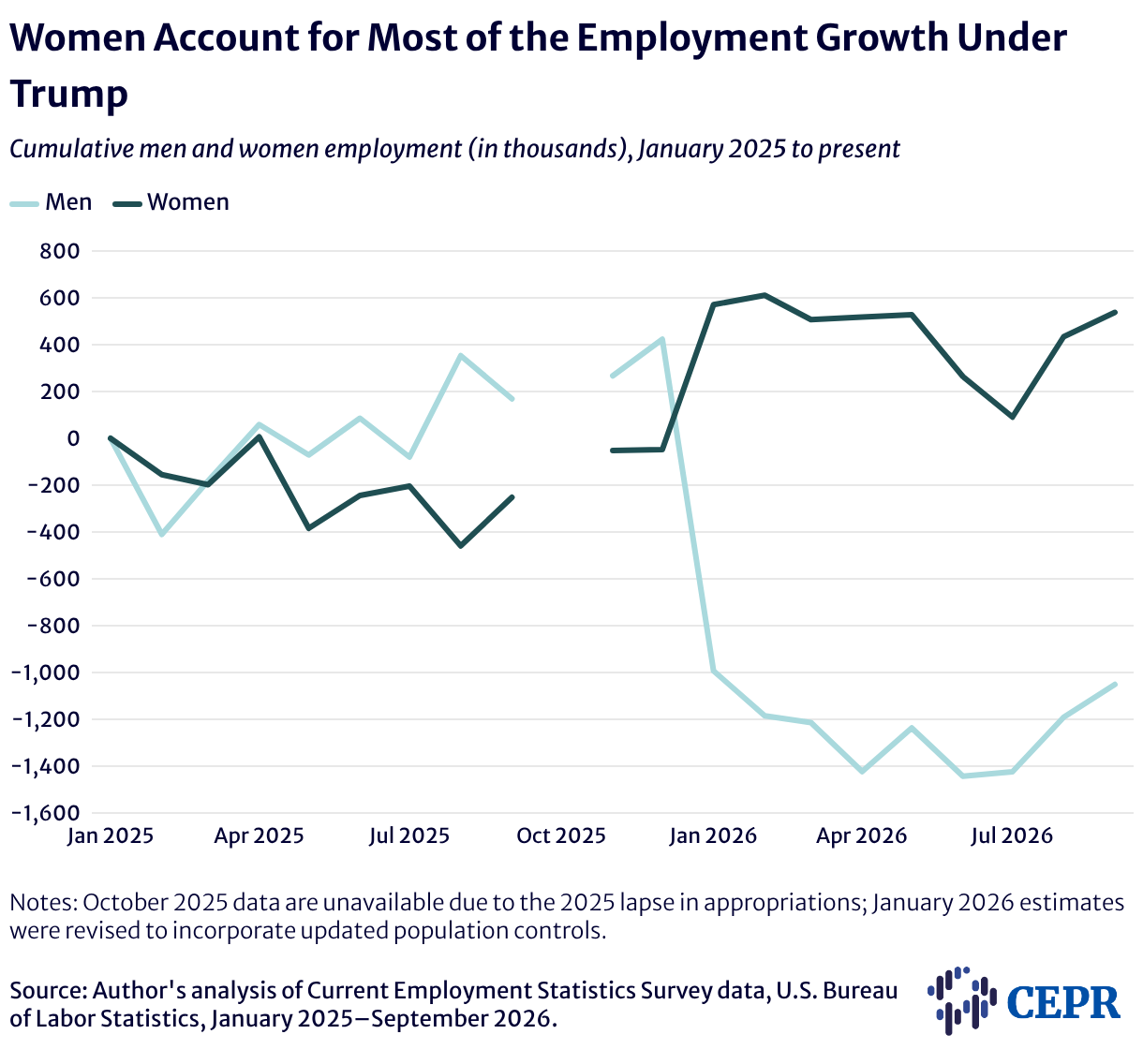
The unemployment rate edged up to 4.2 percent, but the labor force participation rate rose. The employment-to-population ratio (EPOP) for prime-age (ages 25-54) workers rose, reversing previous declines. Overall, the EPOP for prime-age workers is unchanged year-over-year at 82.7 percent. For men it is down 0.1 p.p. at 86.2 percent and for women up 0.2 p.p. at 75.3 percent.
Health Care and Social Assistance Again Lead Job Growth
The health care and social assistance sectors were again responsible for the bulk of the job gains in the month, adding 23,000 of the 29,000 new jobs in September. This continues the pattern we have seen in the last year, where these sectors accounted for more than 100 percent of all job growth, adding 520,400 jobs, compared to 496,000 overall.
Restaurants were also a major source of job gains, adding 10,800 jobs. This follows a large gain reported for August after reported drops in June and July, despite the World Cup. There could be some seasonal adjustment issues at play here; the gain over the 4 months since May is just 8,000.
Local governments lost 13,000 jobs after adding 54,000 in August. This is almost certainly a seasonal adjustment issue. September employment was down 8,000 from the May level.
Construction and Manufacturing Again Post Modest Gains
The construction sector added 11,000 jobs in September, slightly above its 9,000 average over the last year. The sector has average gains of 16,000 a month in 2023 and 2024. Manufacturing gained 9,000 jobs, its fourth consecutive month of modest growth. Over the last year employment is up by 40,000.
The mining sector, including oil, lost 2,000 jobs. The likely issue here is that companies don’t expect high oil and gas prices to be sustained and therefore are reluctant to make major new investments. Jobs in the oil industry, including support activities, are up just 1,900 over the last year. Jobs in coal mining fell to 37,900, down 1,400 from the year-ago level.
Evidence of AI-Driven Job Loss Is Limited
The insurance sector, which had lost 72,700 jobs from August 2025 to August 2026 (2.4 percent of employment) lost another 2,300 jobs in September. This is a plausible AI story, but not exactly a job loss disaster. Publishing industries 4,000 jobs in September and are down 32,600 over the last year (3.6 percent), but this is a combination of consolidation and AI. Motion pictures lost 200 jobs, bringing the total loss over the last year to 20,300, 5.8 percent of total employment.
Disadvantaged Groups Again See Rise in Unemployment
The improvement in the employment picture for prime-age workers was associated with a deterioration for more marginalized workers. The unemployment rate for Black workers rose from 6.0 percent to 7 percent, although their EPOP increased from 57.8 percent to 58.1 percent. The unemployment rate for Black women rose by 1.2 p.p. to 6.8 percent, although their EPOP rose by 0.5 p.p. to 57.7 percent. The unemployment rate for young workers, ages 20-24, rose from 7.1 percent to 8.0 percent. These data are erratic month to month. We will need some more months of data to be able to determine the extent to which these groups are seeing a weakening labor market.
Share of Unemployment Due to Quits Falls to 10.5 Percent
In a sign of labor market weakness, the share of unemployment due to voluntary quits fell to 10.5 percent, the lowest since May of last year. In a labor market with an unemployment rate near 4.0 percent, it would be expected that this number would be above 13.0 percent. This is consistent with the story of falling wage growth, since workers who change jobs typically get larger pay raises than workers staying at their jobs.
Employment Rate for Native-Born Workers Falls
Native-born workers are not seeing obvious benefits from the administration’s deportation policy. The EPOP for native-born workers is down 0.7 percentage points from a year ago, and a full percentage point from Sept 2024. By contrast, the EPOP for foreign born people is 0.4 p.p. higher than it was a year ago. It now stands at 63.9 percent compared to 58.3 percent for native-born people.
Self-Employment Trends Lower
The three-month average for unincorporated self-employed is down 1.6 percent year-over-year. The drop for incorporated self-employment is down 2.4 percent year-over-year. Self-employment had been rising rapidly in the pandemic recovery. The year-round average for unincorporated self-employment in 2024 was 4.0 percent above its pre-pandemic level in 2019, while for incorporated self-employed it was 10.3 percent higher. This trend seems to have stopped in the last two years.
Little Evidence of AI-Driven Productivity Boom
The index of aggregate hours increased at a 1.2 percent annual rate in the quarter. This is not a final measure of hours worked, but using it as a starting point, even a 3.0 percent pace of GDP growth would only translate into a 1.8 percent rate of productivity growth. That would be slightly above the recent trend, but hardly some sort of unprecedented boom. Things may change in the future, but to date we are not seeing any evidence of AI being a totally transformative technology.
Overall Picture: The Labor Market is Weaker than 4.2 Percent Unemployment Suggests
By historical standards, 4.2 percent is a low unemployment rate. But it is clear that workers don’t feel comfortable leaving their jobs to look for new ones. As a result, wage growth is stalling even as inflation is accelerating. Workers’ wages are no longer keeping pace with inflation; this follows two years (2023-2024) where real wages had been rising at more than a 1.0 percent annual rate. That is not a great story.



Comments
Log in or sign up to join the conversation.