


Having followed economic policy debate closely for four decades, I’ve learned that common sense often has no place. It is a standard practice for two completely opposite concerns to be raised, with the leading participants seemingly having no idea they are contradictory.
The best current example is that the view that AI is about to lead to astonishing breakthroughs in productivity, leading to unimagined wealth, while at the same time leading pundits fret about how the government debt is bankrupting the country. In some cases, such as Elon Musk, the same person makes both arguments very strongly, apparently unaware that they are contradictory positions.
Anyhow, one of my favorites in the category of silly ideas from supposedly smart people is that AI will take all the jobs. Bill Gates gave us this story in an interview with Ezra Klein a few days ago.
As I and others have pointed out, there is little evidence to date that AI has had any noticeable impact on employment outside of a few narrow sectors. The economists who have tried to do more careful sectoral analyses have found limited effects. At most, they project that we will see productivity gains comparable to what we saw in the tech boom of the 1990s, still less than what we had during the 1947-73 Golden Age.
But suppose Gates is right that we actually do so a massive surge in productivity much larger than these economists predict. This still does not imply massive job loss, even assuming no large-scale government spending, for the simple reason that we can shorten work weeks and work years.
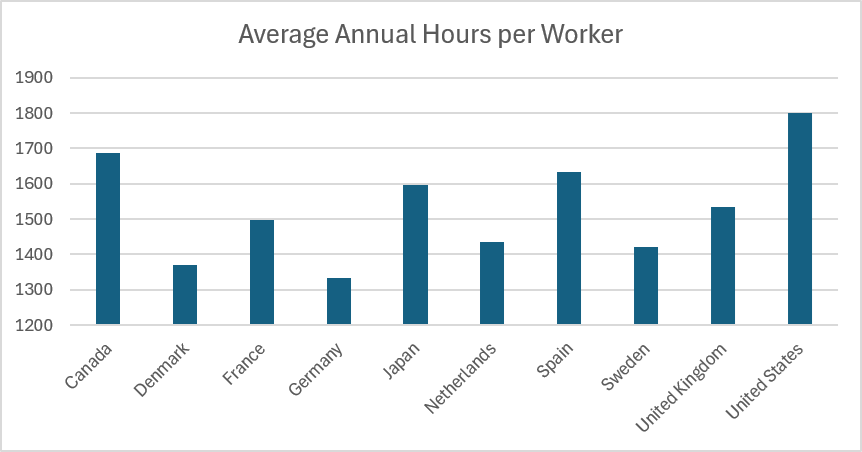
As it stands, workers on average put in far more time than their counterparts in other wealthy countries. While workers in the U.S. put in an average of 1800 hours a year, workers in Canada put in an average of 1690 hours, approximately 6% fewer hours. Workers in France work an average of 1500 hours, almost 17% fewer hours. And workers in Germany work an average of 1330 hours, 26% fewer hours. The shorter work years are due to a combination of shorter work weeks (overtime pay premiums kick in at 35 or 36 hours) and mandate paid leave for vacations, holidays, sick leave, and family leave.
Shorter work years mean the same amount of work can be spread among more workers. To take a simple example, 150 million workers putting 1800 hours of work on average comes to 270 billion hours of work.
Suppose that in the next decade AI miraculously increases productivity by a third, far more than almost any economist predicts. This means we could produce the same output in 180 billion hours. If the goal is to keep 150 million workers employed, then we can reduce the average work year to 1200 hours. That would be about 10% less than Germany’s current work year. If the average workweek fell to 30 hours, then everyone could have 12 weeks a year of paid vacation, implying 40 weeks of work.
This sort of stuff is not rocket science. We instituted the 40-hour workweek almost 90 years ago with the Fair Labor Standards Act in 1937. It would have been reasonable to shorten workweeks/work years further in the subsequent century, as other countries have done, but powerful business interests have blocked those efforts.
It may well be the case that the billionaires will keep buying politicians to prevent any shortening of work time, but we need to keep our eyes on the ball. Dealing with productivity gains from AI, no matter how large, is a simple problem. We don’t need complex solutions; we just need to get the billionaire-bought politicians out of the way.



Comments
Log in or sign up to join the conversation.