


Robinhood just hit another recovery high this week.
That's twice now in the last month I've mentioned this stock to you. So let me answer the question you might be asking.
Why do I keep coming back to this one?
It doesn't need a bullish market. It needs an active one.
Here's the thing most investors miss about Robinhood's business.
The company doesn't need stocks to go up to make money. It needs people to trade.
Every buy, every sell, every options contract, every crypto trade generates revenue for HOOD, regardless of which direction the market is headed.
A choppy, volatile, headline-driven market (like the one we've had this week) can be just as good for Robinhood's business as a steady bull run.
There's a real caveat, though. If the market grinds lower for too long, investors eventually get discouraged. They stop checking the app. They stop trading. That's the actual long-term risk to this story, not any single down day.
Which is exactly why the broadening market I've been writing about matters here too.
When money rotates into new sectors and themes (energy, financials, small caps, industrials) instead of sitting parked in the same seven mega-cap names, that means more stocks are moving, more stories are developing, and more reasons for investors to log in and trade.
A broadening market is more activity across a wider set of names. That's good for HOOD's core business.
The numbers are already telling this story
Back in early May, Wall Street analysts expected Robinhood to earn $3.27 per share in 2028.
Today, that estimate sits at $3.76 per share.
That's a meaningful upward revision, and it tells you something important. Robinhood is outperforming what analysts expected just two months ago. This isn't hype. It's real, measurable outperformance showing up in the numbers.
That matters because this type of revision tends to build its own momentum. When a company keeps beating expectations, analysts keep raising their targets, and Wall Street eventually re-rates the stock to reflect the new, higher bar.
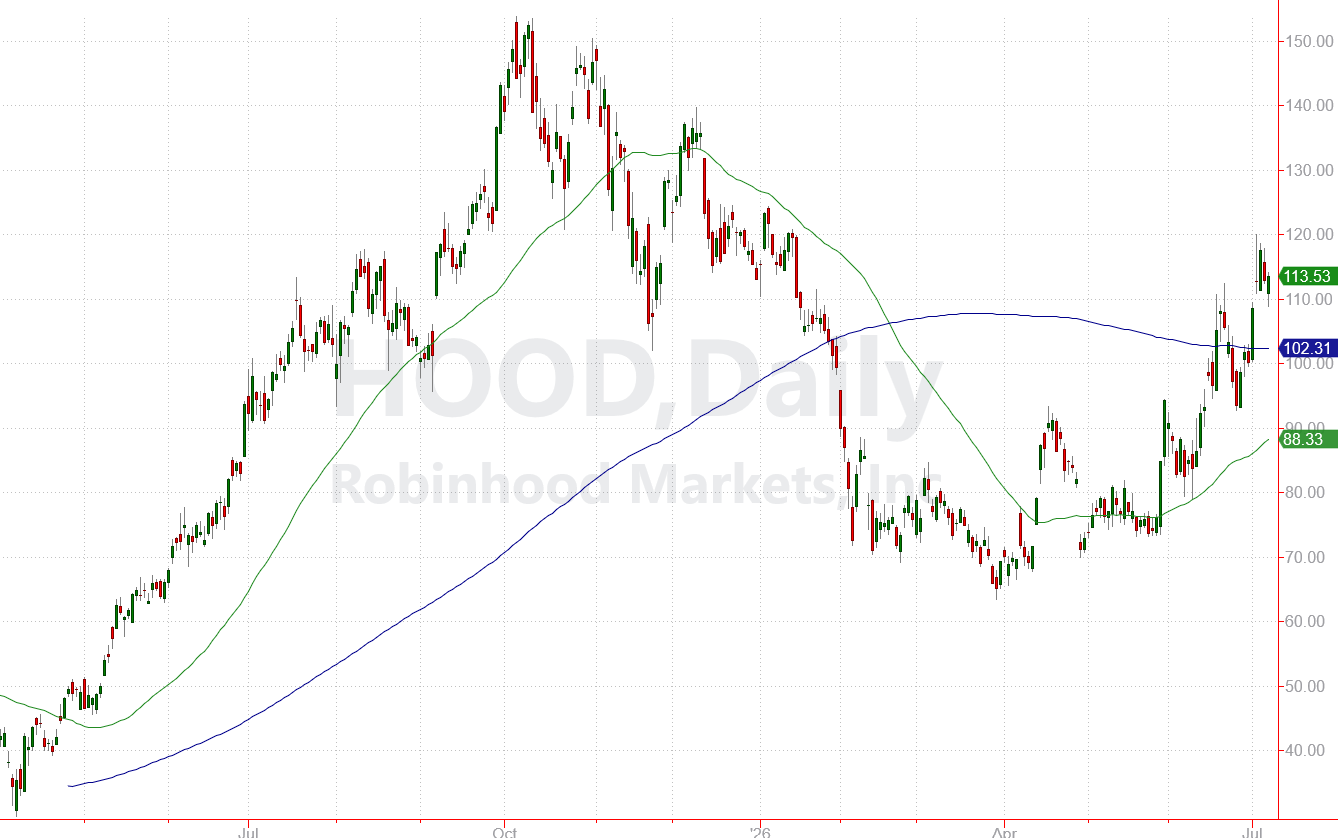
Estimates moving higher today often leads to a sustainable trend higher for the stock.
An unexpected tailwind
I mentioned this on Tuesday, but it's worth a quick reminder here.
Trump Accounts, the new government savings accounts for children, will be custodied at Robinhood.
That's a frictionless, government-delivered on-ramp bringing new families into the Robinhood ecosystem for the first time. One more log on the fire for this story.
Robinhood 2.0
Here's what I think most investors are still missing. Robinhood isn't the free stock trading app you remember anymore. It's rapidly becoming a full financial life platform.
A few of the moves that stood out to me:
AI is now trading (and spending) for you, if you want it to. Robinhood rolled out agentic trading, letting users connect AI models like ChatGPT or Claude directly to their brokerage and crypto accounts.
The AI can scan markets and execute trades within guardrails you set. There's also an agentic credit card for Gold members, where your AI can shop for the best price and make purchases on your behalf.
Robinhood is going global, and going on-chain. The company launched the public mainnet for Robinhood Chain, its own institutional-grade blockchain, and expanded into Canada and Singapore, with crypto trading rolling out in the UK.
Prediction markets are a genuinely new business line. Robinhood Derivatives now offers event contracts on pro and college football, letting users trade game outcomes and player performance in a real financial market structure.
That's an entirely new category of engagement (and revenue) built on top of the existing platform.
The wealth management buildout is real. Between the new Advisor Network (connecting users to independent fiduciary advisors), full net-worth aggregation across linked accounts, and full family finance features including kids' accounts with spending controls, Robinhood is positioning itself to hold a much bigger share of a customer's total financial life, not just their trading account.
Put it together, and you get a company adding new products and new revenue lines on top of an already-growing core business. That's exactly the kind of setup I like to find early.
Where I actually find these ideas
HOOD is a good example of something I track constantly on my Watch List: a company where the numbers are quietly improving before the broader market has fully caught on.
It's not the only one right now.
I'm also watching:
An infrastructure name riding the data center build-out.
A handful of technology companies growing profits as new technology rolls out across their industries.
Financial names benefitting from the same kind of activity story I just walked you through with HOOD.
Retail names catching a shift in consumer behavior.
And a few special situations, companies rapidly changing how they do business in ways the market hasn't fully priced in yet.


Comments
Log in or sign up to join the conversation.