

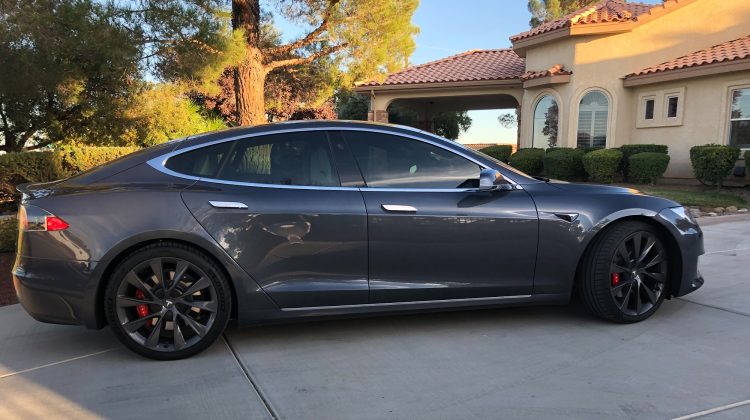
A few years ago, my friend Brian took me for a drive in his Tesla (TSLA) out in Las Vegas. Top-of-the-line model, the kind with the acceleration numbers that sound made up until you actually feel them.
We drove out to a stretch of deserted desert road, and Brian brought the car to a complete stop. “Hold on,” he said.
Then he floored it.
I felt my stomach get sucked into the seat behind me. The g-forces pulling me backward were unlike anything I’d felt in a car before. It was an incredible machine. I still think about that stretch of road.
Here’s the thing, though. Loving the car doesn’t mean I have to like the stock.
And that distinction matters a lot this week, because Tesla just reported earnings. And the gap between “incredible product” and “incredible investment” is exactly what’s on display.
What Actually Happened This Quarter
On the surface, Tesla had a genuinely strong quarter in a lot of ways.
Revenue came in at $28.24 billion, up 26% year-over-year, beating the roughly $27.6 billion analysts expected.
Deliveries hit a record 480,126 vehicles, up 25% year-over-year and well above the roughly 406,600 Wall Street had modeled.
But profitability told a very different story.
Adjusted earnings per share came in at $0.33, badly missing the $0.50-0.55 range analysts expected. GAAP EPS of $0.32 also fell short. Operating margin collapsed to just 1.4%, down from 4.1% a year ago.
Free cash flow turned negative, coming in at negative $1.09 billion.
To be fair, that was actually better than the roughly negative $3.25 billion some analysts had feared. So there was a silver lining buried in there. But it’s still Tesla’s first cash-burning quarter in over two years, a real reversal from the $146 million in free cash flow the company posted in the same quarter last year.
Capital expenditures jumped 142% to $5.79 billion, as Tesla poured money into AI infrastructure, Optimus humanoid robot production, and Cybercab manufacturing.
So here’s the full picture: record deliveries, record revenue, and a company that’s still burning cash and missing profit expectations by a wide margin. The stock fell after the report.
TSLA as a SpaceX Proxy
Part of what makes TSLA such an interesting (and volatile) stock to own is that a lot of investors don’t just treat it as an automaker.
They treat it as a proxy for the entire Musk empire, largely because of persistent speculation that Tesla and SpaceX could eventually be combined in some form.
That matters a great deal right now, because SpaceX has broken below its own IPO price and hasn’t shown real signs of a rebound.
If TSLA is carrying some of that same investor psychology, weakness in one name has a way of bleeding into the other.
This is a big part of why TSLA has never traded purely on its own automotive and energy fundamentals. It trades on a much bigger story about Musk’s entire portfolio of companies, and whether that portfolio is still capturing investor imagination the way it once did.
How Much Is the “Elon Premium” Actually Worth?
Here’s the real question underneath all of this: investors have been willing to pay a substantial premium (and I mean a lot more) to own a stock managed by Elon Musk.
Not just for what Tesla builds and sells today, but for the promise of what it might become. Optimus. Robotaxi. Full self-driving. The AI ambitions layered on top of the car company.
The premium itself isn’t really in question. It obviously exists.
The real question is how much patience investors have left when it comes to the gap between promises made and profits actually delivered.
And I want to be precise about what I mean by “delivery,” because it’s easy to get this confused.
I’m not talking about car deliveries. Those were record-setting this quarter.
I’m not even talking about robot delivery timelines.
I’m talking about the delivery of actual profit growth to shareholders. And that’s exactly where this quarter came up short.
As a trader, I watch charts closely, because they tell you where capital is actually flowing: into a stock, or out of it.
Right now, the chart on TSLA is telling a clear story: capital is flowing out.
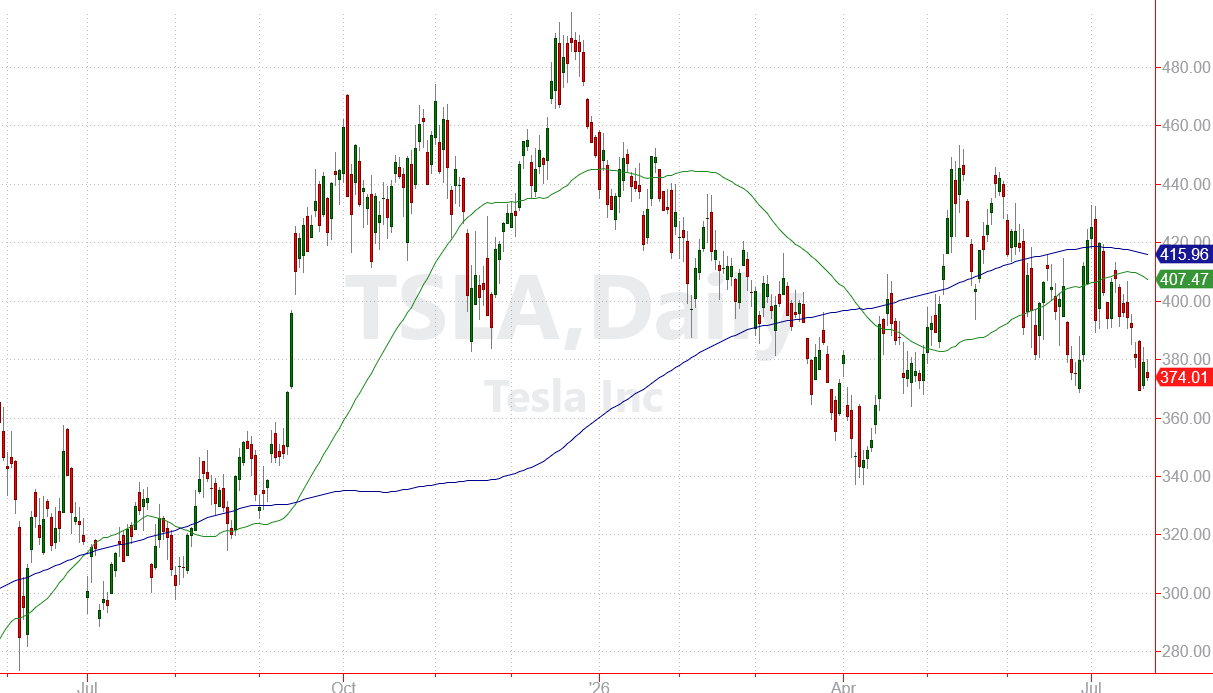
That’s a signal worth respecting regardless of how anyone feels about the company’s long-term vision, Brian’s Tesla included.
What TSLA Could Be Worth Without the Premium
Let’s do some simple math on what happens if that premium fades and TSLA eventually has to trade like a “normal” company (priced on realistic profit expectations rather than a founder’s story.)
A generous valuation (and I mean genuinely generous) would be 50 times Tesla’s projected 2028 profits. At that multiple, TSLA would be worth roughly $163.50 a share.
I want to be clear about what this is and isn’t.
This isn’t a prediction that TSLA is definitely headed to that level. It’s an illustration of just how much of the current share price is built on the premium itself, separate from the underlying business.
That’s the size of the gap if investor sentiment shifts meaningfully.
And to be clear, 50 times 2028 earnings is not a stingy multiple. Most companies in the market would love to trade at 50 times forward profits.
This is a generous assumption, not a worst-case scenario. Which should tell you something about how much optimism is currently baked into the stock.
My Position, and Where TSLA Fits on My Watch List
Full Disclosure: I currently hold a bearish position in TSLA. I own in-the-money put contracts that will benefit if the stock continues breaking down from here.
TSLA is just one name among many on my Watch List right now. I track 20 bearish names, 20 bullish names, and 20 income-focused names: 60 stocks total, updated monthly and sometimes more often when conditions call for it.

Comments
Log in or sign up to join the conversation.