


I’ve traded through enough bull markets and seen enough euphoric story narratives to recognize hyperbolic froth when I see it.
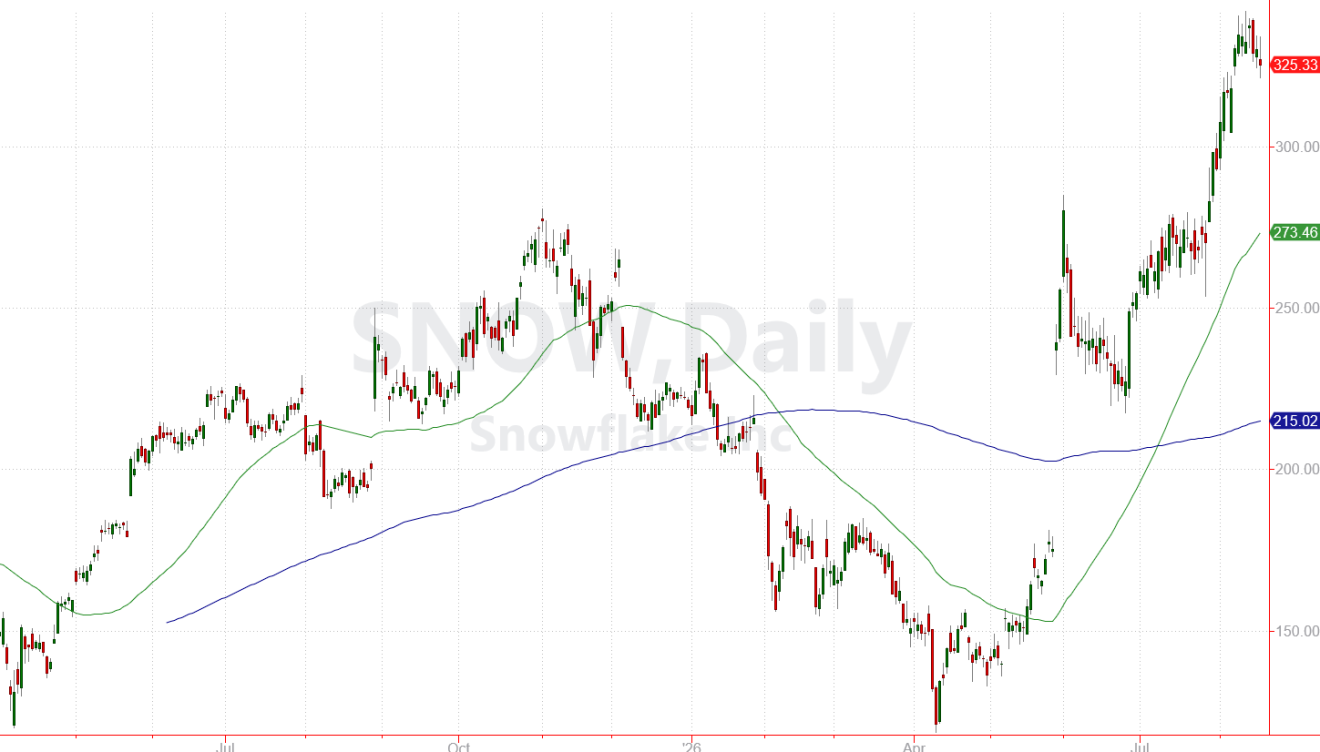
Today, I’m watching a dangerous situation develop for Snowflake (SNOW). It’s worth walking through exactly what is happening because this is a pattern you’ll see again and again if you stay in this business long enough.
Wall Street’s Euphoric Expectations
UBS just raised its price target on Snowflake to $425, up from $370.
And UBS isn’t the only one… Over the past few weeks, one analyst after another has been racing to hike their targets higher, each one seemingly trying to outdo the last.
On its own, a single price target increase doesn’t mean much. Analysts adjust their numbers constantly as new information comes in.
But when a group of Wall Street lemmings starts chasing a stock higher in quick succession, that’s usually a reflection of momentum feeding on itself.
That’s the first thing that caught my attention here.
What Snowflake Actually Does
So what does Snowflake actually sell, and why is Wall Street this excited about it?
At its core, Snowflake takes a company’s data, which is usually scattered across a dozen different systems (CRM software, ERP and finance tools, internal apps, website logs) and pulls all of it into a single cloud platform.
This allows the data to be used more effectively.
Here’s one of the advantages that has Wall Street analysts excited: Instead of charging a flat licensing fee, Snowflake bills customers based on how much they actually use the platform.
That consumption-based model is exciting for investors. SNOW is being pitched as one of the few software businesses that holds up no matter how AI agents end up changing the way companies buy and use software.
If usage keeps climbing, so does the bill, no matter who or what is doing the querying.
If you want to see how the company frames this story in its own words, Snowflake’s own Data Cloud page lays it out well. It’s worth a look if you want to understand the bull case before I walk through why I think the price has gotten ahead of it.
The Math That Makes This Froth
Here’s where the story runs into a problem.
Snowflake trades near $323 per share right now.
Analysts expect the company to earn $2.71 per share in fiscal 2028 (next year).
Do the math and you get a stock trading at 119 times next year’s expected profits. That’s already a steep price to pay for a single year of earnings.
Push the timeline out further and it doesn’t get much more comfortable.
Fiscal 2029 estimates sit at $3.72 per share. (Fiscal 2029 will end more than 2 years from today).
That works out to roughly 87 times earnings that don’t exist yet, based entirely on a projection.
Said plainly: Investors are paying $87 today for one single dollar of profit that Snowflake might earn more than two years from now.
Keep in mind, estimates get revised all the time, sometimes higher, but just as often lower when growth slows or competition eats into margins.
And this is all happening while the stock carries a market capitalization north of $100 billion.
There’s very little room in a valuation like that for anything to go wrong.
Why the Premium Is Fragile, Not Just Expensive
A valuation priced like this assumes Snowflake owns an unshakeable moat, the kind of dominant position that lets a company set the terms for its entire market.
I don’t think that moat is nearly as secure as the price action suggests.
Databricks is Snowflake’s closest architectural rival, and it’s solving exact same corporate problem from a different direction.
Where Snowflake built its business as a data warehouse and has been layering AI capabilities on top, Databricks started as an AI and machine learning platform and has been building warehouse-style capabilities on top.
The two companies are converging on the same customers from opposite starting points, and Databricks isn’t standing still while it happens.
Microsoft (MSFT) Fabric adds another layer of pressure, especially for smaller and mid-sized accounts. It’s bundled directly into Office 365, which means a huge number of companies already have access to it as part of software they’re paying for anyway.
That’s a hard thing to compete against on price.
And behind all of that, Amazon (AMZN)’s Redshift and Google (GOOGL)’s BigQuery are both still in the fight too, backed by two of the largest cloud infrastructure companies on the planet.
This is a genuinely crowded field, with several well-funded, capable competitors all fighting for the same customers.
Today’s Snowflake investors are paying a price that assumes total, uncontested dominance. This premium price doesn’t leave much room for any of that competition to actually show up in the numbers.
Why I’m Not Buying Puts Yet
So am I buying puts on Snowflake today? Not yet, and here’s why.
Decades of trading have taught me one lesson over and over: Don’t stand in front of a stock that’s making a parabolic move higher. No matter how overpriced you’re convinced it is.
The market has a way of staying irrational for much longer than a short position can stay comfortable. And plenty of good traders have gotten run over trying to fight a trend before it was ready to turn.
One of my old mentors used to say “Don’t be a hero… they carry heroes out on their shields.”
Experience has also taught me to stay ready.
Stocks that run this hot, on froth and momentum rather than underlying fundamentals, tend to fall a long way once sentiment finally cracks.
The bigger and faster the move up, the sharper the move down usually is once buyers stop showing up.
I wrote about exactly this pattern a couple weeks ago, when a leveraged AI-focused hedge fund with more than $45 billion under management got forced out of its positions almost overnight.
Leverage and euphoria have a way of unwinding together, and they rarely do it slowly.
What I’m Actually Watching For
Here’s are three specific situations that would get me involved.
1: A break of the current trend.
I’m keeping an eye on the 50-day moving average here. As long as Snowflake holds above it, the uptrend is still technically intact.
A clean, decisive break below that average would be a sign that buyers are starting to lose control.
2: A gap higher that closes significantly lower.
This is one of the clearest signs of buyer exhaustion. It usually shows up when the last wave of enthusiasm arrives all at once, pushes the stock to a fresh high right at the open… and then just as quickly gets sold into, leaving the stock to close well off its high for the day.
3: A double top.
If Snowflake rallies, pulls back, and then fails to push meaningfully past its prior high on the next attempt, that tells you something important.
It tells you the market has effectively drawn a line and decided that’s about as much as it’s willing to pay for this stock right now.
If I see any one of those setups develop, I’ll be ready to move.



Comments
Log in or sign up to join the conversation.