


Right now, investors are running away from anything with an "AI" label on it.
The worry isn't new. It's the same one I've been writing about for weeks. Companies are spending hundreds of billions of dollars building out AI infrastructure, and a growing number of investors are asking when (or if) that spending actually turns into profit.
Every time the answer looks a little further away, the sell button gets pushed a little harder.
That's exactly what happened to semiconductor stocks this week. And it's exactly why Applied Materials (AMAT), one of the names on my Watch List, is having one of its ugliest weeks of the year.
But when I actually dig into why AMAT is getting sold, I don't see a broken company. I see a case of guilt by association, and possibly an opportunity.
The Damage
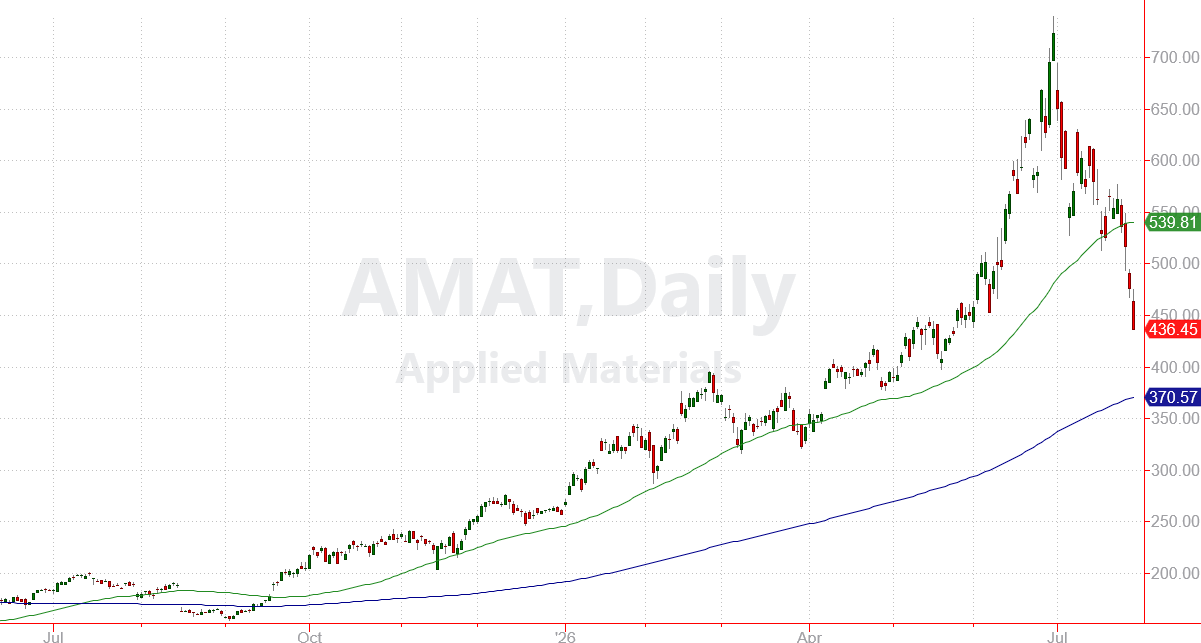
Applied Materials closed Wednesday down 8.4% on the day. That brings its five day loss to a brutal 21.2%, and its one month decline to 37.2%.
For context on how sharp that reversal is: AMAT is still up nearly 70% year to date. This stock ran hard, peaked in late June, and has been giving a big chunk of that gain back ever since.
Here's the part that matters most. AMAT didn't do this to itself. This was a sector-wide flush. Micron (MU) fell nearly 10% the same day. Taiwan Semiconductor (TSM) dropped 4.5%. Broadcom (AVGO) lost almost 3%. Even Nvidia (NVDA), the biggest name in the group, slid over 3.5%.
When an entire sector sells off together like that, it's rarely about any one company's fundamentals. It's about sentiment. And sentiment can turn a lot faster than a business can actually change.
The Piece of News That Matters This Morning
Part of what's driving the action this morning traces back to Microsoft (MSFT)'s earnings report last night.
Microsoft beat expectations across the board. Revenue came in at $90.01 billion against estimates of $87.62 billion.
But the number that caught my eye was Azure, Microsoft's cloud business. Azure revenue grew 31.6% year over year, and growth actually accelerated to 43% on a constant currency basis, up from 40% the quarter before. For the full fiscal year, Azure revenue crossed $100 billion for the first time.
That's not a company pulling back on AI spending. That's a company whose AI infrastructure bet is paying off in real time, in the numbers, right now.
Why AMAT Is a Beneficiary, Not a Bystander
Here's the connection most investors are missing in the panic.
Hyperscalers like Microsoft don't build AI infrastructure themselves from raw materials. They buy chips.
And the companies that make those chips don't build their factories out of thin air either. They buy the equipment that does it, the etching, deposition, and materials engineering tools that turn a silicon wafer into a working chip.
That's Applied Materials. It sits downstream of the entire AI buildout, not tied to the fate of any single hyperscaler or any single chipmaker. When Microsoft spends more on Azure capacity, some of that money eventually flows toward the equipment AMAT sells. Same with every other company racing to build AI infrastructure.
The sell-off treated AMAT like it's just another expensive AI stock riding hype.
I think that's the wrong read. This is a picks-and-shovels business sitting in the middle of hundreds of billions of dollars in committed spending.
What I'm Watching Now
In the hour after Microsoft's earnings hit the wire, AMAT shares moved from their brutal Wednesday close up more than 2% in after hours trading, back above $445.
That's a small move in the grand scheme of a stock that's down 37% in a month. But it's a meaningful one.
It tells me at least some investors are starting to look past the "AI spending is scary" headline and ask the follow up question: who actually gets paid when that spending happens? That's the read-through that can turn a sell-off into a buying opportunity for the names left standing.
To be clear, I don't own AMAT yet. This is a candidate, not a position.
I'm watching two levels closely: the 200-day moving average, sitting near $370, and the breakout point from AMAT's April and May base, up around $400.
If the stock finds its footing somewhere in that zone and starts showing signs of stabilizing, that's when I'll start looking seriously at an entry.
Until then, I'm watching and waiting. Chasing a falling knife is how good ideas turn into bad trades.
More Names Like This One
AMAT isn't the only stock caught up in this kind of mispricing right now. My Watch List is built specifically to catch situations like this, good businesses getting dragged down by sector-wide fear, or crowded, expensive names finally cracking under their own weight.
Both sides of that story create opportunity if you know where to look.
Right now there are several other names on my list showing setups just like this one, primed to move once the dust settles.


Comments
Log in or sign up to join the conversation.