


I spent a good chunk of the weekend clearing off my desk, going through my Watch List name by name, and getting organized for what's shaping up to be one of the busier weeks of the year.
This morning I'm sitting down with a clean desk, a fresh cup of coffee, and a calendar that's about to get loud.
We've got a Fed decision landing in the middle of a jam-packed earnings week. That combination doesn't come around often, and it's worth walking through in detail. Let's get into it.
The Week's Biggest Earnings Reports
Earnings season has been strong so far. 88% of S&P 500 companies that have reported this quarter have beaten EPS estimates.
But here's the twist: the market hasn't been rewarding that good news the way you'd expect. Stocks are getting sold even after strong results. That tension is going to be on full display this week.
Here's what I'm watching, day by day.
Tuesday after the close: Ford (F)
Ford pulled back sharply in June and July after a run tied to excitement around its grid-scale battery technology.
Shares have since found their footing at a key support level, which is exactly the kind of setup I like for a put-selling income play.
Analysts expect Ford to earn $1.64 per share this year and grow that to $1.84 next year, with the stock trading near 8 times forward earnings. Add in a roughly 4% dividend yield, and there's a solid income cushion even before you factor in options premium.
Wednesday before the open: Vertiv (VRT)
Vertiv makes critical power and cooling infrastructure for data centers, putting it right in the middle of the AI buildout story.
Shares surged as hyperscalers announced massive capex plans, then pulled back this summer along with the rest of the AI trade. Vertiv looks like it's finding support just below $300.
Analysts expect the company to earn $6.48 per share this year and grow to $8.83 next year. That's a name I'm watching closely heading into Wednesday morning.
Wednesday afternoon: the Fed, then Meta (META) and Robinhood (HOOD)
This is the big one. The Fed announces its rate decision Wednesday afternoon, and this time there's real uncertainty attached to it.
Under Jerome Powell, the market rarely got surprised. He telegraphed his intentions well in advance.
Kevin Warsh has made clear he won't play that game. Odds of a hike currently sit at 35.8%, an unusually wide range of uncertainty this close to a meeting.
Then, after the closing bell, Meta reports.
Historically, Meta has beaten EPS estimates on 93% of its Q2 reports and has gained at least 4% on its earnings reaction day in each of the last three years, including an 11.3% pop last July. That's a name that tends to move, and move hard.
Robinhood also reports Wednesday afternoon. Shares have been trending higher since finding support this spring, helped along by the company's new partnership tied to Trump Accounts, which should open the door to a wave of new customers.
Analysts expect Robinhood to earn $2.30 per share this year, growing to $3.08 next year. The stock is finding support and I like it as a longer-term bullish story.
Thursday after the close: Amazon (AMZN)
Amazon's Q2 history is a mixed bag. The company has only beaten EPS estimates in 58% of its Q2 reports over the last 25 years, though it's beaten sales estimates 71% of the time.
Here's the part that catches my attention: in each of the last two years, Amazon reported a strong quarter, including a full earnings triple play last year, and the stock still sold off hard both times, falling more than 8% in reaction.
That's the same "good news gets sold" pattern we're seeing across the market right now, and Amazon may be the clearest example of it this week.
Friday before the open: Exxon Mobil (XOM) and AbbVie (ABBV)
Exxon closes out the week. Analysts expect earnings to roughly double or more from a year ago, landing somewhere in the mid-$3 per share range, driven by higher crude prices and wider refining margins.
Energy remains the top-performing sector of the year, and Exxon is about as pure a way to play that as it gets.
AbbVie also reports Friday morning. Shares broke out to new all-time highs this summer after the company announced a deal to acquire Apogee Therapeutics, refreshing its drug pipeline.
Analysts expect AbbVie to earn $14.12 per share this year, growing to $16.27 next year, with the stock trading near 16 times next year's expected profits.
That's a lot of earnings for one week, and it's just the highlights. I'll be tracking all of these closely, along with plenty of other names on my Watch List.
The Technicals: A Market Rolling Over, Unevenly
Away from earnings, the charts are telling an interesting story.
The Nasdaq 100 (QQQ) got extended to the upside this spring and is now rolling over. As of Friday's close, QQQ sits 3.7% below its 50-day moving average and is technically oversold.
That's the kind of setup that spooks investors into taking profits, especially in the priciest, most crowded names.
But the S&P 500 isn't quite as heavy in tech, and it's holding up much better, sitting less than 1% below its own 50-day.
The equal-weight S&P (RSP), which strips out the mega-cap weighting entirely, actually gained ground during the same stretch that QQQ was falling apart.
And small caps (IWM) are sitting right on their 50-day moving average, a healthy, constructive spot.
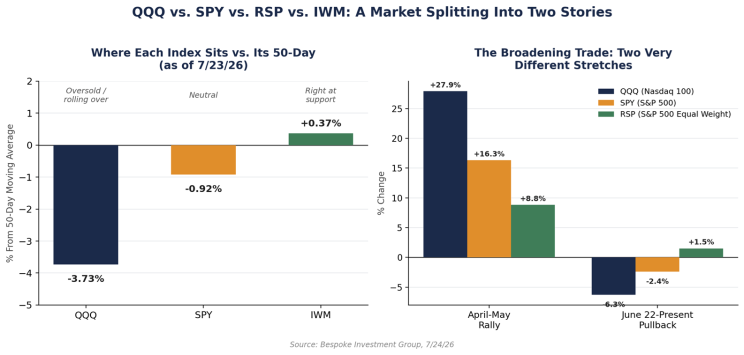
That's the broadening story I keep coming back to, and it's genuinely good news. This rally isn't just seven stocks anymore.
My playbook when I see this kind of divergence isn't to go all-in or all-out. It's to stay balanced.
Hold some cash. Hedge where it makes sense. And my favorite move: buy put contracts on the extended, expensive names that are already showing cracks. That's a more targeted way to protect gains than trying to time an entire index.
The Macro Backdrop: Iran Hasn't Left the Building
Don't lose sight of what's happening halfway around the world. Iran headlines are hitting the wires nearly every day now, sometimes more than once a day.
That matters because it flows straight through to energy prices, which flows into inflation data, which the Fed has to weigh in a decision that's already up in the air.
Oil, interest rates, and the dollar have all been drifting higher together over the past few weeks. That's a headwind for stocks, and it's a big reason this Fed meeting carries more risk than usual.
Comments
Log in or sign up to join the conversation.