

Summary
Something curious happened in the Treasury market today. With no economic data to drive it, the 10-year yield climbed 6.4 basis points to 4.51% and the 2-year rose 5 basis points to 4.23%, even as WTI crude oil dropped over $2 a barrel to $74.59. Falling oil is typically disinflationary, which should put downward pressure on yields. Instead, yields went the other way. The bond market is trying to tell us something, and it's worth listening to.
The Treasury Bond Market Is Talking. Are You Listening?
The 10-year yield is at 4.509%. The 2-year is at 4.23%. There was no major economic data today to explain the move. That’s not a coincidence — it’s the point.
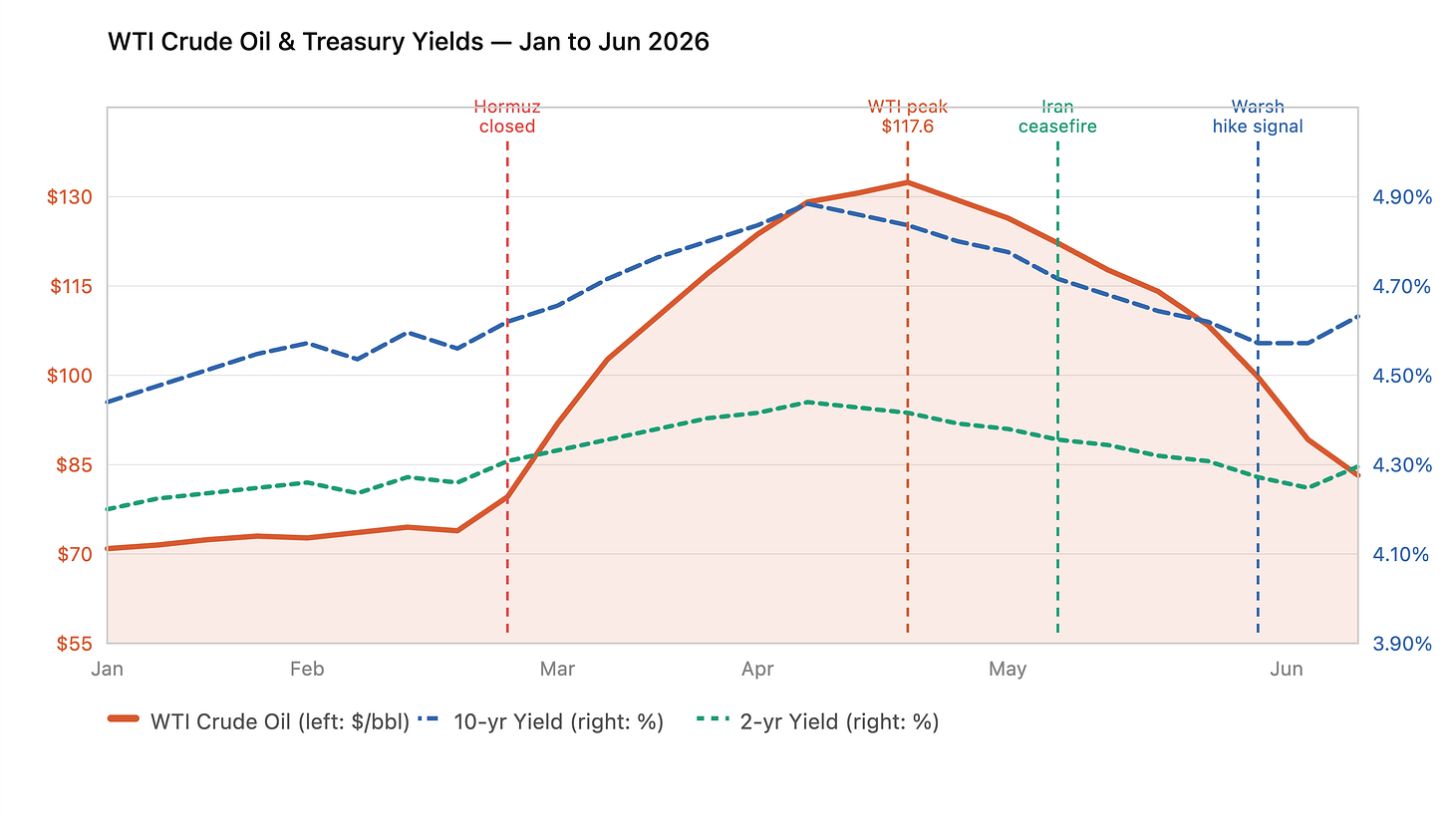
WTI crude oil moved above $110/barrel during April 2026 as the Iran war heated up and the Strait of Hormuz closed down, and has traded lower since that point to today’s price of $74.59. Treasury bond yields moved higher initially, and with the reversal in crude, have moved lower.
That’s why today’s upward Treasury yield action in the absence of any economic data, coupled with the fairly significant move lower in crude oil prices, strikes us as curious.
The Smart Money
If you want to know what the markets are thinking about inflation, government debt, and the U.S. economy, you should ignore the political rhetoric, the pundits, and the stock market.
Instead, watch the Treasury market where the proverbial ‘smart money’ lives and trades.
The bond market doesn’t have a PR department. It doesn’t hold press conferences, doesn’t spin, and doesn’t care about anyone’s feelings. It prices risk in the trillions of dollars every day.
And if you know how to read what it’s saying, you’ll understand more about where this economy is headed than you’ll get from almost any other source.
The Numbers
As of this writing, the 10-year Treasury yield sits at 4.509%, and the 2-year Treasury yield is at 4.23%. The 10-year is up 6 basis points today, and the 2-year moved up 5 basis points.
This has occurred with no major economic data released today, no jobs report, no inflation reading, and no Fed statement.
The yields moved higher anyway despite the counter-inflationary drop in crude oil.
When this happens, it can signal one of two things. Either professional traders are repositioning ahead of something they expect to be coming, or the anxiety that’s been building in the background is simply resurfacing.
Today, I think it’s both.
The Spread: What 28 Basis Points Is Telling You
The difference between the 10-year and the 2-year yield right now is roughly 28 basis points, which means the 10-year pays about a quarter of a percentage point more than the 2-year.
For context, the historical average spread between the 10-year and 2-year Treasury is about 80 basis points. We’re at 28. So while we have a positive-trending yield curve, we’re still historically flat.
What does a flat-but-positive curve mean?
The bond market is saying we’re muddling through. Not recession, not expansion, just kind of stuck.
And being “stuck” with a Fed that may be leaning toward raising rates, not cutting them, is a very different kind of stuck than what most people were hoping for at this point in 2026.
Why a Move Without a Catalyst Is Actually More Meaningful
I want to come back to the point I made at the start, because I think it’s the most important one.
Today’s yield increases happened without a specific news event.
When yields rise on a strong jobs report or a hot inflation print, the market is reacting to new information. That’s normal. When yields rise on a quiet Monday with no data, something else is happening. The background anxiety, the inflation that won’t go away, the deficit that keeps growing, the Fed that’s leaning toward hiking, are all combining to create a nervous bond market.
What This Means for Real Estate and Mortgages
If you’ve been following this Substack for any length of time, you know I try and tie everything back to the real world, and for most of our readers, the most immediate real-world impact of Treasury yields is on mortgage rates.
Here’s the math: 30-year fixed mortgage rates are typically priced at roughly 170 to 200 basis points above the 10-year Treasury yield. With the 10-year at 4.509%, that puts conventional mortgage rates in the 6.2% to 6.5% range right now.
Every 10 basis points the 10-year moves higher adds approximately $60 to $70 per month to the cost of a $1 million mortgage. That’s not trivial. And for the first-time buyers we’ve been writing about, who are already stretched thin on monthly carrying costs, every basis point is another obstacle between them and a purchase contract.
If the 10-year breaks convincingly above 4.50% this week, mortgage rates will follow. And the already-constrained buyer pool for high-priced homes gets constrained further still.
The Three-Part Message, in Plain English
Let me distill everything above into the simplest possible terms.
What the Treasury market is saying about inflation: “It isn’t going away. The Fed knows it. And the next move is more likely up than down.”
What the Treasury market is saying about government debt: “Washington is spending money it doesn’t have, and we want to be paid more every day to finance it. The bigger the deficit, the higher the price.”
What the Treasury market is saying about the economy: “We’re not in recession. But we’re not in good shape either. The easy money era is over, the Fed isn’t riding to the rescue, and anyone waiting for rate cuts to bail them out is going to be waiting a long time.”
The bond market is the most honest scorekeeper in finance. It doesn’t care about the narrative. It cares about risk and return.
Right now, it’s telling you that risk is elevated, return requirements are rising, and the conditions that would allow the Fed to ease are currently nowhere in sight.
That’s the message. The only question is who is listening.

Comments
Log in or sign up to join the conversation.