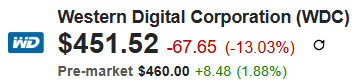
The basic setup for artificial intelligence hardware looked simple. If a company sold the foundational infrastructure for data centers, the market rewarded it with a premium valuation. Western Digital just tested that model and failed. The storage giant reported exceptional earnings, massive free cash flow, and strong guidance. In a normal environment, the stock would likely surge. Instead, shares plummeted roughly 13% in regular trading on Thursday. The reaction suggests the market is no longer satisfied with strong execution. The core debate is now whether these record margins represent a permanent baseline or a cyclical peak.
|
The Penalty for Perfection in Storage Hardware |
|
 |
Verdict: The underlying business fundamentals for enterprise storage remain robust, but the equities have suffered severe multiple compression. This price action represents an aggressive reset of market expectations that had lost touch with historical industry cycles.
|
Western Digital reported fiscal fourth quarter revenue of $3.75 billion. That marks a 44% increase year over year and beats consensus estimates. Non GAAP earnings per share reached $3.56. The company demonstrated operating leverage by expanding its non GAAP gross margin by 1,310 basis points to reach 54.4%.
|
Despite these settled figures and strong guidance for the current quarter, shares plummeted roughly 13% on Thursday on heavy trading volume. The selloff was not localized. It dragged down the broader memory and storage group. |
|
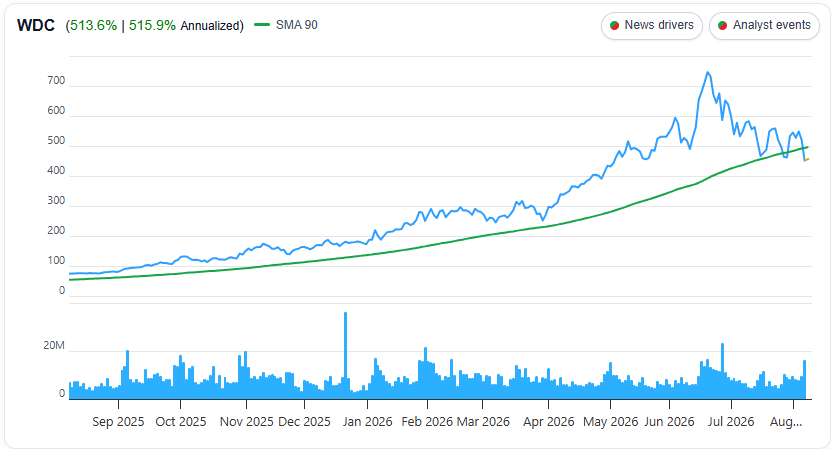 |
Western Digital (WDC) 1 Year Chart
|
The central puzzle dividing the market is whether the current infrastructure buildout is a durable trend or a front loaded cyclical boom. Cloud revenue accounted for 89% of total sales in the fourth quarter, leaving Western Digital heavily exposed to hyperscaler storage demand. That concentration is a real risk if cloud customers eventually slow their deployments. But the other side of the story matters too. Management said customers are already discussing long term agreements covering 2029, 2030, and 2031. That does not eliminate cycle risk, but it gives Western Digital more demand visibility than a simple quarter to quarter capital spending story would suggest.
|
What changed in the thesis
|
The shift in expectations occurred because beating estimates is no longer sufficient when a stock is priced for perfection. Western Digital shares had gained roughly 200% in 2026 before the report, so investors were looking for another large upside surprise. The quarter was strong, but exabyte shipments increased 22% year over year, below management's longer term 25% plus growth trajectory, while Seagate (STX) had recently posted a stronger near term margin outlook. The selloff looks less like a sudden collapse in demand and more like a reset in what investors are willing to pay for very strong growth that was already expected.
|
What the market may be missing
|
The aggressive selling implies an immediate collapse in demand, but the underlying cash flow mechanics tell a different story. Western Digital generated $1.28 billion in free cash flow during the fourth quarter alone. The company used this capital to reduce share count and repair its balance sheet. Management repurchased $1 billion in stock and ended the fiscal year with a net cash position of roughly $500 million. By focusing strictly on top line growth, sellers might be ignoring that Western Digital is operating as a highly disciplined manufacturer generating massive returns.
|
Valuation and expectations
|
The stock just went through a classic multiple compression event. Despite earnings jumping year over year, the share price fell because the forward multiple had expanded to assume perpetual growth. The repricing creates a potentially more attractive entry point, but only if the underlying earnings estimates hold up against downward revisions in the coming months. |
|
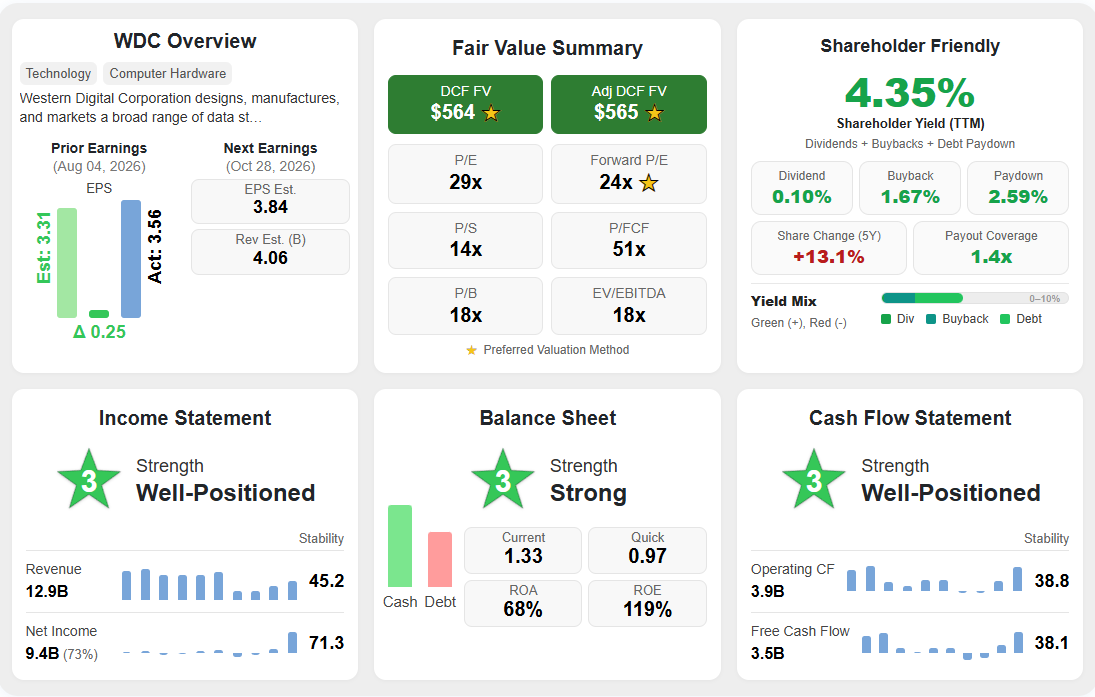 |
Western Digital (WDC) Summary Scores
|
The historical storage cycle remains one of the largest risks to the stock, but Western Digital is no longer a semiconductor company. It is now focused on hard drives, and the real question is whether hyperscaler storage demand, pricing, and exabyte growth stay strong enough to support today's margins. If cloud customers slow deployments or pricing power fades, earnings could reset quickly. But with customers discussing long term agreements extending through 2031, the market is not simply pricing an immediate collapse in demand. It is demanding proof that today's HDD economics can last.
|
Markets are focused on the July US employment report due at 8:30 AM ET, with the Reuters consensus expecting roughly 80,000 jobs added and unemployment holding at 4.2% Shares of Western Digital are posting a modest pre market bounce of roughly 2% following Thursday's sharp selloff, alongside mild recoveries across technology and storage stocks
Why it matters this morning
|
Broad index futures are trading carefully as traders wait to see whether the jobs report strengthens or weakens the case for a Federal Reserve rate hike in September. Within storage, the early bounce in Western Digital suggests some opportunistic buying after yesterday's aggressive valuation reset, but the jobs report is likely to dictate the broader market direction this morning.
|
Fiscal 2026 revenue increased 175% year over year to $20.25 billion. First quarter revenue guidance of $10.3 billion to $10.8 billion was strong, but it was not enough to satisfy elevated market expectations. Shares fell sharply early Thursday before recovering to close down roughly 6.8%.
|
Micron closed down roughly 1.3% Thursday after falling more than 7% earlier in the session. Its most recent reported quarter was fiscal third quarter, which ended May 28, with $41.46 billion in revenue and a record non GAAP gross margin of 84.9%. The recovery matters because Micron did not finish the day in the same type of collapse as Western Digital.
|
The direct hard drive competitor fell sharply early Thursday but reversed and finished the session up roughly 1.8%. Seagate's fiscal fourth quarter revenue increased roughly 48% year over year to $3.63 billion and the company generated $1.1 billion in free cash flow. That makes Seagate a useful contrast with Western Digital rather than evidence of a synchronized sector selloff.
|
The first move across Western Digital, SanDisk, Micron, and Seagate was indiscriminate. The close was not. Western Digital and SanDisk stayed sharply lower, Micron recovered most of its losses, and Seagate actually finished higher. That is a more useful signal for long term investors. The market sold the storage and memory theme first, then started separating the companies based on their own guidance, growth, and expectations.
|
First quarter non GAAP gross margin trajectory, with management guiding for a range of 55% to 56% Sequential exabyte shipment growth to see if hyperscalers are digesting existing inventory rather than expanding Capital expenditure forecasts from the major cloud service providers over the next three months
If top tier technology firms meaningfully reduce their infrastructure budgets, the assumption of durable storage demand would weaken. The more important test is whether Western Digital can keep exabyte growth, pricing, and margins moving in the right direction together. One quarterly miss would not prove the thesis is broken, but a sustained margin shortfall alongside weaker demand or pricing would be much harder to dismiss. |
|





Comments
Log in or sign up to join the conversation.