

It’s time for a midweek update, and there’s good news for precious metals investors after metals and miners bounced today on further signs that the U.S. labor market continues to weaken. Two of the three jobs reports this week came in weaker than expected, helping to partly offset the decline in metals that began on Friday following the more hawkish-than-expected annual Fed meeting in Jackson Hole and the resurgence in energy prices due to escalating tensions and the resumption of kinetic action in the U.S.-Iran war.
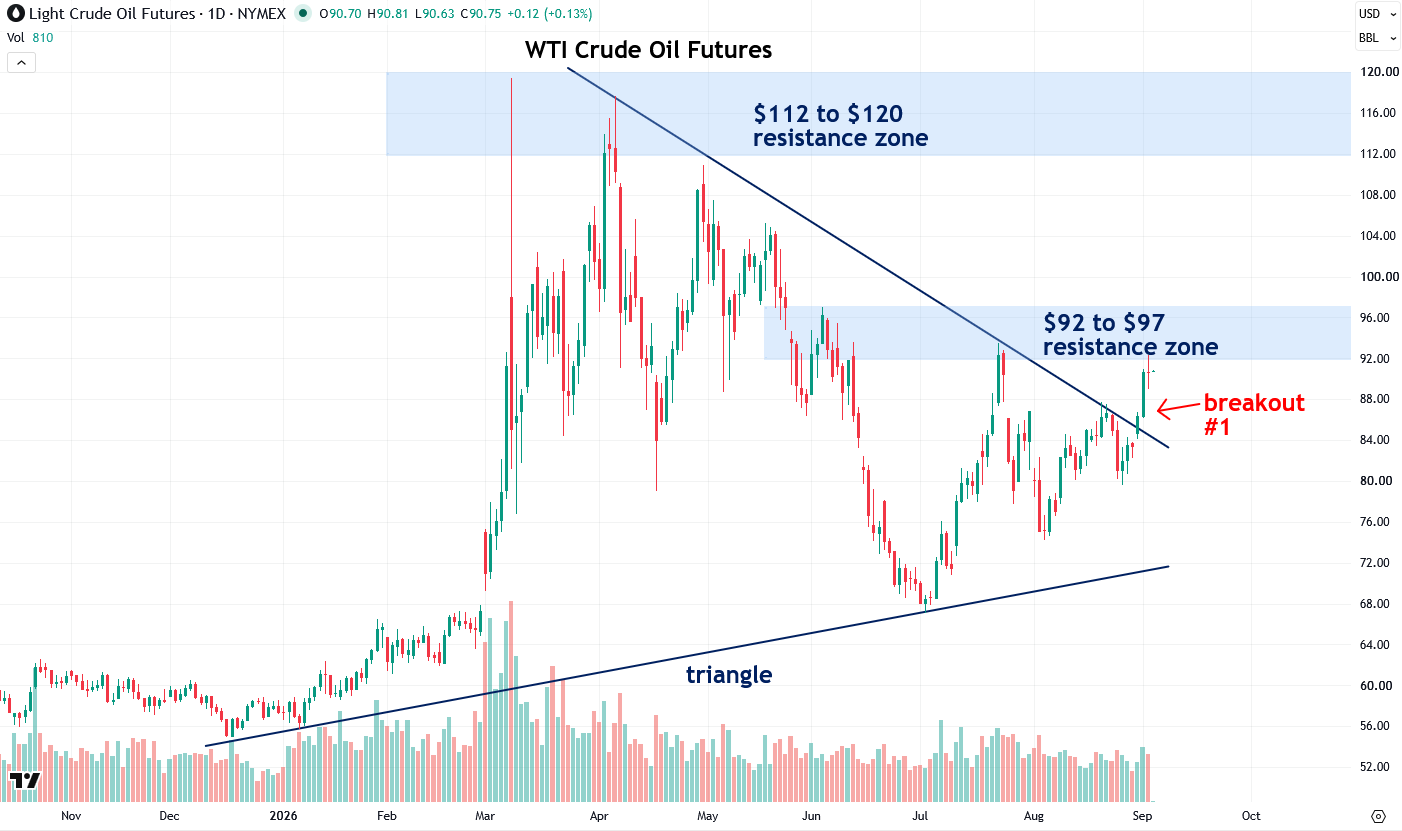
Let’s start by reviewing the latest action in crude oil, with WTI crude rising from around $80 a barrel to roughly $90 and Brent crude also gaining about $10 a barrel. The surge was triggered by renewed U.S. strikes on Iran after a multiweek hiatus during which the U.S. attempted to rely primarily on economic sanctions.
However, Iran is becoming increasingly defiant and is even going on the offensive against neighboring countries and U.S. outposts in the region, in addition to its ongoing strikes against tankers in the Strait of Hormuz.
This is an ugly situation, and it doesn’t seem to be ameliorating anytime soon. There is enormous uncertainty surrounding how this quagmire is ultimately going to play out, and the markets, including precious metals, are practically surging and plunging every other day based on the latest developments in the war.
One day, we hear that the Strait of Hormuz is open, only for it to close again, and similarly, the U.S. signals that it intends to hit Iran hard, only to suddenly back off again. It has been going on like this since March, and I speak for many people when I say that it is extremely tiring and confusing.
Meanwhile, the U.S. Strategic Petroleum Reserve has fallen by another 3 million barrels and is now at its lowest level since 1982, with other countries’ reserves similarly depleted.
As a result of the latest escalation with Iran, both WTI and Brent crude oil broke out of the triangle patterns I showed in my recent report about investing in energy. These breakouts increase the odds of oil rising even higher, but as many of you probably know by now, breakouts above diagonal trendlines, such as the upper boundary of a triangle, are not as reliable as breakouts above horizontal resistance levels and zones, such as $92 to $97 and $112 to $120, which formed at key peaks in crude oil.
As someone who also invests in the energy sector, I am waiting to see whether crude oil can surpass those resistance zones. If it does, it would greatly increase the odds that crude oil is about to rise even further. I recommend reading my recent report to learn about the different ways to invest in energy.
Even if you aren’t interested in investing in energy, it still matters to the overall global economy and financial markets, including precious metals. While rising oil prices have put downward pressure on precious metals and base metals since the U.S.-Iran war began, this is a historical anomaly, as energy, metals, and other commodities have typically rallied in tandem during commodity bull markets. I expect that to be the case over the coming decade as well.
In the short term, however, spikes in energy prices have put downward pressure on precious metals by increasing inflation and interest rate expectations, which weighs on precious metals because they are non-yielding assets.
My latest approach and philosophy for dealing with this frustrating conundrum, as someone whose portfolio is heavily weighted toward precious metals, is to also diversify into energy, base metals, and agricultural investments. The idea is that when one zigs, another zags, helping to offset each other’s swings, while I ultimately expect them all to climb together over the next decade as the commodities supercycle truly gets underway.
What helped offset the inflationary pressure caused by the rise in energy prices this week were two weak U.S. jobs reports: the JOLTS report on Tuesday and the ADP private payrolls report on Wednesday.
The July Job Openings and Labor Turnover Survey (JOLTS) showed 7.271 million job openings, below the market expectation of 7.3 million. Similarly, Wednesday’s ADP August private payrolls report came in at just 38,000, down from 46,000 in July and below the estimate of 47,000, marking the slowest month since January.
After those weak jobs reports, though they are of lesser importance, all eyes are now on Friday’s U.S. August employment report, which is expected to show growth of 53,000 jobs and an unemployment rate of 4.1%. This report carries added importance after the shocking July report showed a loss of 23,000 jobs, as signs continue to mount that the U.S. labor market is decelerating sharply.
At the moment, the Fed is more concerned about inflation than the labor market, though the labor market is still obviously important. Next week brings two major market catalysts in the form of Thursday’s Producer Price Index (PPI) report and Friday’s Consumer Price Index (CPI) report.
These reports are particularly pivotal because they are the final major inflation reports before the September 16 FOMC meeting, for which there is currently a 62.3% chance of a 25-basis-point, or 0.25%, fed funds rate hike, according to CME Group’s FedWatch tool.
My thinking is that it’s time to just rip the Band-Aid off, hike rates already, and let the chips fall where they are going to fall. The amount of collective energy spent parsing every word from Fed Chair Warsh and dissecting every single economic data point is a waste of society’s time and energy, in my view.
And I wish precious metals investors, or more accurately, the paper precious metals market, would stop being so sensitive to and worried about a small increase in interest rates, even if rates ultimately have to rise by more than 25 basis points.
Now let’s take a look at where precious metals stand, starting with gold, which leads the overall complex.
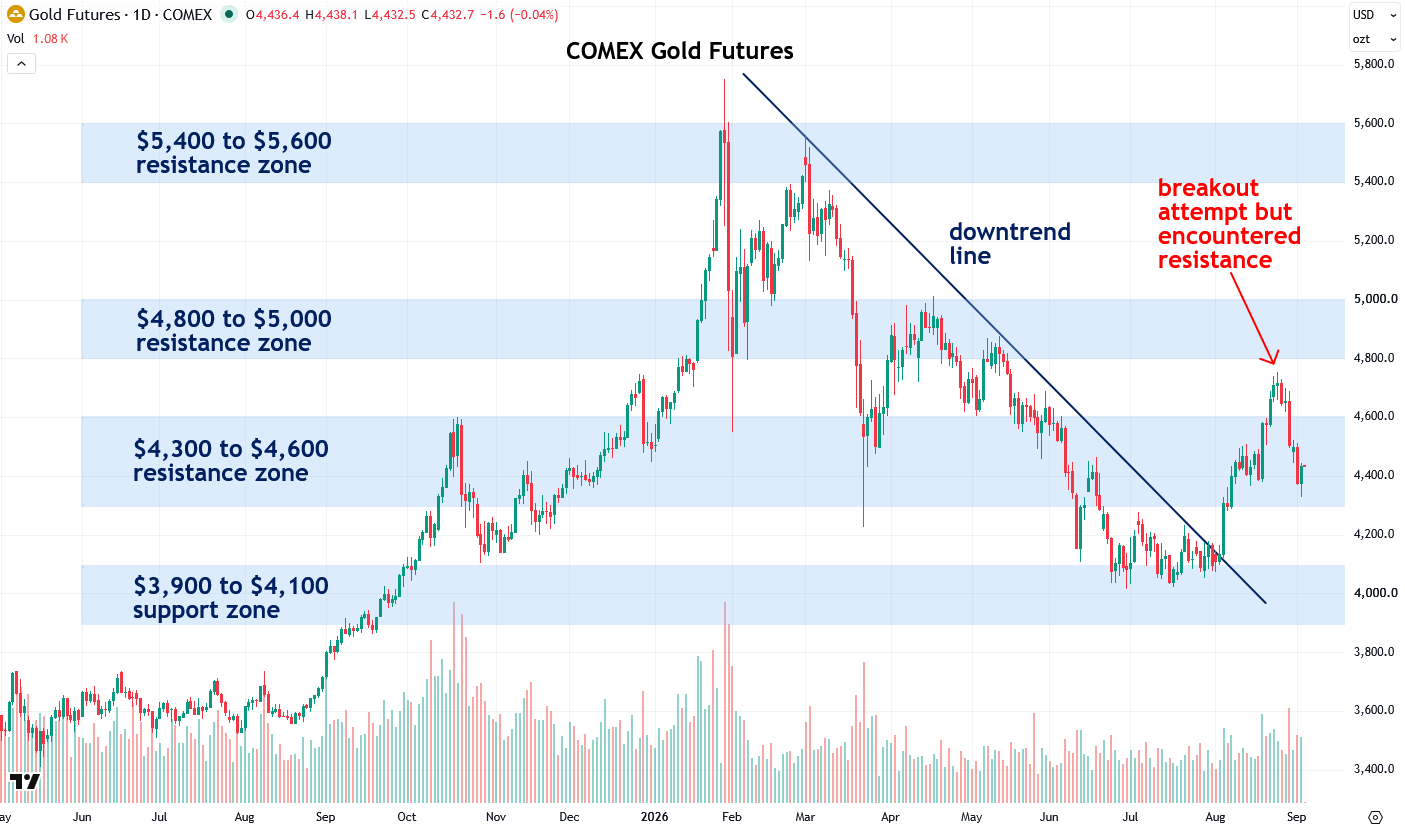
Gold staged an impressive rebound in August from its July lows, precisely off the $3,900 to $4,100 support zone that formed at the lows in October and November. After rising approximately $700 an ounce, or 17%, in just a few weeks, it’s only normal for there to be a healthy pause or pullback before embarking on the next leg higher.
What triggered that pullback was Fed Chair Kevin Warsh’s hawkish speech at Friday’s annual Jackson Hole meeting, in which he took a tough tone on inflation. That speech, combined with the resurgence in energy prices, caused a pullback across the precious metals complex, including gold.
Gold attempted to break out above its $4,300 to $4,600 resistance zone early last week but bumped its head against the $4,800 to $5,000 resistance zone, after which it pulled back due to the factors I just mentioned. The good news is that gold is still holding above the $4,300 to $4,600 zone as it pauses for breath, which has helped reset its temporary overbought condition and is setting it up to continue the rebound process that is still in its early stages.
However, the key catalysts ahead, including Friday’s U.S. jobs report, next week’s PPI and CPI inflation reports, the upcoming Fed meeting, and developments related to the U.S.-Iran war, are important wildcards for the near future.
As I have been consistently saying, I would like to see gold and all of the precious metals and miners clear all of the resistance zones overhead. Once that happens, the rally will become much smoother and less fragile once again. These resistance zones formed at key peaks over the past year and are areas where above-average amounts of supply (aka selling) are likely to occur as investors who bought at those peaks and subsequently found themselves underwater sell once they finally break even.
Another factor to keep in mind is that it is still technically summer as far as the financial markets are concerned, which means low-volume, thin trading conditions. That will come to an end after this Labor Day weekend as trading activity returns to normal.
Low-volume conditions mean less fuel for bull markets, so the normalization of trading volume is key for this rebound to really heat up and become more resilient. This partly explains the fits and starts we have been seeing.
To learn more about support and resistance zones, I recommend reading my two-part tutorial (Part 1 and Part 2).
As a reminder, I firmly believe that precious metals and miners are in a long-term bull market that began only in April 2024 and has at least another eight years to run based on historical cycles. I believe the January-to-August correction was merely a healthy pause within that bull market rather than the beginning of a new bear market. Read my recent report, where I explained this thesis in detail.
Moving on to silver, we can see that it attempted to break above the critical $70 level on Friday, a level that has played a major role over the past year. However, it was slammed back down just hours later following Fed Chair Kevin Warsh’s hawkish speech and then pushed even lower by the renewed escalation with Iran and the ensuing spike in energy prices.

Comments
Log in or sign up to join the conversation.