

The USD/JPY is centre of attention after extending its surge to near 163.00 level, putting Japanese authorities in an increasingly uncomfortable position. The move has pushed the yen to its weakest against the dollar level since 1986, prompting fresh speculation that Tokyo could soon step into the foreign exchange market. The US dollar has also rebounded against other currencies, but the move in the USD/JPY has been primarily driven by yen weakness. Indeed, the Japanese currency has now dropped for a fourth consecutive quarter. This is its longest period of sustained weakness in four years and underlines just how powerful the pressure has been on the currency.
Can intervention change the broader trend?
Japanese Finance Minister Satsuki Katayama has again stressed that officials stand ready to act whenever necessary to address excessive currency moves. Those comments have become familiar to markets, but traders are becoming increasingly convinced that intervention is now a matter of timing rather than possibility. History suggests that direct intervention can trigger sharp, short-lived moves in USD/JPY exchange rate, but lasting success is far less common.
Japanese authorities demonstrated this during their intervention earlier in the year, reportedly selling around $70 billion worth of dollars when USD/JPY first traded above 160. While those operations temporarily strengthened the yen, the pair eventually resumed its upward trajectory as investors refocused on the underlying policy divergence between the Federal Reserve and the Bank of Japan. Traders use the yen as a funding currency because of the low interest rates in Japan.
This remains the central challenge for Tokyo. Without a meaningful policy tightening, intervention alone is unlikely to produce a sustained reversal. Instead, officials can primarily slow speculative momentum and discourage disorderly market conditions rather than fundamentally alter the direction of travel.
Previous interventions have often been launched during periods of thinner liquidity, maximising their market impact. With this the US Independence Day holiday approaching on Friday, trading volumes are expected to become lighter, potentially providing an attractive opportunity should authorities decide to act.
US data could decide the dollar’s next move
On the dollar side of the equation, the US economic calendar is quite important for the FX markets, starting today. Markets will closely monitor Federal Reserve Chair Kevin Warsh’s speech, where investors will search for fresh clues regarding the future direction of US monetary policy. That will then be followed by the latest US official employment report on Thursday, which has the potential to reshape interest rate expectations once again.
USD/JPY technical analysis
From a technical analysis point of view, the breakout past the 161.95-162.00 area, where the pair had las created a major top, means the uptrend has gathered even more pace now. For as long as this area now holds as support on any potential retests from above, the path of least resistance will remain to the upside. Things will get a bit bearish only if recent low at 161.53 gives way, but then there is a larger support zone sitting around the 160.50-160.75 area. The bears have lots of work to do to turn the tide.
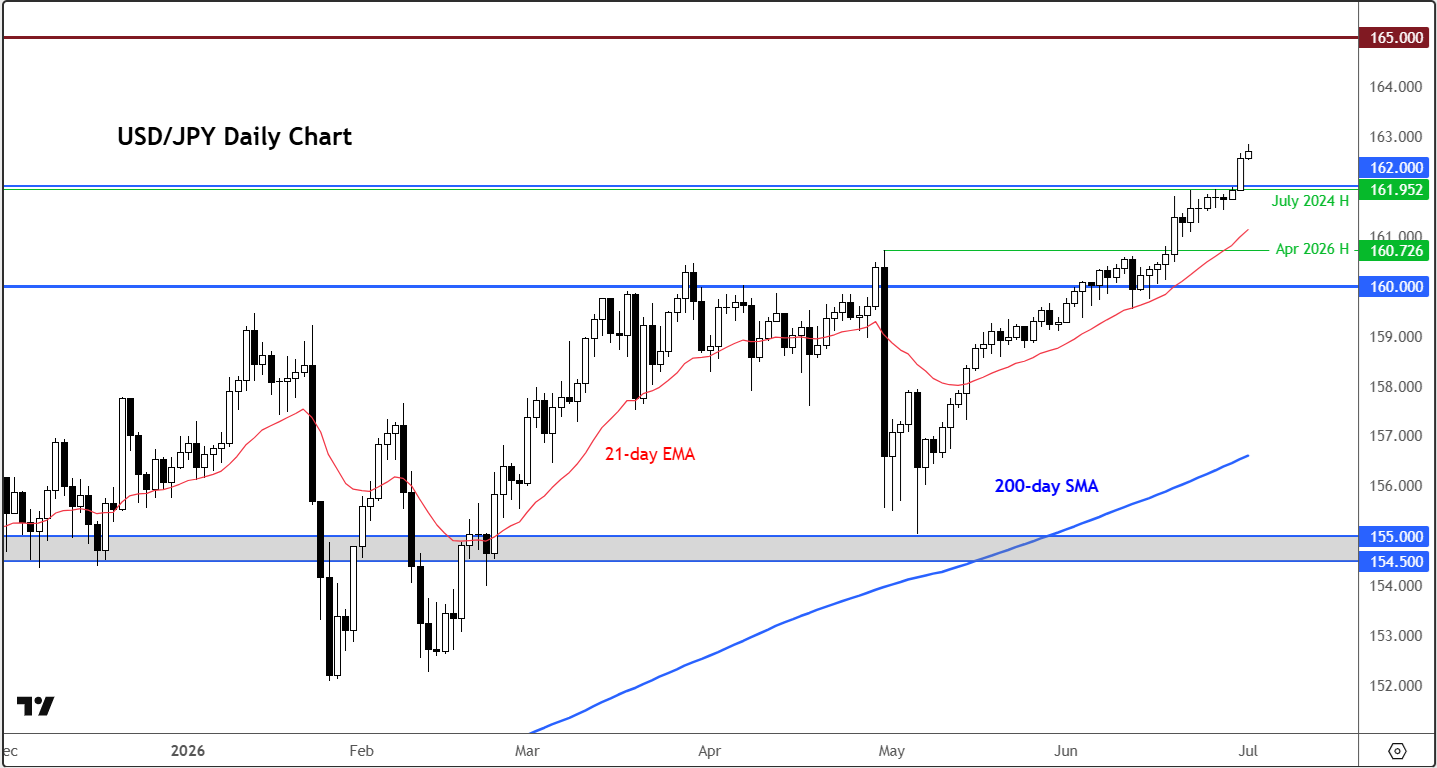
On the upside, round handles like 163.00, 164.00 etc., could be the next targets to watch, barring a big intervention.
The biggest near-term risk to bullish positions is an unexpected intervention from Japanese authorities. Such action could trigger an aggressive, albeit potentially temporary, decline in the pair. Beyond that, the longer-term direction still depends largely on monetary policy. Unless the Bank of Japan adopts a significantly more aggressive tightening stance or the Federal Reserve begins a sustained easing cycle (both appear unlikely), the broader USD/JPY trend continues to favour strength in the pair.



Comments
Log in or sign up to join the conversation.