

US equity futures slipped on Thursday, surrendering part of the previous session’s advance as renewed weakness across the semiconductor sector weighed on sentiment.
Among the US indices, Nasdaq 100 futures fell around 0.5%, while European markets, including the DAX, also came under pressure. Dow futures proved a little more resilient, supported by a strong rally in UnitedHealth (UNH) after the healthcare giant comfortably beat earnings forecasts. Investors will also turn their attention to Netflix (NFLX), which is due to release its quarterly results after the closing bell.
Semiconductor sector drags markets lower
The pressure was most evident across chipmakers. The VanEck Semiconductor ETF (SMH) dropped roughly 2%, with Arm Holdings (ARM) among the biggest laggards after falling about 4%. Taiwan Semiconductor (TSM) also came under heavy selling pressure, while several European semiconductor names traded lower alongside their US counterparts. Yesterday, it was ASML (ASML) that echoed the same sentiment, with the stock trading sharply higher earlier in the session on the back of its earnings results but then reversed course and ended the day down. Here’s a list of the biggest premarket movers today.
AI enthusiasm begins to cool
The remarkable rally in artificial intelligence-related stocks appears to be losing some momentum after months of almost uninterrupted gains. Given the pace of the prior advance, some consolidation was always likely.
But there are some investors who are increasingly questioning whether the enormous sums being committed to AI infrastructure can generate sufficient returns within a reasonable timeframe. At the same time, supply chain constraints, power availability, and the sheer scale of planned investment are prompting a more cautious assessment of future growth prospects.
That being said, rather than signalling the end of the AI trade, the recent weakness could simply reflect a period of portfolio rotation. After an exceptional run, some investors may prefer to lock in profits from richly valued semiconductor names and reallocate capital towards sectors offering more attractive valuations and steadier earnings visibility.
Softer inflation data has helped keep markets afloat
One of the reasons why markets have been fairly resilient despite renews Middle East tensions and rising oil prices this week is to do with the fact that US inflationary pressures eased surprisingly sharply in June.
Yesterday saw producer prices surprise on the downside after the previous day’s softer consumer inflation report, reinforcing hopes that price pressures are gradually moderating.
At the same time, another round of solid earnings from major US banks provided reassurance that corporate profitability remains healthy even as inflation slows.
Lower Treasury yields also continued to underpin sentiment towards growth assets, although the technology sector’s leadership is increasingly being challenged by profit-taking in some of its strongest performers.
Fed remains cautious despite improving data
Even with recent inflation data moving in the right direction, Federal Reserve officials continue to urge caution.
Fed Chair Kevin Warsh, during his congressional testimony, alongside comments from Governor Chris Waller, stressed that policymakers need to see sustained evidence of disinflation before drawing firm conclusions. One or two encouraging inflation reports are unlikely to be enough, particularly as higher oil prices threaten to complicate the outlook in the months ahead.
For now, financial markets continue to anticipate just one further Fed rate increase this year. If expectations for policy tightening continue to edge higher, the US dollar could remain supported and thus may also provide modest pressure on equity markets.
Retail sales and Fed speakers in focus
Attention now turns to June’s US retail sales report, where economists expect a more modest 0.2% monthly increase following several months of robust consumer spending.
Markets will also monitor remarks from Fed officials Lori Logan and Jeff Schmid, both regarded as among the more hawkish members of the committee, for further clues on how policymakers are interpreting the recent run of softer inflation data.
Nasdaq 100 Technical Analysis
Markets were moving into a more cautious, risk-off mood at the time of this writing, with the Nasdaq 100 futures turning lower after managing a decent bounce off the lows yesterday.
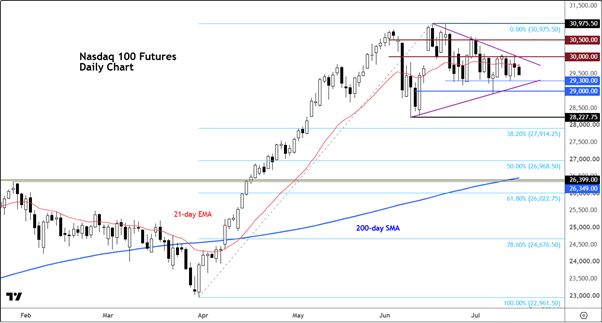
But once again, the index failed to break above this bearish trendline and resistance near the key 30K mark, with the consolidation phase continuing.
So, will this turn into a full-blown risk-off move? It’s still too early to say. However, judging by recent price action, it probably pays to be a little more cautious.
We’ve had a very strong rally, followed by a healthy period of consolidation. But the fact that buying momentum is fading around the psychologically important 30,000 level suggests the market could be vulnerable to a deeper correction in the days ahead.
That said, I’m not ready to turn decisively bearish just yet. For that to happen, I’d want to see the index break below its triangle formation, followed by a move beneath the 29,000 level. That would provide much stronger confirmation that the bulls are losing control.



Comments
Log in or sign up to join the conversation.