


Global equity markets are coming under increasing pressure as another sharp rise in oil prices adds to an already difficult backdrop for risk assets. The S&P 500 (SPX) and Nasdaq (QQQ) have been able to grind higher for much of the year, but those gains have increasingly rested on a narrow group of mega-cap technology and AI stocks. Even so, futures on these indices have fallen today. But it the weakness in the Dow (DIA) and Russell 2000 (IWM) which is becoming more important: these are arguably better gauges of the underlying health of the market, and their deterioration is becoming harder to ignore.
Oil and yields raise the stakes
The latest move in crude is particularly unhelpful. Oil initially fell sharply earlier this week, allowing the major US indices to regain their poise and the S&P 500 index pushed to fresh records. That relief proved short-lived. Brent has since surged back above $100 a barrel, reviving concerns that the inflation problem may prove far more persistent than investors had hoped.
Higher oil prices are feeding directly into bond markets. Unsurprisingly, Treasury yields are rising as investors reassess the prospect of further interest-rate hikes, while tighter financial conditions are beginning to weigh on risk appetite. With depleted inventories providing a fundamental floor under crude, the near-term direction remains skewed higher unless there is a meaningful breakthrough in US-Iran negotiations. But it is quite the opposite. Markets appear to be preparing for the risk of further military escalation instead.
With oil rising, the 10-year Treasury yield has climbed to its highest level since the early 2000s, while the average 30-year US mortgage rate is at its highest since November 2023. As yields become more attractive, bonds also start to offer a more credible alternative to equities. That could become increasingly important if investors begin demanding a larger valuation discount before returning to stocks.
For equities, the combination of higher yields, tighter financial conditions and renewed inflation risks is becoming increasingly uncomfortable. Unless there is a fundamental shift in either the oil or bond-market story, the risk of a deeper correction is rising.
Dow Jones technical analysis: 50,000 in focus
The price action on the Dow Jones chart is becoming increasingly bearish. Since the failed attempt to break higher around the August record, the index has been forming a sequence of lower highs and lower lows, while its failure to reclaim the 21-day EMA reinforces the impression that bulls have lost control of the near-term trend.
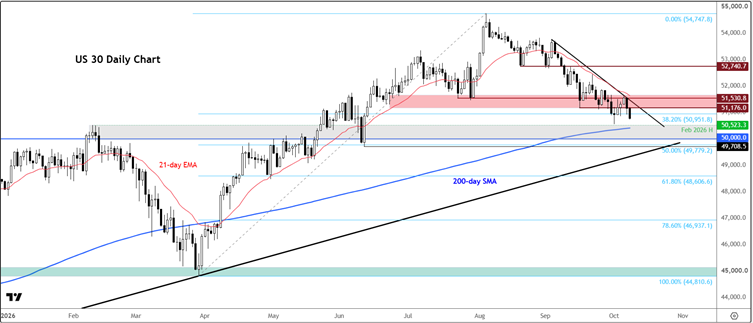
The break below 51,500 was particularly significant. That level has now turned into resistance, while the series of lower highs has established a clear bearish trend line. For me, the Dow needs to reclaim 51,500 to revive the bullish case. Until that happens, the path of least resistance remains lower.
The first major downside target is the earlier-year low around 50,523. A break below that would bring the 200-day moving average and the psychologically important 50,000 level into focus. Beneath there, the longer-term bullish trend line from the April 2025 and March 2026 lows currently sits around 49,000, while the 50% Fibonacci retracement of the March-August advance is close to 49,780.
In other words, the 50,000 area is likely to be the next major test. A sustained break below it would materially weaken the broader bullish structure and raise the prospect of a much deeper correction.



Comments
Log in or sign up to join the conversation.