


Markets were reminded once again how quickly geopolitical risks can return after a sharper exchange of fire between the US and Iran sent crude oil prices sharply higher yesterday. While the reaction across Wall Street and the currency markets was relatively measured compared with Europe, Brent crude hovering close to $80 a barrel has nevertheless altered the macro backdrop.
If oil prices remain elevated, any progress on inflation could begin to stall. That would complicate the Federal Reserve’s policy outlook and increase the likelihood of interest rate hikes in the near term. This would keep the US dollar supported while potentially weighing on equities, particularly in countries that are heavily reliant on imported energy.
European stocks bore the brunt of yesterday’s selling, with indices such as the DAX (DAX) and IBEX leading the declines, while US benchmarks proved comparatively resilient. Even so, investors remain wary that a prolonged period of elevated oil prices could eventually spill over into broader risk assets.
Can Trump prevent another energy shock?
Markets briefly steadied with the S&P 500 index climbing to around 7500 level after Trump suggested Iran remained willing to negotiate, easing some of the immediate fears of a wider military escalation. Whether those hopes prove justified remains uncertain.
The key concern for traders is the possibility of fresh disruption to Middle Eastern oil supplies. Any renewed threat to shipping through the Strait of Hormuz would almost certainly inject another layer of risk into energy markets and could quickly push crude prices higher.
At this stage, the market appears to be assuming neither side has an appetite for a prolonged conflict. That assumption has helped prevent an even stronger rally in oil, but geopolitical headlines are likely to remain a significant source of volatility over the coming days.
Attention turns to next week’s inflation data
The minutes from the Federal Reserve’s June meeting offered little that investors did not already know. Policymakers broadly maintained their cautious approach, leaving markets with few fresh clues about the timing of the next policy move.
Instead, attention is already shifting towards next week’s US inflation report, which should provide a much clearer indication of whether price pressures are beginning to build again. Investors will also be listening closely to Kevin Warsh’s testimony before Congress for any further insight into the policy outlook.
Should energy prices continue to climb, inflation expectations may edge higher again, potentially reinforcing the Fed’s cautious stance and limiting the scope for equities to extend recent gains.
S&P 500 futures testing an important resistance zone
From a technical perspective, S&P 500 futures have recovered from yesterday’s sell-off after buyers stepped in around the 7,500 area. The rebound is encouraging, but it has carried the market into an important resistance region between roughly 7,540 and 7,578, an area that previously acted as support before giving way.
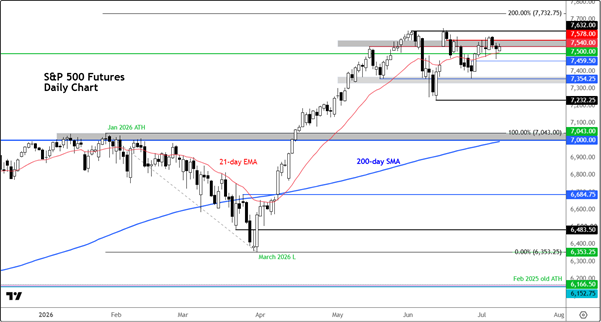
A sustained move above this zone would improve the short-term technical picture and could allow the index to retest the recent highs between 7,632 and 7,648. Beyond that, the next bullish objective sits near 7,732, representing the 200% Fibonacci extension of the January-to-March decline.
On the downside, however, 7,500 remains the first level to watch. A decisive break below there would place the 21-day exponential moving average back under pressure and increase the likelihood of a deeper pullback.
Further support lies around 7,450, followed by 7,354, a level that marked the breakout point during June’s rally. Losing that support would significantly weaken the near-term outlook and expose the previous swing low around 7,232.
Should selling accelerate beyond that point, attention would then turn towards the psychologically important 7,000 region.



Comments
Log in or sign up to join the conversation.