

The dollar fell sharply after a much weaker-than-expected US inflation report caught markets by surprise. But despite the selling, I’m not convinced the dollar’s weakness will last, with currencies of economies that are dependent on energy imports likely to remain under pressure amid the re-escalation of the US-Iran tensions and the resulting rally in energy prices.
CPI was quite weak, but that’s in the past
Before the inflation numbers were released yesterday, the greenback had been benefiting from rising geopolitical tensions between the US and Iran. Higher oil prices had boosted demand for the dollar, particularly against lower-yielding currencies, such as the Swiss franc, as investors looked for both safety and better returns. The dollar was also showing relative strength against the likes of the euro because of the higher energy prices.
Then came the CPI report. US annual inflation slowed to 3.5%, well below expectations of 3.8%, while monthly prices fell by 0.4% - the biggest monthly decline in more than six years.
That prompted traders to aggressively scale back expectations of a near-term Federal Reserve rate hike, sending the dollar sharply lower and lifting the EUR USD exchange rate and other major forex pairs.
But since then, we have seen a bit of unwinding of those moves.
Crude oil remains the primary driver
The inflation story may not be that simple. Oil prices continue to climb as tensions in the Middle East intensify. Brent crude is now trading around $87 a barrel, and if the conflict escalates further, energy prices could rise much more.
Earlier this year, at the height of the conflict, Brent briefly traded above $110, so we’ve seen how quickly the market can move when supply concerns take hold.
Higher oil prices would almost certainly push inflation expectations back up, which could force markets to rethink the outlook for US interest rates.
So, while the latest CPI report has weakened the dollar for now, that effect may prove short-lived if energy costs keep rising or remain elevated.
As for the euro, well, it has held up reasonably well thanks to expectations that the European Central Bank may need to keep policy tighter for longer.
However, Europe is far more exposed to rising energy costs than the United States. If oil prices continue heading towards 100 dollars a barrel, the drag on the eurozone economy could easily outweigh any benefit from higher ECB interest rates.
EUR/USD technical analysis
From a technical analysis point of view, the trend remains bearish on the EUR/USD even if the pair has now climbed back above the 1.1400 handle following the inflation report. Let’s see if the bulls will be able to push the pair towards the next resistance levels around 1.1500 and then at 1.1575 thereafter. But the downward pressure remains. Price may gravitate towards a support level such as 1.1400. Below that, 1.1380ish is the next target, and then there is not much until the June low of 1.1325.
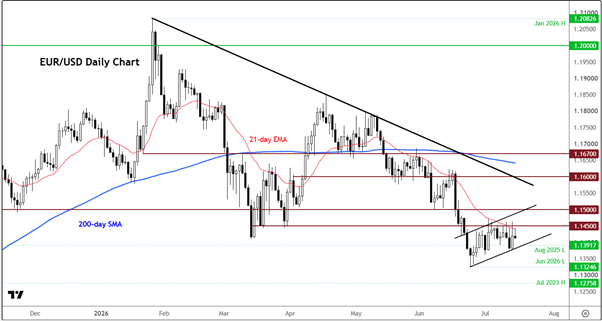
So, although today’s inflation data has given the EUR/USD a welcome lift, the bigger picture still favours the dollar if the oil rally continues. That’s why I remain cautious on the euro and continue to see downside risks for EUR/USD in the weeks ahead.



Comments
Log in or sign up to join the conversation.