


Week 48 | Outlook: 23–27 November 2026
This week the S&P 500 and Dow joined the Nasdaq in correction territory, with Friday’s brutal selling accelerating into the close, leaving many to ponder which fund(s) had blown up. The S&P (SPX) lost 3.70% on the day and 8.61% on the week, while the Nasdaq Composite (NDX) fell 5.61% on Friday and just over 10% for the week. We think the set up offers scope for a sharp rebound well worth playing for, but the form the bounce takes deserves monitoring closely.
Strong earnings results weren’t enough to change the bearish mood among investors. Nvidia (NVDA) reported quarterly revenue of $115.8 billion and forecast approximately $130 billion for the following quarter, yet its shares continued to freefall. Anthropic’s much anticipated flotation also failed to restore confidence across technology. We believe investors are becoming more demanding about what they’ll pay for future growth, especially where financing, export access and corporate governance complicate the story. A healthy order book doesn’t make the share price inexpensive.
Nor has the retreat produced a uniform rush into defensive assets. Treasuries strengthened, with the ten-year yield reported near 4.91% late on Friday afternoon, while gold remained under pressure. Oil recovered from its earlier Friday losses but still finished another week lower. We think that combination points towards a growing concern about growth and liquidity, rather than a simple inflation trade in which tangible assets rise together. Gold’s failure to benefit from falling bond yields is particularly difficult to ignore.
There is a credible case against assuming the economy is already falling apart. Our macro composite score remains mixed at 54.4 out of 100, and the latest initial unemployment claims release showed 203,000 claims, only a modest increase. Nvidia's results were good. However, with the selling we saw our equity breadth score has weakened to 32.2 and sentiment has fallen to 15.8, classified as extreme fear. We think those readings make a short term rebound in equities more than plausible, and it is likely to be a strong rally.
Most of this week's potential catalysts arrive on Wednesday 25 November, but we wouldn't wait for results to get long. October personal income and outlays, including PCE inflation, arrive alongside the second estimate of third-quarter GDP at 13:30 GMT. Durable goods orders are due at the same time, followed by new home sales at 15:00 and the Fed’s Beige Book at 19:00. HPE’s Monday evening call, followed by Dell (DELL) and Workday (WDAY) on Tuesday evening, gives investors another look at enterprise technology demand. Thanksgiving makes this an unusual five session outlook. US cash equities are closed on Thursday 26 November and finish at 18:00 GMT on Friday 27 November.
US indices: odds favour the bulls this week
The reported positioning change runs from Tuesday 10 November to Tuesday 17 November. Leveraged funds added 52,078 E-mini S&P 500 longs and covered 16,004 shorts, improving their net position by 68,082 contracts. They nevertheless remained net short by 234,978 contracts. That is a substantial reduction in bearish exposure during a falling market, but not a move into an outright net long position. We think that distinction makes this report less reassuring than a casual reading might suggest.
Funds had already used part of their capacity to cover shorts before the subsequent sell-off accelerated. There are still plenty of shorts outstanding, but the report doesn’t show an untouched reservoir of pessimism suddenly waiting to reverse. Our Wednesday–Friday inference is that the renewed selling probably rebuilt some bearish exposure and discouraged the fresh longs added earlier. Monday and Tuesday could still alter that direction before the next positioning observation. Thanksgiving delays publication of that next COT report until Monday 30 November.
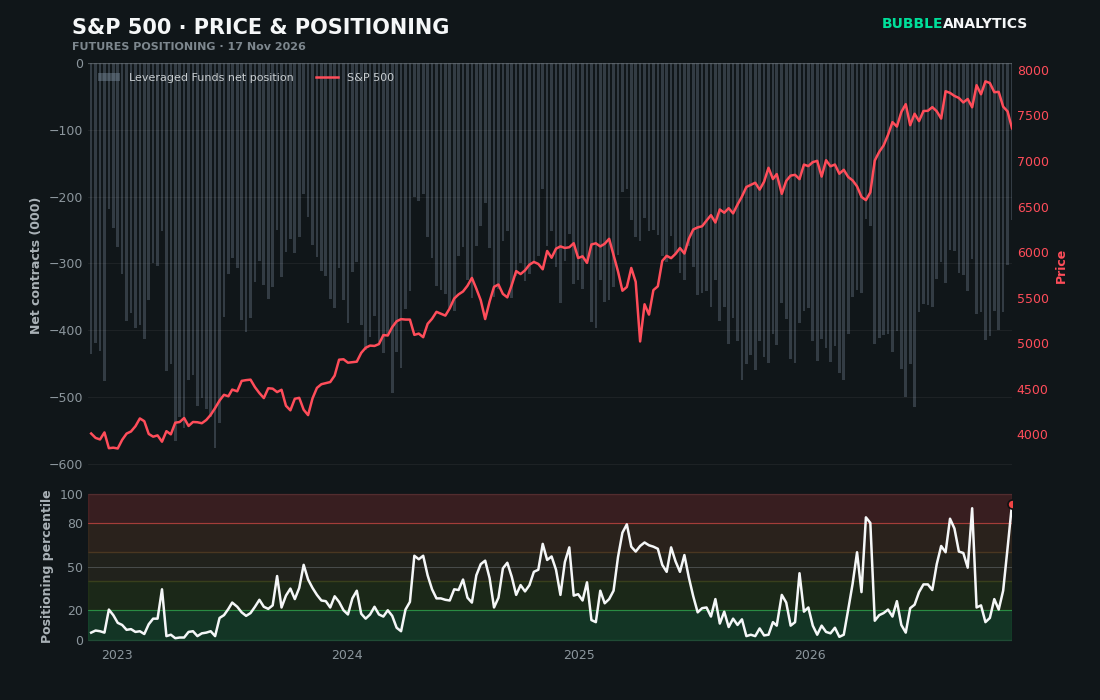
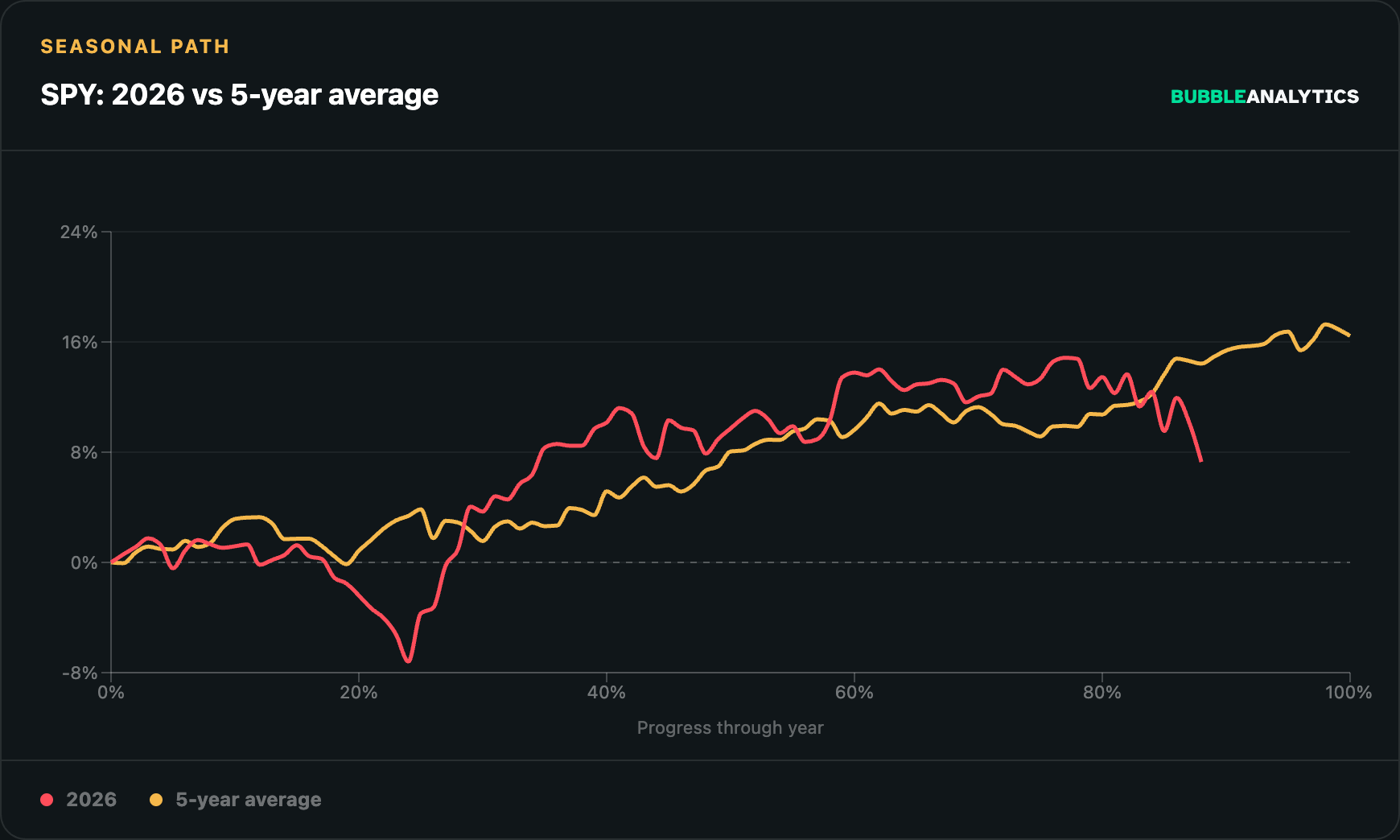
The five-year SPY seasonal profile offers a more supportive counterweight. Across 2021–2025, the Week 48 average return was approximately 1.13%, and the seasonal path rises through this part of November. That gives us a reason to take a recovery attempt seriously. Current breadth and sentiment readings support that view. The deterioration has now extended beyond the largest technology shares, and while relatively stronger performance elsewhere can make an equal-weight comparison look encouraging, losing less than the market leader is useful resilience but isn’t the same as broad buying. A decent bounce followed by a retest of the recent lows to give us a breadth washout would be a better marker of a lasting low.
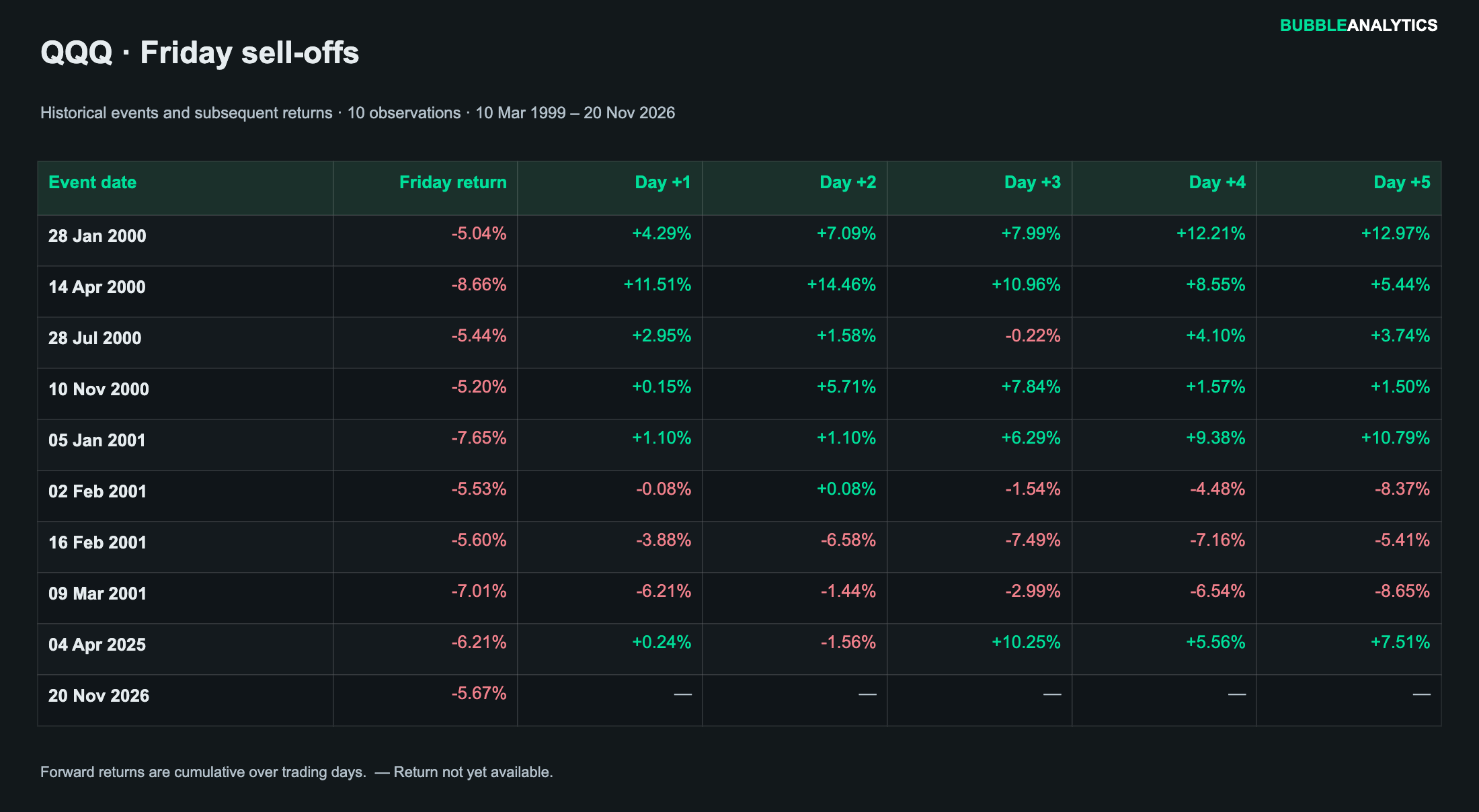
With the sell off emanating from tech, we thought we would take a look at the Nasdaq 100 ETF (QQQ) for a steer on the chances of a recovery. Friday sell offs of 5%+ are quite rare, and in all cases bar the second year of the dot-com bear market we saw sizeable returns over the following week. That is our base case for this week then, but be warned that a lack of upside follow through early on would be an omen of something far more bearish about to play out. For QQQ we have support at 593.86, with resistance at 631.45, 650.90 then 706.64. For SPY we have support at 671.38, with resistance at 723.07 and 740.71.
Gold: much unloved but worth watching
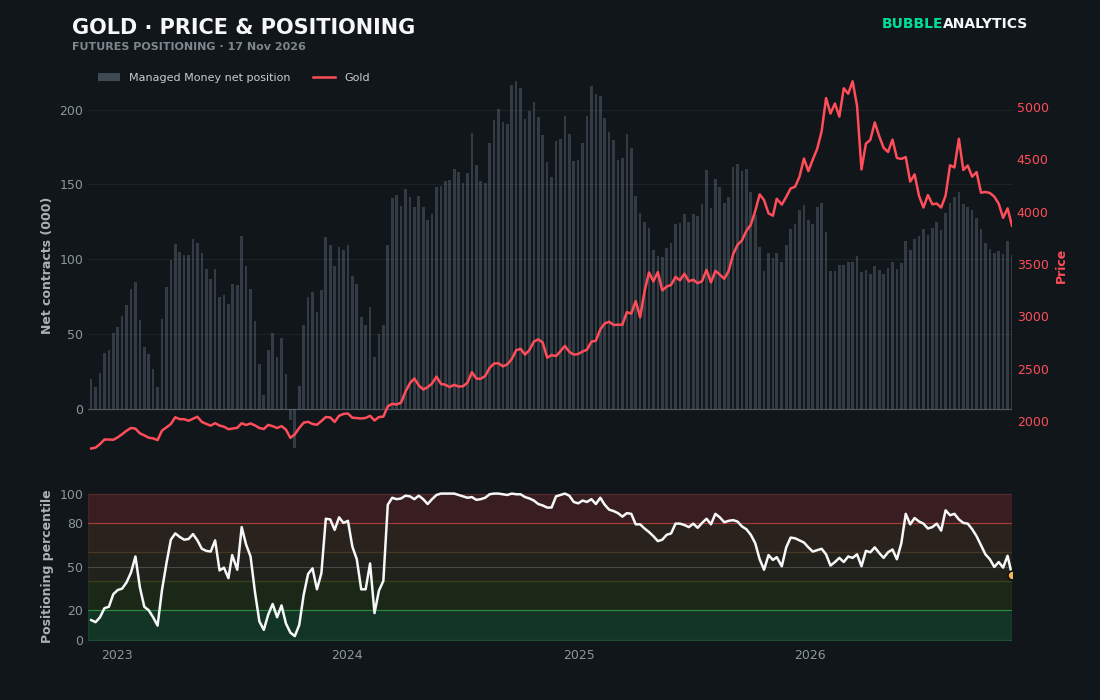
Gold’s Tuesday-to-Tuesday report, covering 10–17 November, shows managed money reducing its net long by 9,399 contracts to 102,942. Long holdings fell by 5,412 contracts while shorts increased by 3,987. The resulting position sits at the 44th percentile of its own 4 year history. Enthusiasm has been reduced, but this is neither a net short market nor an extreme positioning washout. Unfortunately we think there is still room for investors to reduce exposure if the metal continues to disappoint when protection is most wanted.
The Wednesday–Friday inference is for further erosion of that net long. Gold weakened after Tuesday, Thursday’s early recovery failed to establish a durable improvement, and Friday brought renewed pressure even as Treasuries rallied. We think the most likely positioning consequence is continued retreat from bullish exposure. Gold's inability to respond to lower nominal yields suggests that concern about Fed policy is offsetting it's usual defensive appeal.
Seasonality argues against becoming too comfortable with the downside. GLD’s five-year Week 48 average is approximately +1.56%, and its seasonal path improves into late November. We think that raises the chance of a rebound this week in tandem with stocks. Since gold has already failed to deliver the protection that fearful equity sentiment might have suggested, we can assume it now trades in lock-step with equities instead.
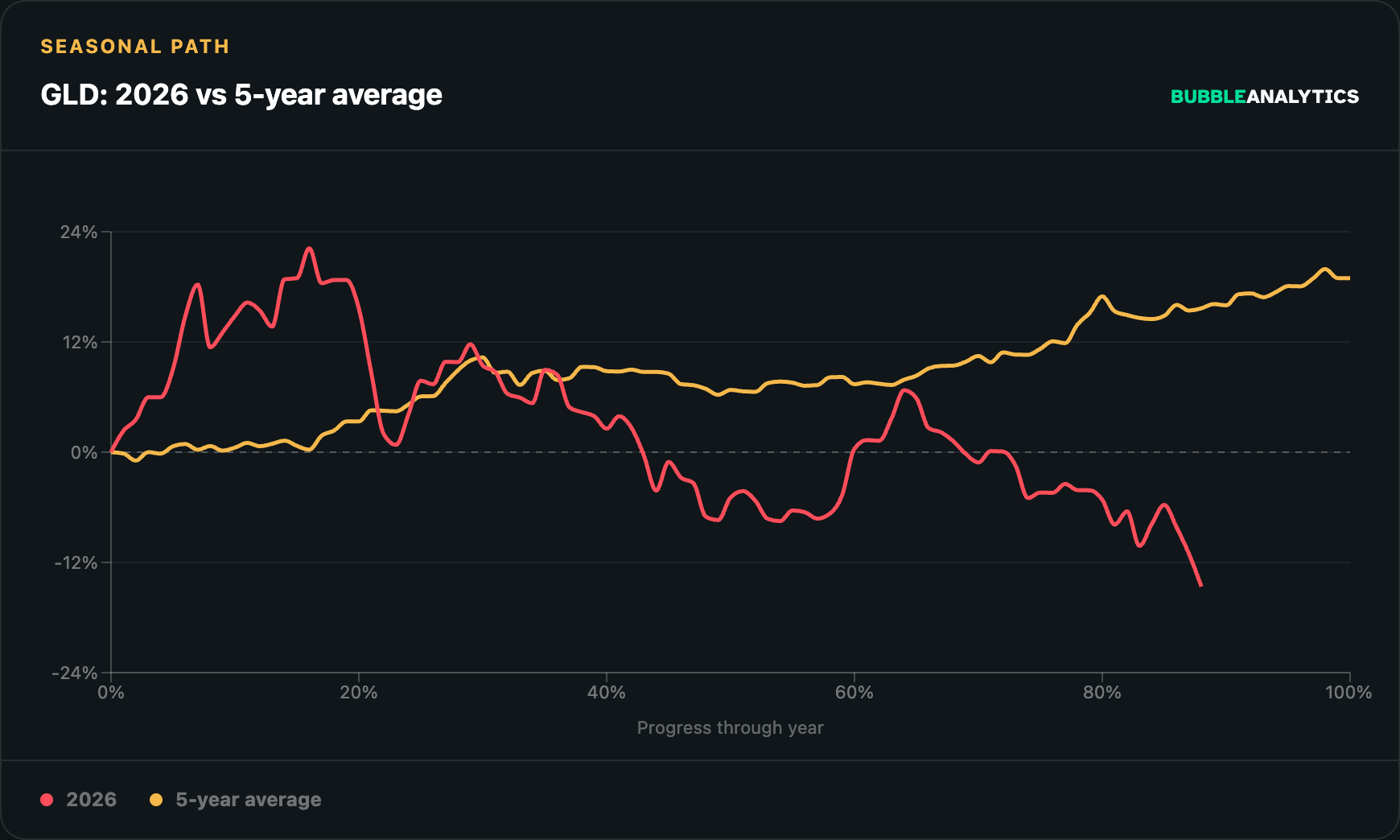
Our preferred view is a hesitant start followed by an attempt to stabilise around Wednesday’s inflation release. Softer inflation and a less demanding dollar backdrop would give that recovery a good foundation. We don’t yet expect an immediate return to the earlier uptrend and see a bounce this week as the prelude to further lows ahead. Resistance in GLD is 339.83 with support at 293.70 to 305.63.
Oil: a bounce into a challenging fundamental backdrop
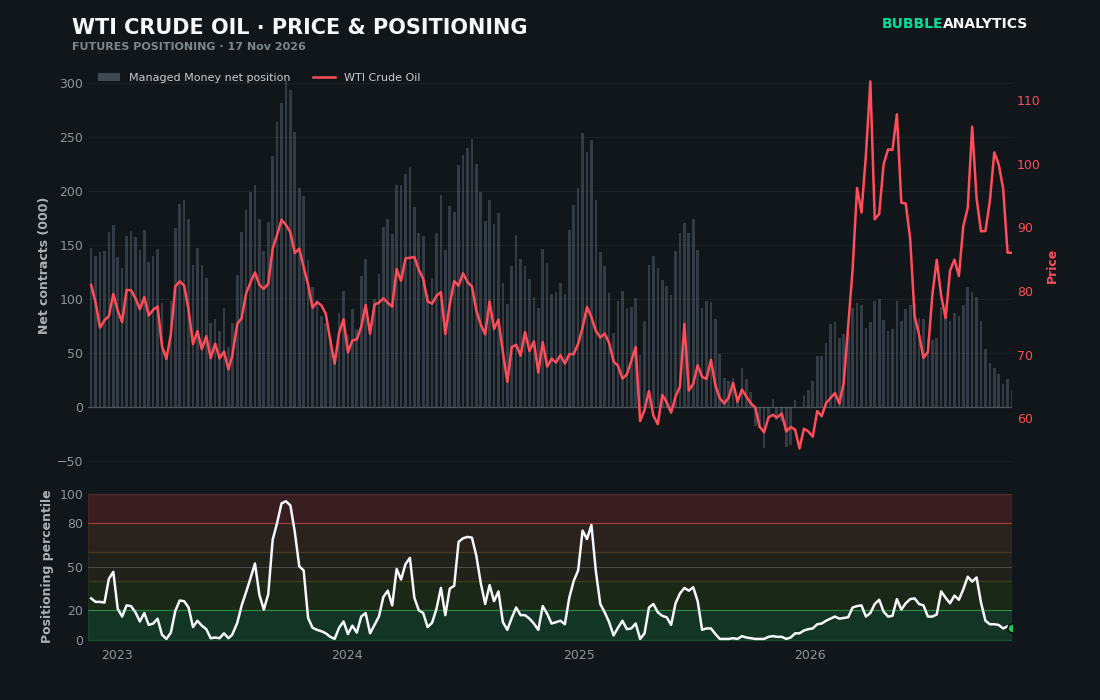
Managed money’s WTI position became more defensive between Tuesday 10 and Tuesday 17 November. Funds added 5,519 longs, but added a much larger 15,419 shorts. The net long consequently fell by 9,900 contracts to just 15,814. Positioning sits at the 7.7th percentile of its own history. This was a change driven by heavier short additions, rather than an across-the-board liquidation of long holdings, and it leaves oil much closer to the pessimistic end of its range than gold.
Our Wednesday–Friday inference is that the week’s renewed weakness probably encouraged further defensive positioning, although Friday’s recovery may have whipsawed the new shorts. Oil’s final session was firmer than the early reports suggested, and gives oil bulls some hope to cling to, but the broader weekly direction remained down. Reports of stronger Middle Eastern exports are weighing against the disruption premium, while Saturday’s fresh report of a tanker strike near Hormuz underlines how quickly the balance can change. We would not treat either additional supply promises or a single incident as proof of an effect on physical deliveries. Definitive supply has become harder to gauge.
The five year USO seasonal pattern is much less friendly than the other three markets. Its Week 48 average return was approximately −0.44%, and the surrounding late-November path is uneven and generally weak. Together with deteriorating risk appetite, that makes us reluctant to interpret the Friday rebound as the start of a new advance. While the net-long positioning is low historically, there is room to drop further and we feel the short term bear case is stronger on balance.
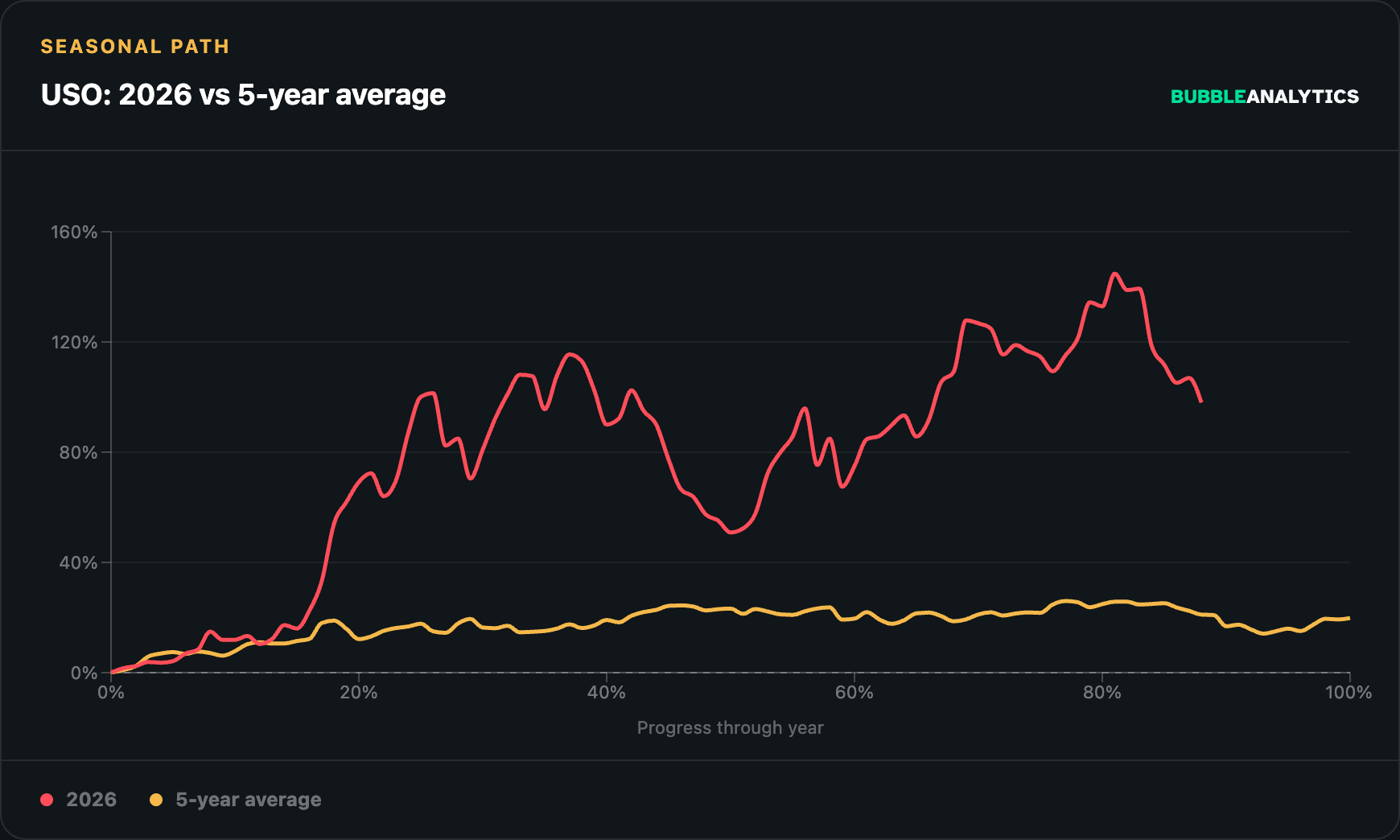
We expect a volatile opening, with weekend shipping headlines capable of extending Friday’s recovery quite sharply. Our preferred path is for that strength to struggle as attention returns to exports, demand and Wednesday’s economic releases, leaving oil vulnerable again into the holiday period. That is a modest bearish preference, not a forecast of an ouright freefall. Resistance in USO stands at 144.90 and 164.67, with support at 138.01 then 124.68.
US bonds: protection comes with crowded positioning
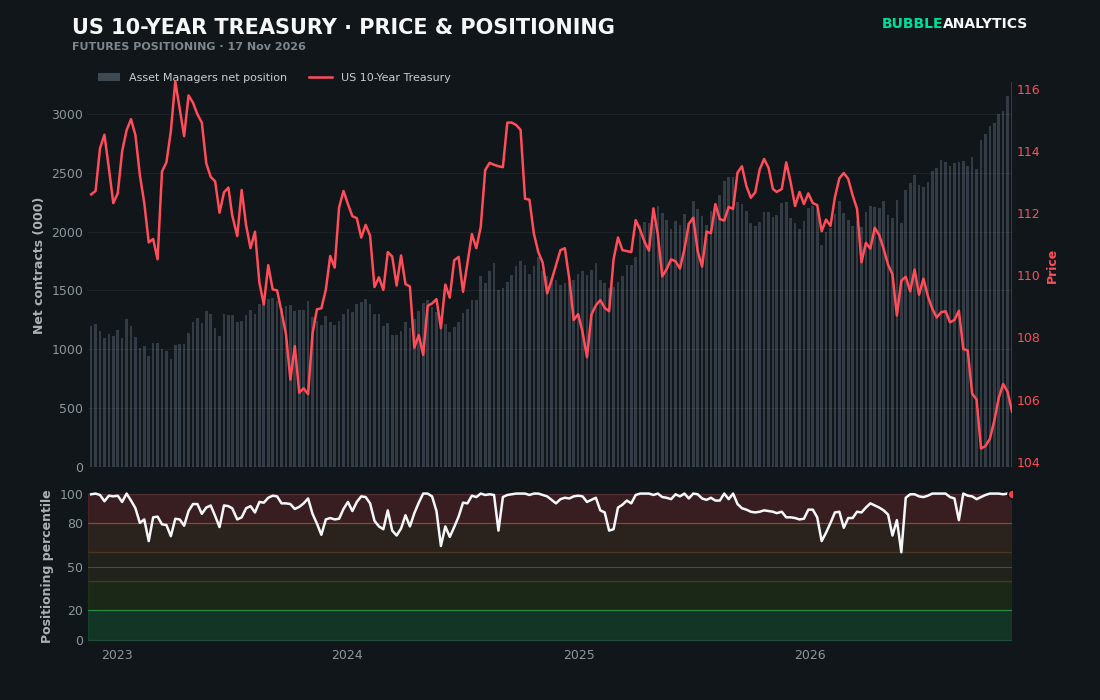
Asset managers increased their net long in US ten-year Treasury futures by 117,073 contracts between Tuesday 10 and Tuesday 17 November, reaching 3,270,834. They added 180,449 longs and 63,376 shorts. The net position stands at the 100th percentile of the recorded historical comparison. This is genuinely a large positive net position, unlike the still-negative S&P stance. We think it provides evidence of substantial institutional commitment to duration, while also warning that an unwinding could result in a sharp decline.
Our Wednesday–Friday inference is that the later Treasury rally probably reinforced that commitment. The strongest defensive response came as equity selling intensified on Friday, and the reported ten-year yield fell to approximately 4.91% late in the afternoon. That is a price observation after the COT cutoff, not evidence that Tuesday’s reported position already captured the rally. We think the next report is more likely to show continued support for duration than a wholesale retreat, unless the first two sessions of the coming week sharply reverse the move.
IEF’s five-year seasonal profile supports the near-term bond case, with a Week 48 average return of approximately +1.39%. Fearful equity sentiment provides another source of demand. The main obstacle is policy: the October Fed minutes, released this week, still described further rate increases as likely appropriate under participants’ baseline outlooks. We believe Wednesday’s inflation figures will further test whether defensive buying can offset that threat.
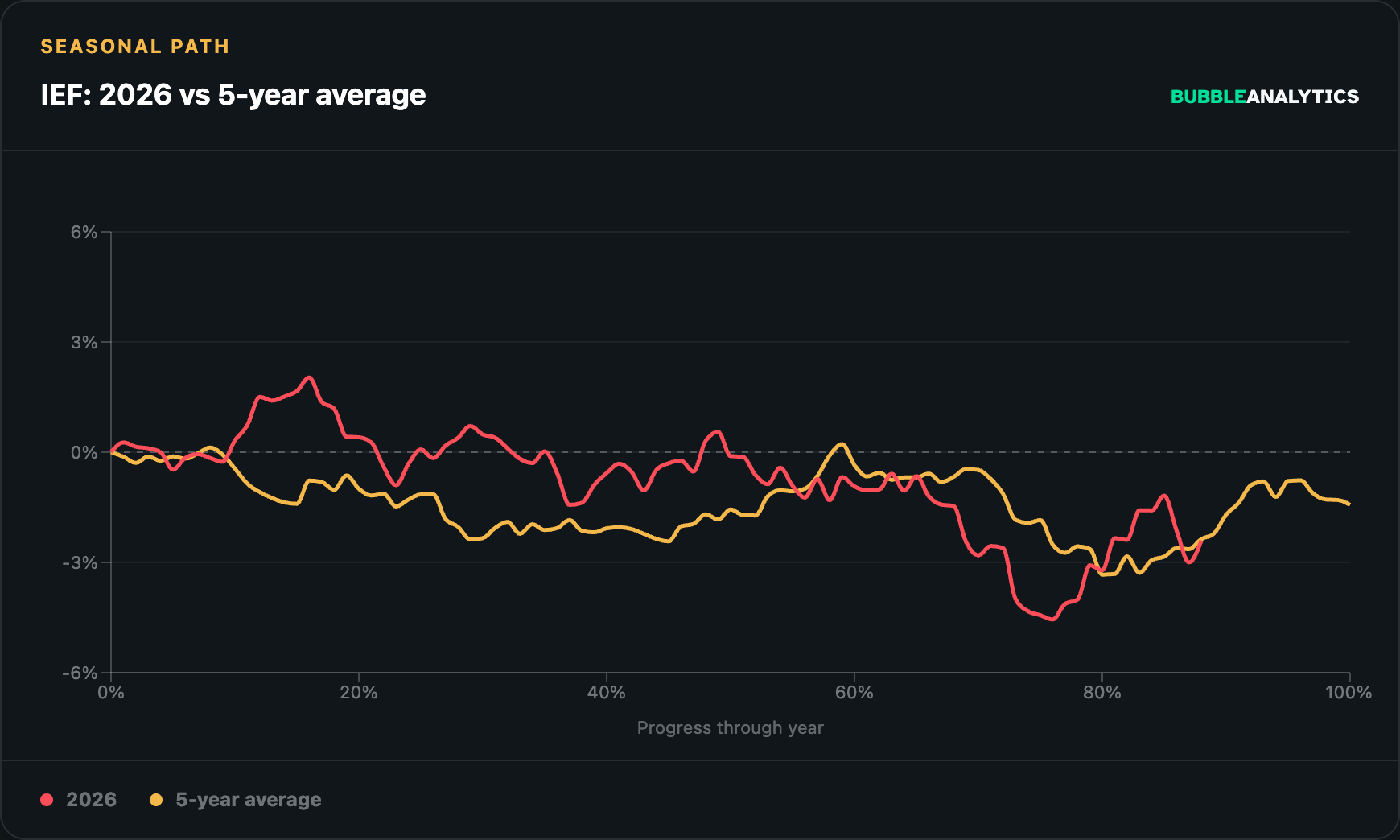
On balance this week we expect bonds to decline in the face of an equity market bounce that should prompt some profit taking after Friday’s move. A strong inflation release could result in that decline gathering speed. For IEF resistance stands at 92.03, with supprt at 89.95 then 88.52 and 87.78.
Our next article will be published on Sunday. Until then, we wish you well for the week ahead. If you have any questions about anything covered here, please get in touch. We’re always happy to hear from you.



Comments
Log in or sign up to join the conversation.