

Outlook: Monday – Friday November 2 – 6 2026
October finished quite uncomfortably for tech investors as the AI led tech wreck got into swing, and Friday's selling took the S&P 500 down 1.82% and the Nasdaq Composite down 2.86%, leaving both negative for the week overall. We think the immediate question for November is how quickly buyers can rebuild confidence should we see further earnings disappointment. A more helpful seasonal backdrop gives them an opportunity, but with major tech players reporting this week the omens look ominous.
The problem isn't just that current demand for LLMs doesn't justify frontier lab valuations; it's that the effect of infrastructure spending on free cash flow is starting to become clear. Amazon's (AMZN) cloud business grew strongly, yet the company reported a $42.4 billion free cash outflow over the twelve months to September. Rising operating cash generation couldn't keep pace with investment, and Friday evening's negative revision to Meta's credit outlook added a further reminder that the funding question extends beyond share prices.
The economic backdrop offers little easy relief. September's headline PCE inflation was 3.6% year on year, with core inflation at 3.1%, while real consumer spending was almost unchanged from August. The Fed held its target range at 3.75–4.00% on Wednesday, but two members indicated they favoured an increase. With inflation still elevated and real consumer spending barely growing, the Fed has limited room to cushion a slowdown. That leaves markets particularly sensitive to whether the coming employment figures point to a gradual cooling in demand or a sharper deterioration.
Defensive assets are telling different stories. Treasuries attracted buyers late in the week, while gold remained under pressure and oil retained a supply-risk premium. We feel those moves reflect different forces rather than a signal that growth is weakening, but higher fuel costs will certainly squeeze household spending and make inflation harder to bring down. That leaves bonds with a useful defensive role short term, but also a reason for their recovery to remain vulnerable.
For the week ahead November 2–6 we have some tasty potential catalysts to watch for. Manufacturing activity starts the week, Tuesday brings the midterm elections and job openings, and services activity follows on Wednesday. Apple (AAPL) reports on Monday, AMD on Tuesday and Qualcomm (QCOM) on Wednesday to keep technology very much in focus. Thursday's Bank of England decision and US productivity figures lead into Friday's payrolls and preliminary consumer sentiment. We favour a hesitant start to the week for equities with an attempted bounce into Wednesday, followed by a drop back by Friday's close.
US indices: buyers need to look beyond the first bounce
Leveraged funds increased their S&P 500 net short by 29,359 contracts to 400,604 during 20–27 October. They cut 32,955 longs and covered only 3,596 shorts. We think the composition matters: the net deterioration came from investors reducing bullish exposure, even as the early-week equity recovery was taking shape. The position was towards the lower end of its recent historical range, leaving a substantial defensive stance behind the headline index.
The Nasdaq-100 told a different story. Leveraged funds increased their net long by 1,351 contracts to 2,301, entirely through heavier short covering than long liquidation. Russell 2000 funds also covered shorts, but remained net short by 48,081 contracts. We don't see that as a convincing wave of fresh buying across US indices. Technology's improved positioning was relatively extended against its own history, while the S&P 500 and smaller companies retained net shorts.
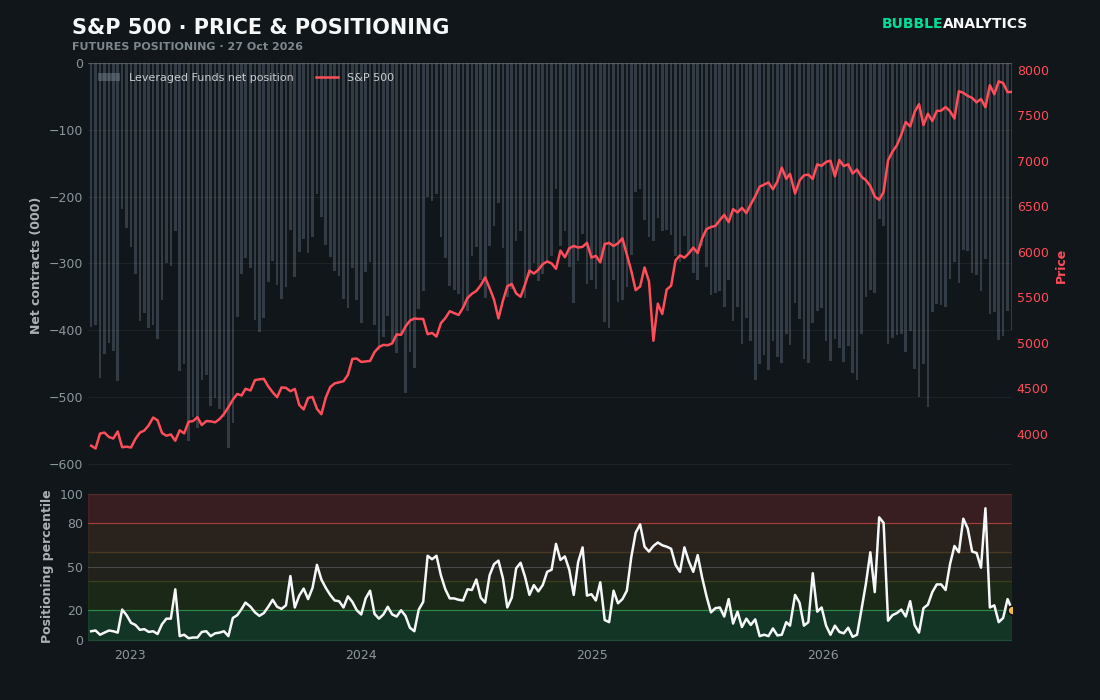
Wednesday–Friday inference: The recovery continued on Wednesday before reversing over Thursday and Friday. We think the later selling probably encouraged renewed defensive positioning and weakened the Nasdaq's earlier improvement. Monday's earnings and Tuesday's trading could still change the balance before the next snapshot, but the direction of the late-week evidence is less constructive than Tuesday's technology positioning.
Breadth gives us a reason to avoid calling a wholesale breakdown. Our breadth score was 62.9, classified as mixed, on 29 October, while sentiment was already in fear at 39.6. Those readings predate Friday's sell-off. Friday's exchange-wide advance–decline counts deteriorated, although participation within the S&P 500 was more balanced than the index's fall might suggest. We think that combination favours selective resilience outside the hardest-hit technology shares, without establishing a durable market bottom.
The five-year SPY seasonality profile is supportive: its average 5Y Week 45 return was approximately 2.02%. We see this as the strongest seasonal counterweight to the recent selling among the four markets covered here. It helps explain why we are open to a recovery attempt into midweek, but Friday's finish gives us little reason to assume it will begin cleanly on Monday.
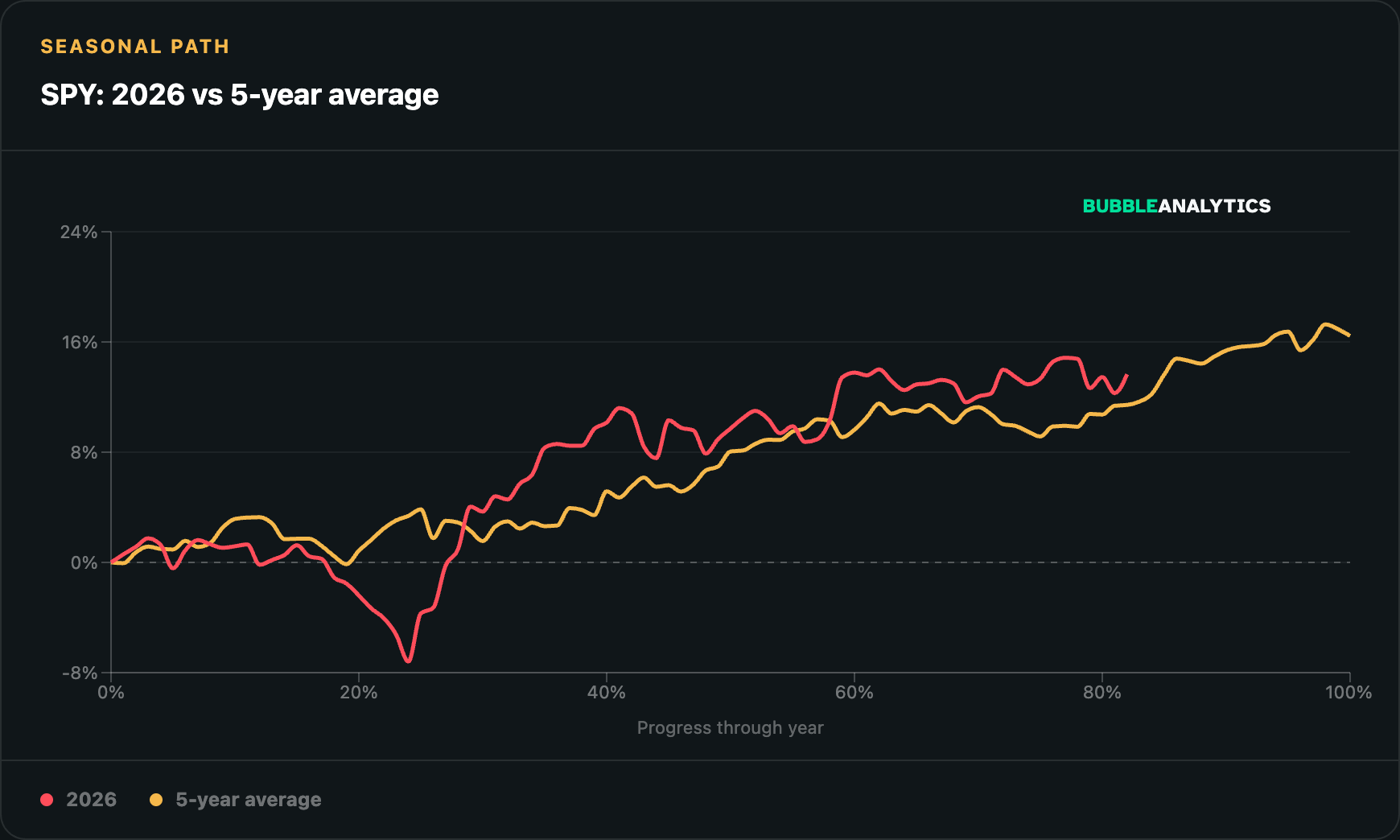
Last week we were looking for a test of support, starting at 749.83, and this was hit almost to the penny on Friday before the decline reversed a touch. This week we favour an early bounce to start the week, possibly after a new low on Monday, with renewed selling from midweek into the weekend. Should 749.83 hold for Friday's close there would be chance of a more meaningful low forming; otherwise support below is 740.71 on SPY.
Gold: much less attractive when yields are rising
Managed money increased its gold net long by 1,356 contracts to 105,562 between October 20 and 27. Longs rose by 1,538 and shorts by 182. This was modest rebuilding after the broader recent reduction in exposure, rather than a return to aggressive accumulation. Positioning stood around the middle of its recent historical range, but in our opinion the case for a rebound doesn't rest on an exceptionally bearish speculative position, and we remain on guard for a swing low forming.
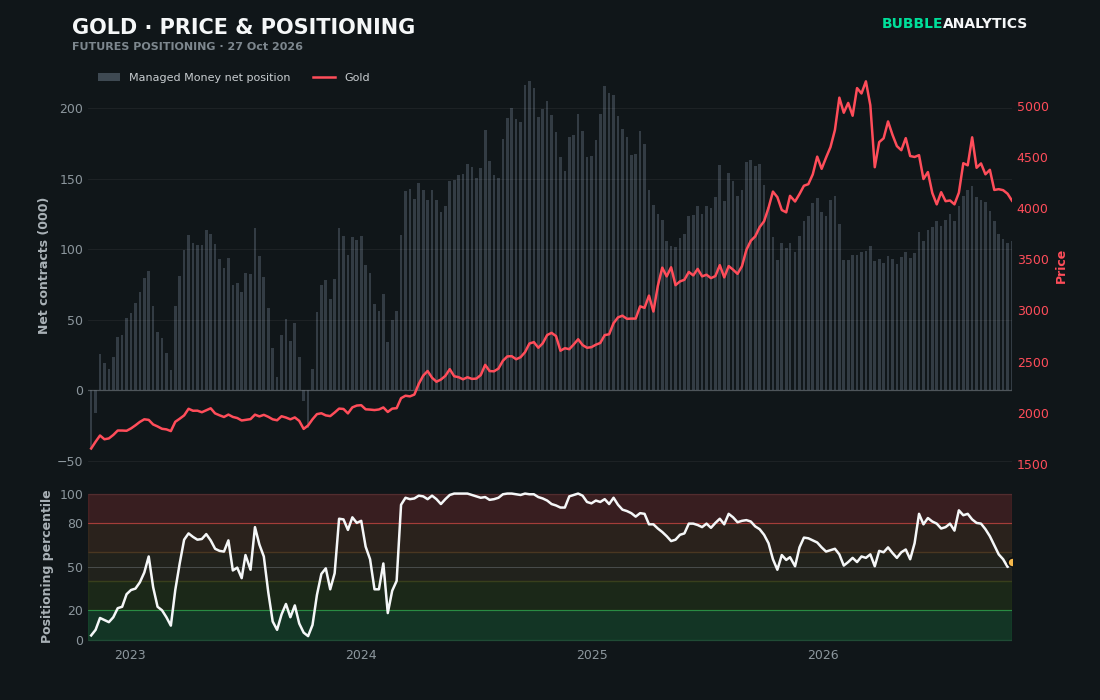
Wednesday–Friday inference: Gold's later weakness, visible in the GLD price path through Friday, makes us think some of Tuesday's modest rebuilding has probably now been reversed. The inability to benefit alongside Treasuries is the more useful message here. Defensive demand is choosing between assets, and gold hasn't yet shown that it can turn a fall in nominal yields into sustained buying. We would like to see that behaviour change before calling a sustainable low in place.
We think persistent inflation helps explain the difficulty. Higher energy costs can strengthen the argument for holding gold over time, but they can also prolong restrictive monetary policy. This week's Fed decision left that second channel open. Fear in equities may encourage diversification, yet the current evidence doesn't justify assuming that money leaving technology will automatically find its way into bullion. Gold needs to demonstrate that response in its own trading.
Five-year GLD seasonality offers a modest positive influence, with the 5Y Week 45 gaining approximately 0.66%. The seasonal path around early November is less uniformly strong than SPY's, which fits a patient view of recovery.
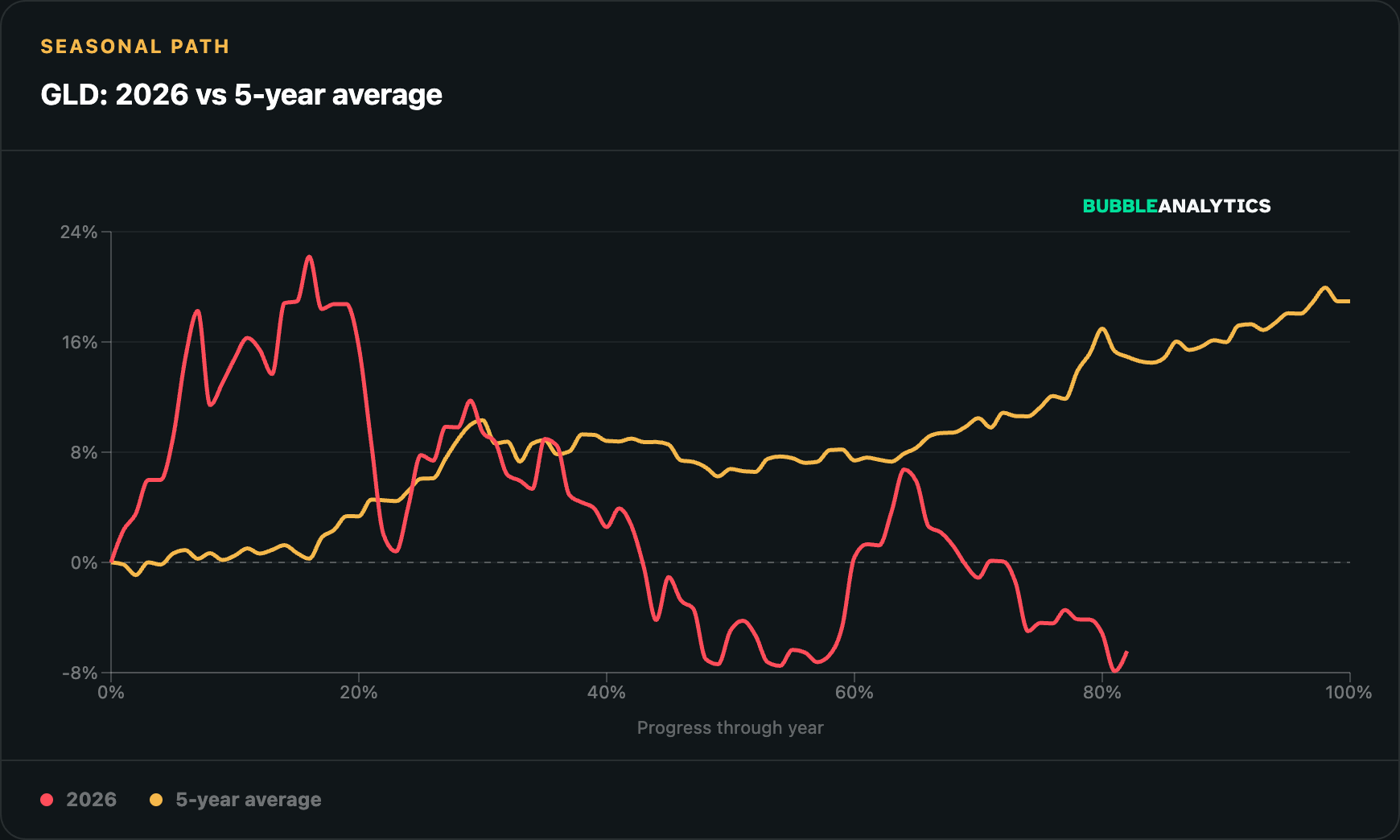
Last week we were looking for a test of support at GLD 351.83, and we came close to that level on Friday but have not tested it yet. We favour initial hesitation or further testing of the recent lows, followed by scope for a muted bounce that may turn into something more if the mid-terms bring political chaos. Support for GLD is 343.52 - 351.83 and a close above next Friday would give the bulls hope.
Oil: a sparse long position meets supply risk
WTI managed money reduced its net long by 5,059 contracts to 31,128 over 20–27 October. Long liquidation of 5,980 contracts outweighed short covering of 921. The remaining net long sat near the lower end of its recent historical range. That gives a different picture from a market in which speculative buyers have already built a large bullish position. If price continues to rise the question is if managed money will chase.
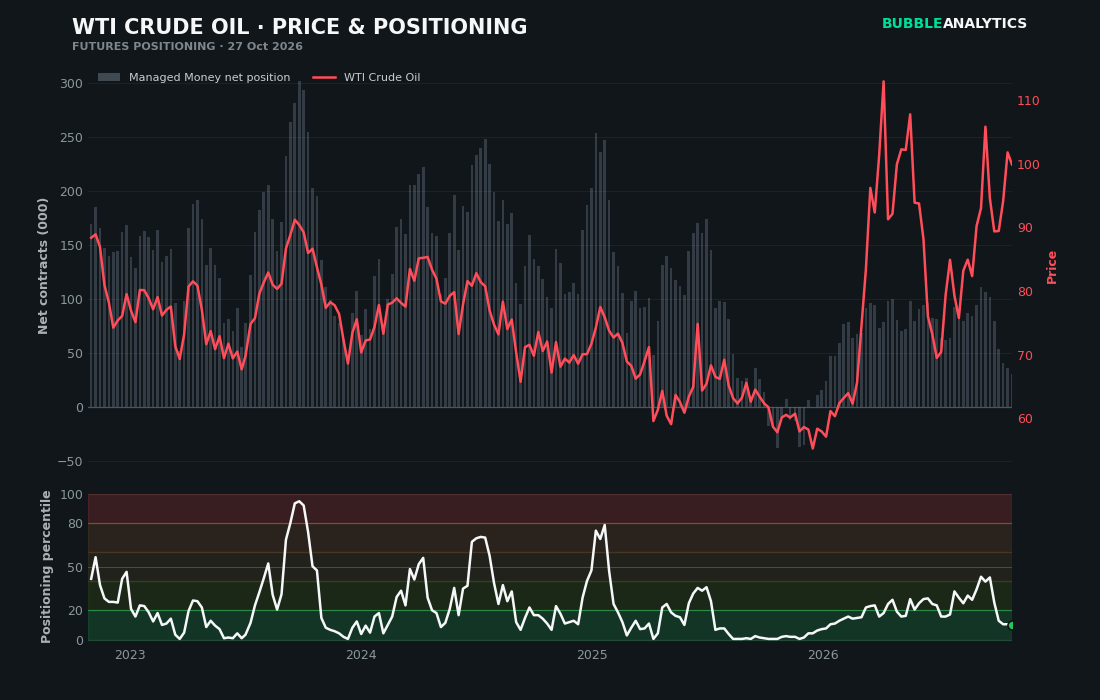
Wednesday–Friday inference: Renewed shipping concerns and firmer late-week oil trading probably interrupted the earlier reduction in bullish exposure. We think the next report could show some rebuilding or additional short covering if that strength survives Monday and Tuesday. The Tuesday snapshot leaves room for a response to supply anxiety, rather than showing that speculative investors had already fully embraced it.
We remain cautious about translating individual attack reports into a precise loss of supply. The market can charge a higher risk premium before the eventual disruption is known, and diplomatic headlines can remove part of it just as quickly. The more durable question is whether transport and production conditions improve enough to reduce the burden on consumers. A weak equity session on its own doesn't answer that question, particularly when oil is being driven by events outside the usual demand cycle.
Five year USO seasonality points in the opposite direction to the late week trading, with an average Week 45 decline of approximately 1.70%. That makes us reluctant to chase an opening jump.
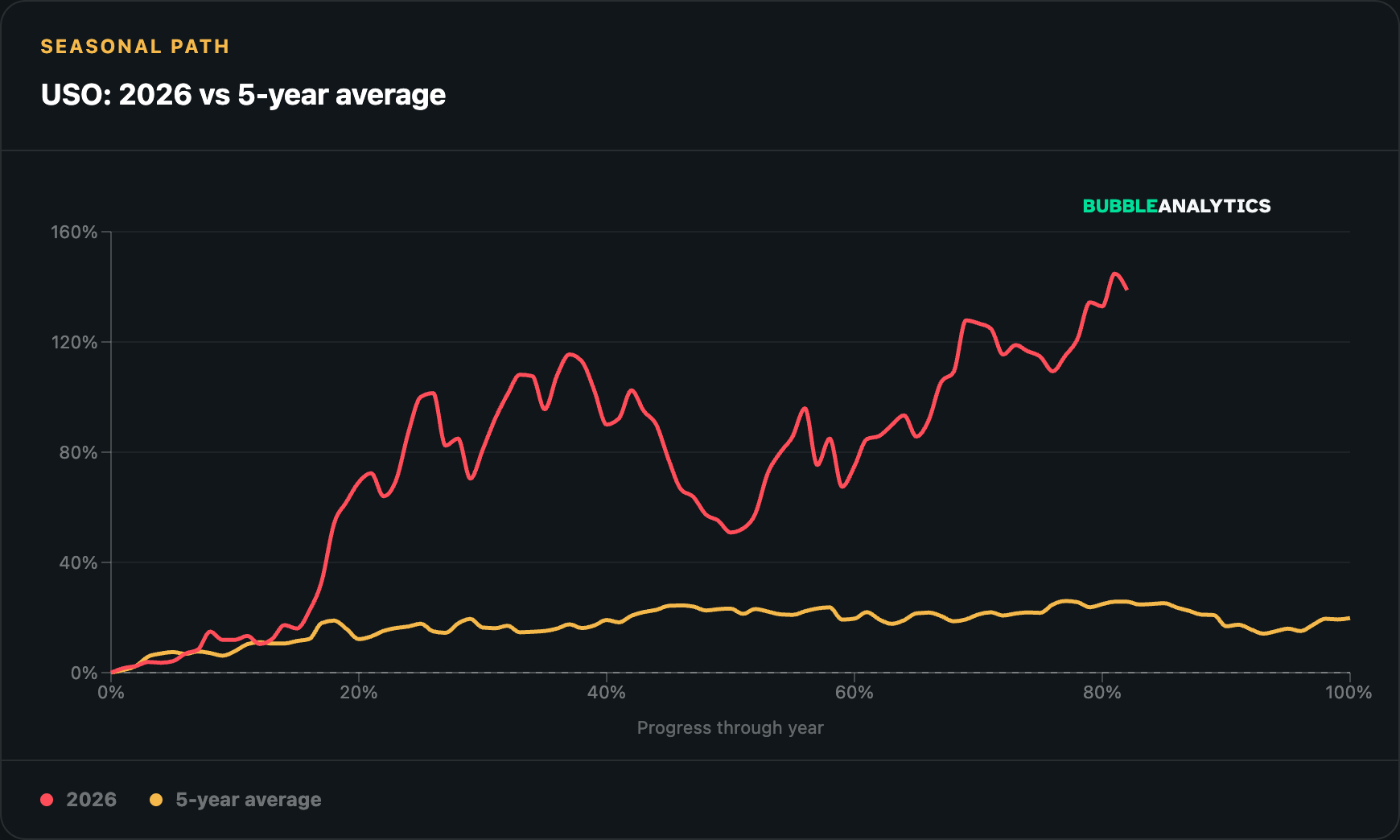
Last week we were looking for a retest of support at 164.67, and we got that followed by brief new highs to the current uptrend on Friday, before settling back to close negative on the week. Not all that convincing in terms of a further breakout to the upside, but there is nothing to say this isn't consolidation of recent gains so an outright top call would be risky here. Wednesday's US petroleum report should help distinguish domestic inventory conditions from the international shipping story. Support lies at 164.67 then 152.48, and given last week's failed breakout attempt, we favour a test of the bull's resolve over the coming week.
US bonds: protection has become a crowded trade
Asset managers increased their ten-year Treasury futures net long by 74,748 contracts to 3,000,164 over 20–27 October. They added 33,633 longs and covered 41,115 shorts. Both sides contributed to the increase in exposure. The position reached the top of its available four-year percentile range, making this a much more crowded allocation than the modest gold rebuilding or reduced WTI net long.
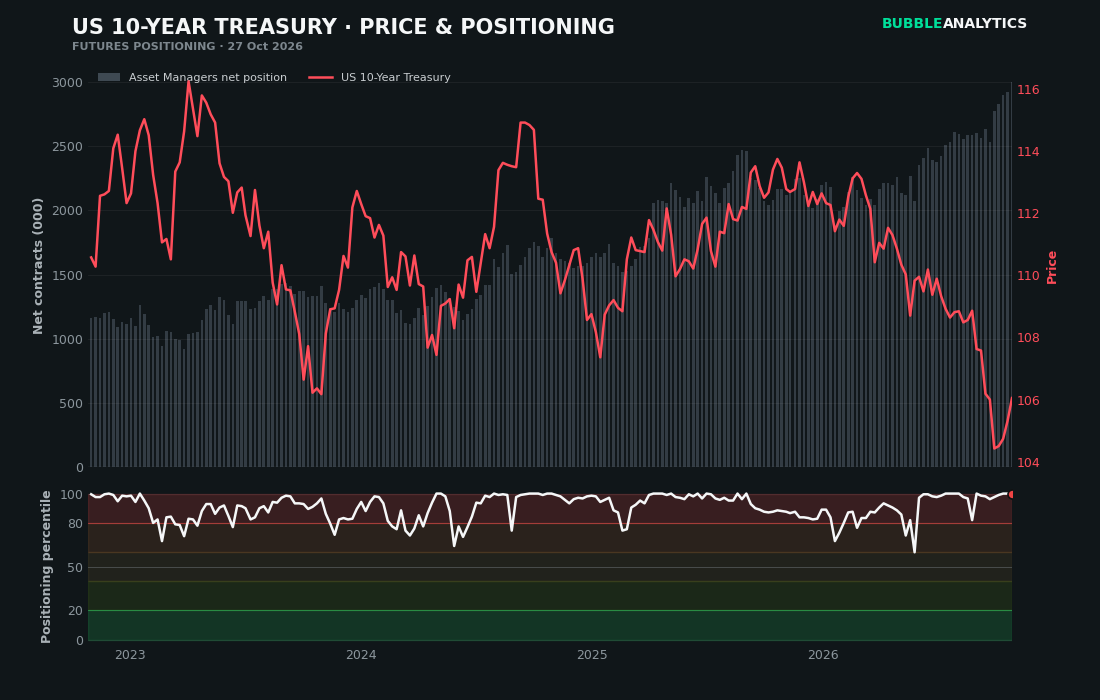
Wednesday–Friday inference: The late-week Treasury rally probably reinforced institutional demand for duration. The official ten-year par yield declined from 5.05% on Wednesday to 4.94% on Friday, including a four-basis-point fall from Thursday. We think the next positioning report is more likely to show continued support than a decisive retreat, provided the first two sessions of November don't reverse that move.
The attraction is clear: investors can seek protection from deteriorating growth expectations without relying on gold as the hedge, but a popular defensive trade can still suffer when the reason for holding it changes. The Fed's reluctance to ease, persistent consumer inflation and oil's supply premium all limit how confidently we would extrapolate the recent decline in yields. The longer bond price decline shown in the chart is still the larger trend in play, with this recent price action likely a corrective bounce.
Five-year IEF seasonality is mildly supportive, with an average Week 45 return of approximately 0.40%. We expect bonds to retain an early bid if equities struggle, but we'd be more cautious about extending that call through the whole week. Wednesday's Treasury refunding announcement adds a supply catalyst before Friday's employment report. Auction sizes and financing guidance can matter even when the immediate demand for protection is strong.
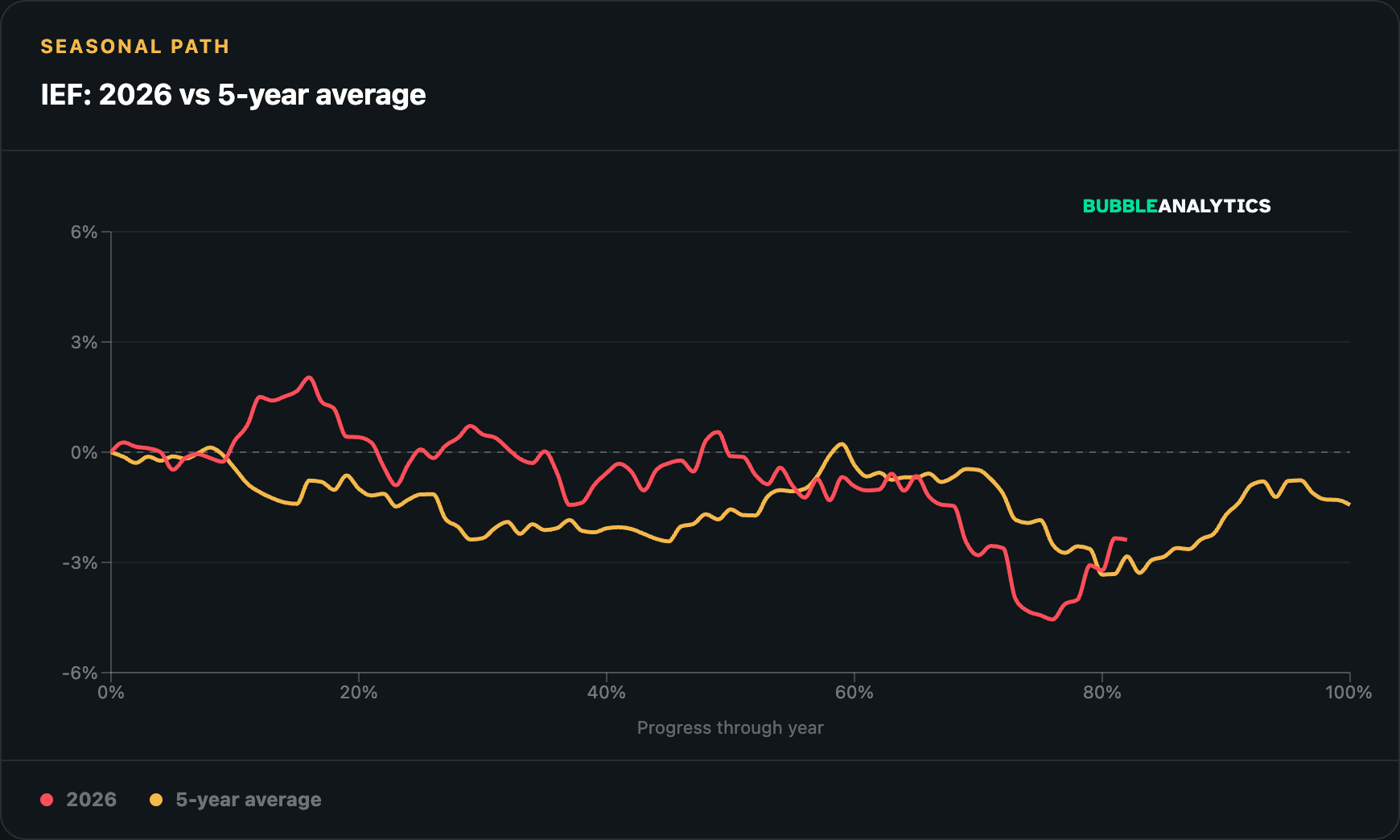
Last week we favoured early strength followed by a pullback into the weekend, but the opposite played out and we saw a further strong move higher on Friday with the equity market weakness. Our preferred path for this week is along the same lines, with a pullback into wednesday followed by a retest of the recent highs. IEF support lies at 90.83 with resistance at 91.74, and the major target for this bounce overall stands at 92.37 - 92.70.



Comments
Log in or sign up to join the conversation.