


Week 44 | Outlook: 26–30 October 2026
Finding something to buy was easier than finding somewhere to hide this week, at least initially anyway. Technology shares recovered before another sharp reversal, Treasury bonds offered protection and then gave some of it back, and quite unusually gold struggled despite a decidedly uncomfortable geopolitical backdrop. By Friday, defensive equity sectors were falling too. We think the coming weeks will test whether this is still normal rotation within the market, or the start of a more demanding adjustment to the price of money.
The problem isn't simply that companies have stopped delivering. Demand for AI infrastructure remains strong, but the risk of providing the funding required to meet it is becoming harder to ignore. Solidigm's decision to stop reviewing a possible flotation, while maintaining its investment ambitions, captures the tension. A business can have customers and still face an awkward financing decision. For equity investors, evidence of demand now needs to be accompanied by a convincing route from investment to cash generation.
Oil makes that judgement harder. Renewed concern about Middle East disruption pushed crude higher into Friday, threatening another squeeze on costs just as investors were looking for reassurance on margins. Meanwhile, October's flash US business survey still described firm expansion alongside stronger price pressure. This is an uncomfortable combination for anyone expecting weaker share prices alone to persuade central banks to offer quick relief.
Consumers provide a different perspective. October's final sentiment reading was 48.0, barely changed from September's 48.1, while expectations for inflation over the next year rose to 4.7%. Households can feel squeezed even when businesses are busy. We think that distinction will matter for the Fed: the economy contains pockets of genuine strain, but the evidence doesn't yet give policymakers an easy choice between supporting growth and containing prices.
There is also more resilience beneath the US index headlines than a simple panic narrative would suggest. Our breadth reading remains mixed but has improved over the past month, even as market sentiment has moved further into fear. While that leaves scope for a rebound, equally we shouldn't mistake every bounce for a fresh expansion in risk appetite, particularly when the largest companies still have important spending decisions to explain.
This week the Fed and Bank of Canada decisions arrive on Wednesday, followed by US GDP and PCE inflation and the ECB on Thursday, then the Bank of Japan and US employment costs on Friday. Microsoft and Alphabet report on Wednesday, with Amazon on Thursday. We favour an attempt at stabilisation early in the week, followed by a much harder examination of earnings quality and inflation. The stronger seasonal period ahead helps, but it doesn't settle those questions.
US indices: all eyes on Wednesday
The COT report covers Tuesday 13 to Tuesday 20 October, before the week's final three sessions. Leveraged funds reduced their S&P 500 net short from 408,726 to 371,245 contracts, an improvement of 37,481. They added 13,630 longs and covered 23,851 shorts. That is a less defensive position, but it remains a substantial net short, with signed net exposure at the 27.8th percentile of its rolling four-year history. The report shows a willingness to reduce caution, rather than broad speculative enthusiasm.
Nasdaq positioning offers a useful contrast. Leveraged funds moved from a net short of 11,593 contracts to a small net long of 950. The latter sits at the 95.2nd percentile of its own history. It would be misleading to call that an enormous outright long position, but the shift does show how much of the earlier caution had already unwound before Thursday's sell-off. There was less protection from a deeply defensive starting position than the S&P figures alone might suggest.
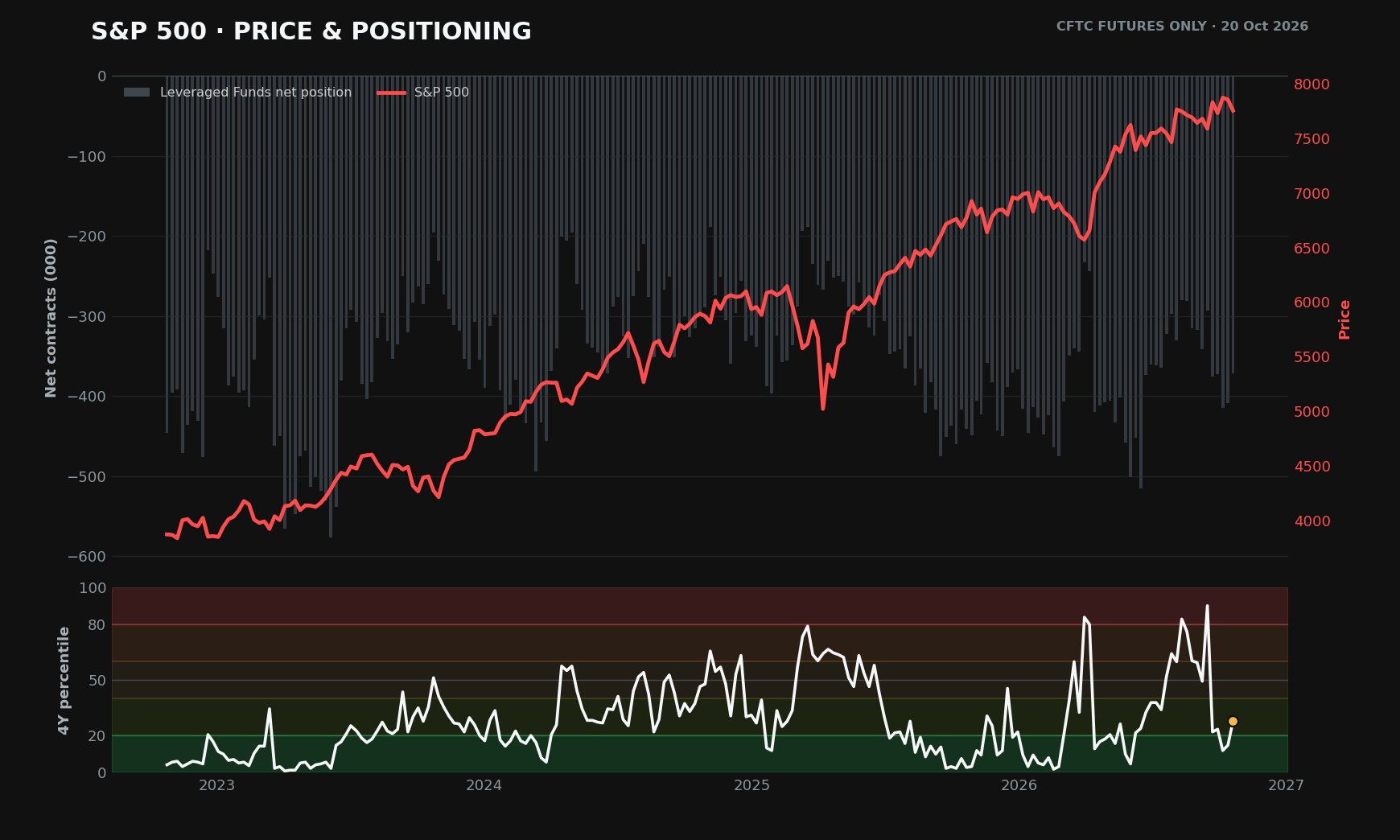
Wednesday–Friday inference: We think the failed recovery will have encouraged renewed hedging and left the next report less constructive, particularly in the Qs. Wednesday's advance was overtaken by Thursday's losses, and Friday closed with the S&P down about 0.5%, the Dow about 1.2% and the Nasdaq about 0.2%. The weakness reaching defensive sectors is more concerning than another isolated semiconductor wobble. Monday and Tuesday's response to that selling will help determine how much of the earlier positioning improvement survives.
The breadth evidence nevertheless argues against assuming the whole market has broken. As of 23 October, about 59% of S&P constituents remained above their 50-day average and 58.6% above their 200-day average. Our breadth score (free on the website) was 57.5, while sentiment stood at 33.1 in fear territory. The five-year SPY seasonal path, based on 2021–2025, also rises through late October and more strongly into November. That combination supports a recovery attempt without giving it a free pass.
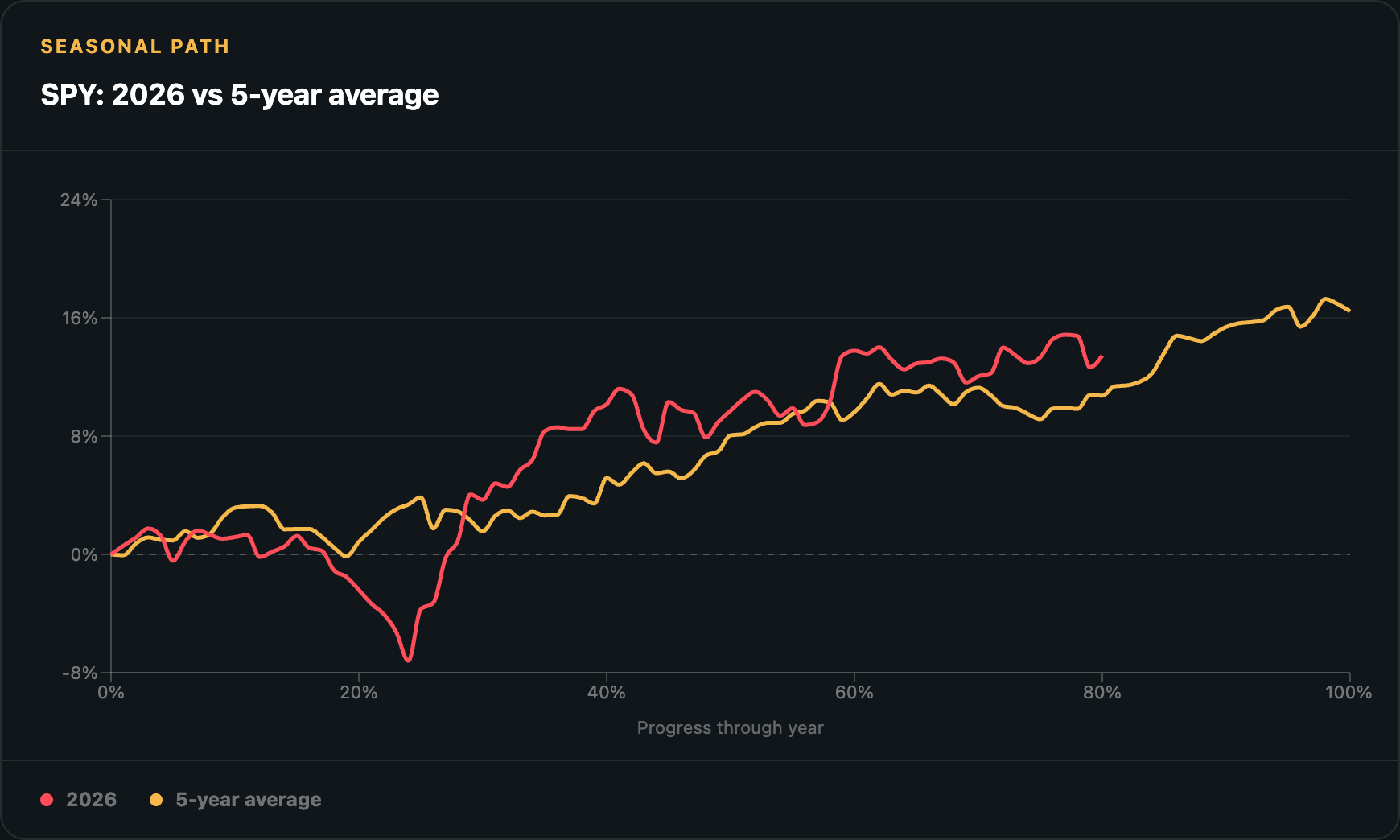
For the next five sessions, we favour an early muted bounce that meets renewed selling around the policy decisions and major technology results. The wider equity advance can survive a correction, but we expect the immediate recovery to remain selective. A rally that broadens after Wednesday, accompanied by calmer oil and bond markets, would be the strongest reason to abandon that cautious view. SPY support 740.71-749.83; SPY resistance 775.98.
Gold: still the safe haven of choice?
Gold's 13–20 October COT report shows managed money reducing its net long from 107,089 to 104,206 contracts. The 2,883-contract decline came from cutting 3,777 longs while covering 894 shorts. Positioning is now close to the middle of its four-year range, at the 49.8th percentile. The market is less crowded than it was, but a more moderate position is only a starting point for recovery. Buyers still need a reason to return.
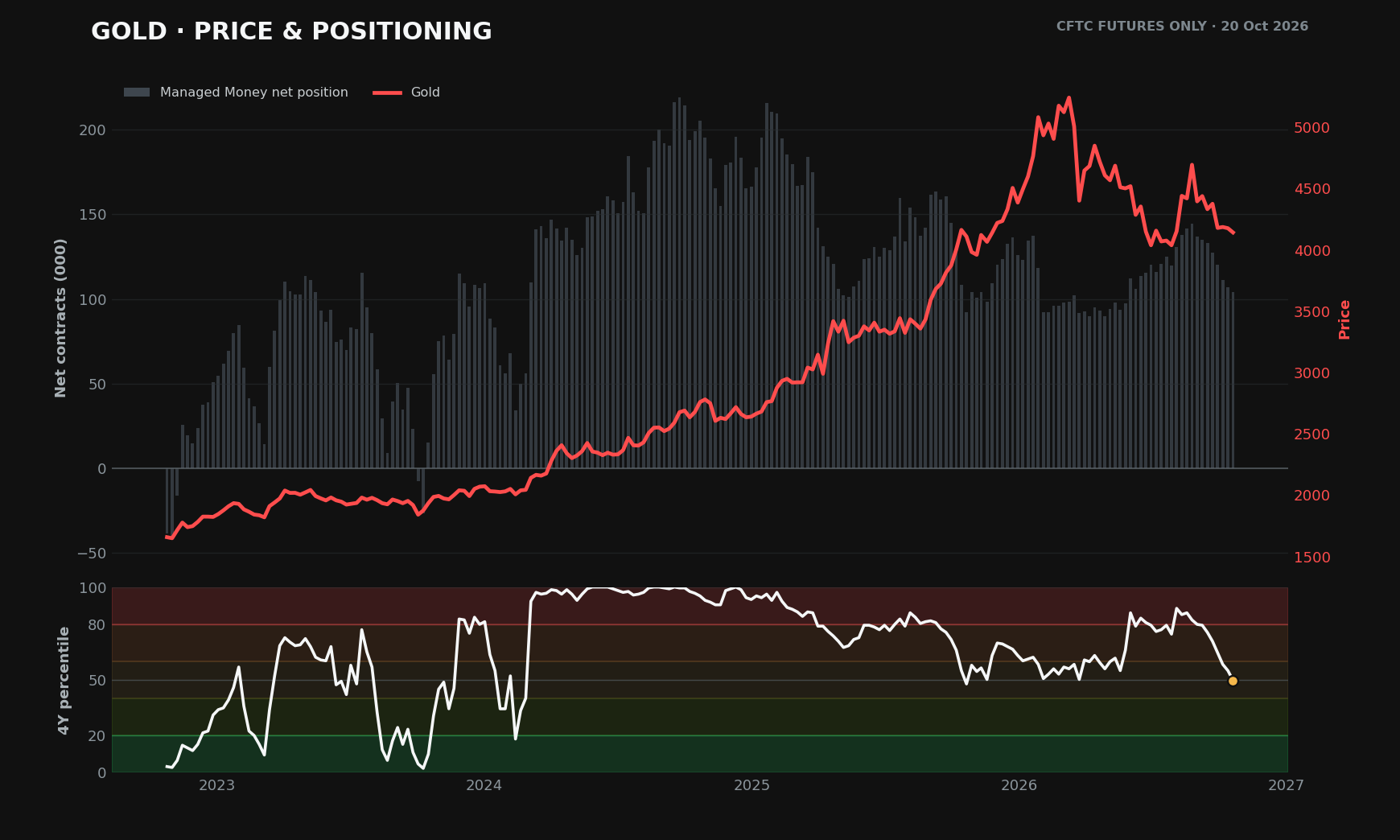
Wednesday–Friday inference: We think the continued weakness points towards further trimming of speculative length in the next report. Gold failed to benefit consistently from equity anxiety and Thursday's Treasury rally, then remained under pressure into Friday. That response suggests investors were more concerned about financing costs and the inflation implications of oil than attracted by gold's defensive reputation. A sharp change in the dollar or rates early next week could interrupt the retreat, but the latest price response gives little reason to presume it has already ended.
The five-year GLD seasonal path is subdued across this late-October stretch before recovering into November. It offers a more encouraging backdrop further ahead, rather than a strong immediate impulse. This year's path has also been much weaker than that seasonal average. We think the practical question is whether gold starts responding positively to supportive news again. A market that can't hold a rise when yields fall has more repair work to do than its positioning percentile might imply.
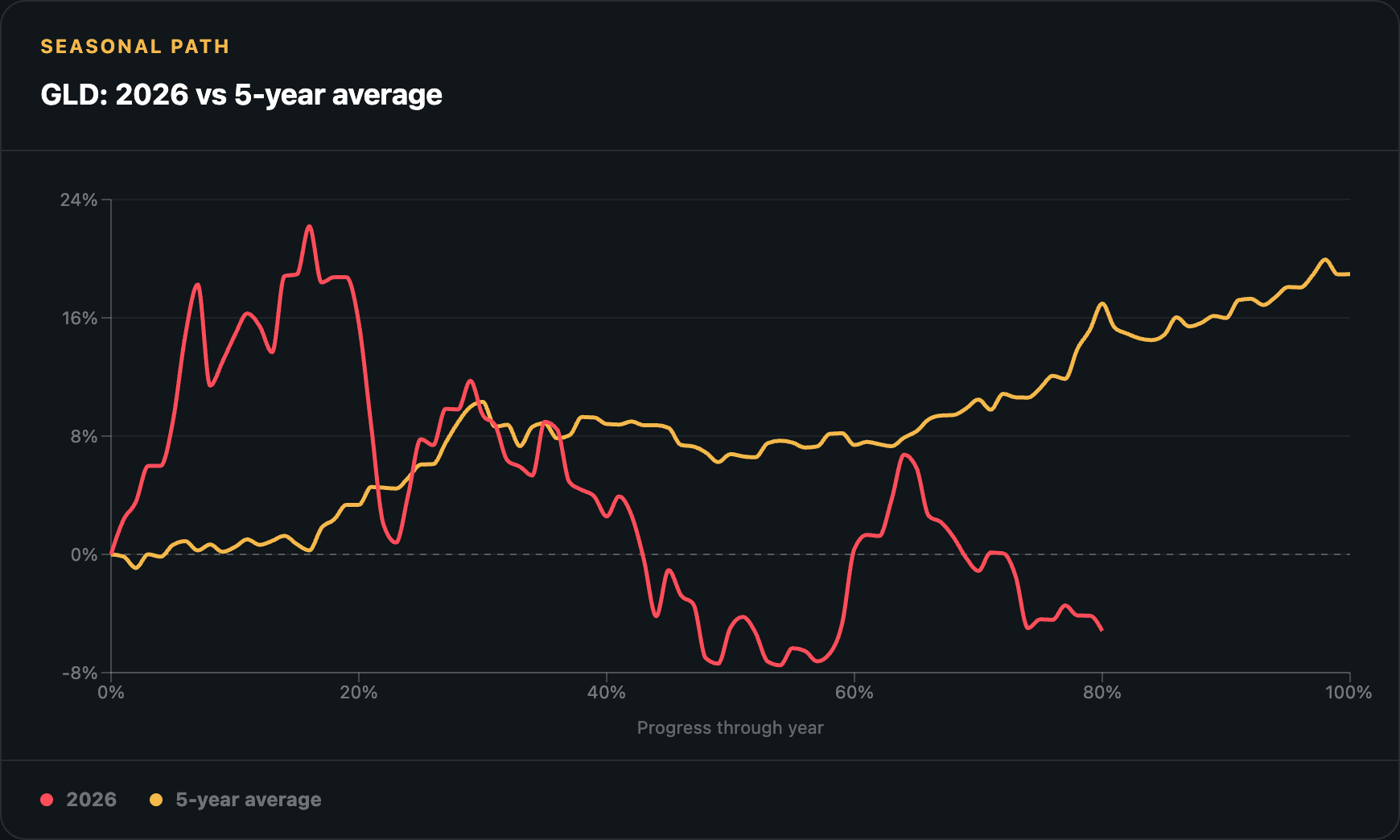
Fear in equities can eventually create demand for bullion, but this week's experience shows why we wouldn't build a forecast around that relationship alone. We had thought a low was imminent, but this week's action has damaged that perspective somewhat, and we think we may see a test of support this week, which for GLD is 351.83. Our preferred five-session path is an attempted early rebound that struggles to carry through the Fed decision and Thursday's inflation release.
Oil: lightly held doesn't mean lightly priced
Managed money reduced its WTI net long from 40,574 to 36,187 contracts between 13 and 20 October, a fall of 4,387. Longs declined by 8,560 contracts, more than the 4,173 shorts that were covered. The net position sits at just the 10.5th percentile of its four-year range. Speculative length was therefore relatively light going into the latter part of the week, even though the oil market was already dealing with persistent supply uncertainty.
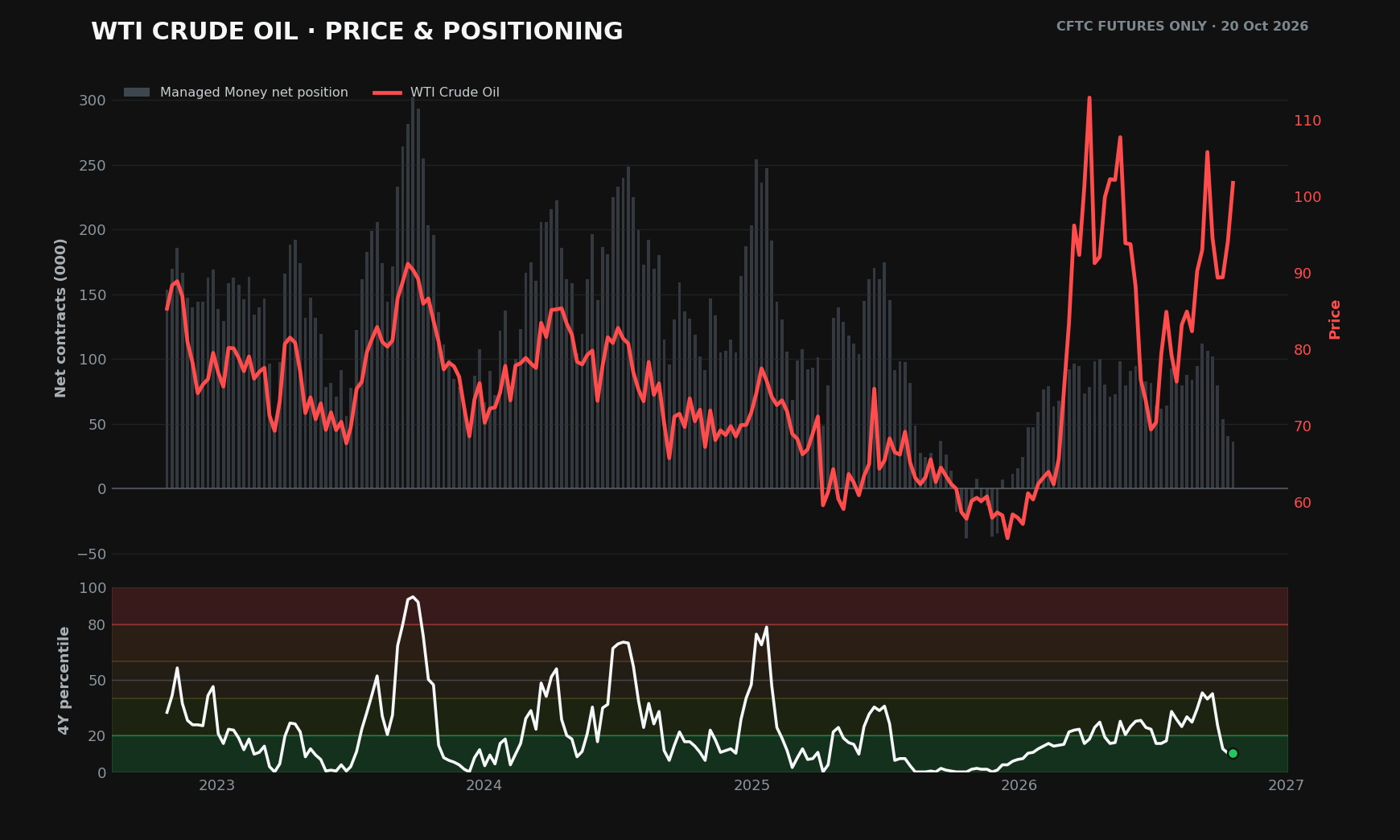
Wednesday–Friday inference: Renewed buying on disruption fears makes a rebuilding of net length more likely in the next report. The strength into Friday suggests traders were willing to pay for protection against a worse supply outcome. With the reported position starting so low in its own range, the rally doesn't require an already crowded speculative trade to become still more crowded. All told that leaves room for further buying if the physical situation deteriorates.
The counterweight is that higher prices and uninterrupted disruption are different propositions. Reports of recovering Gulf crude flows sit alongside continuing concerns about product shipments and infrastructure. We think the distinction matters more than the daily sequence of alarming headlines. If crude availability keeps improving, maintaining the latest risk premium becomes harder. If transport routes or production are hit again, an apparently expensive barrel can become more expensive very quickly.
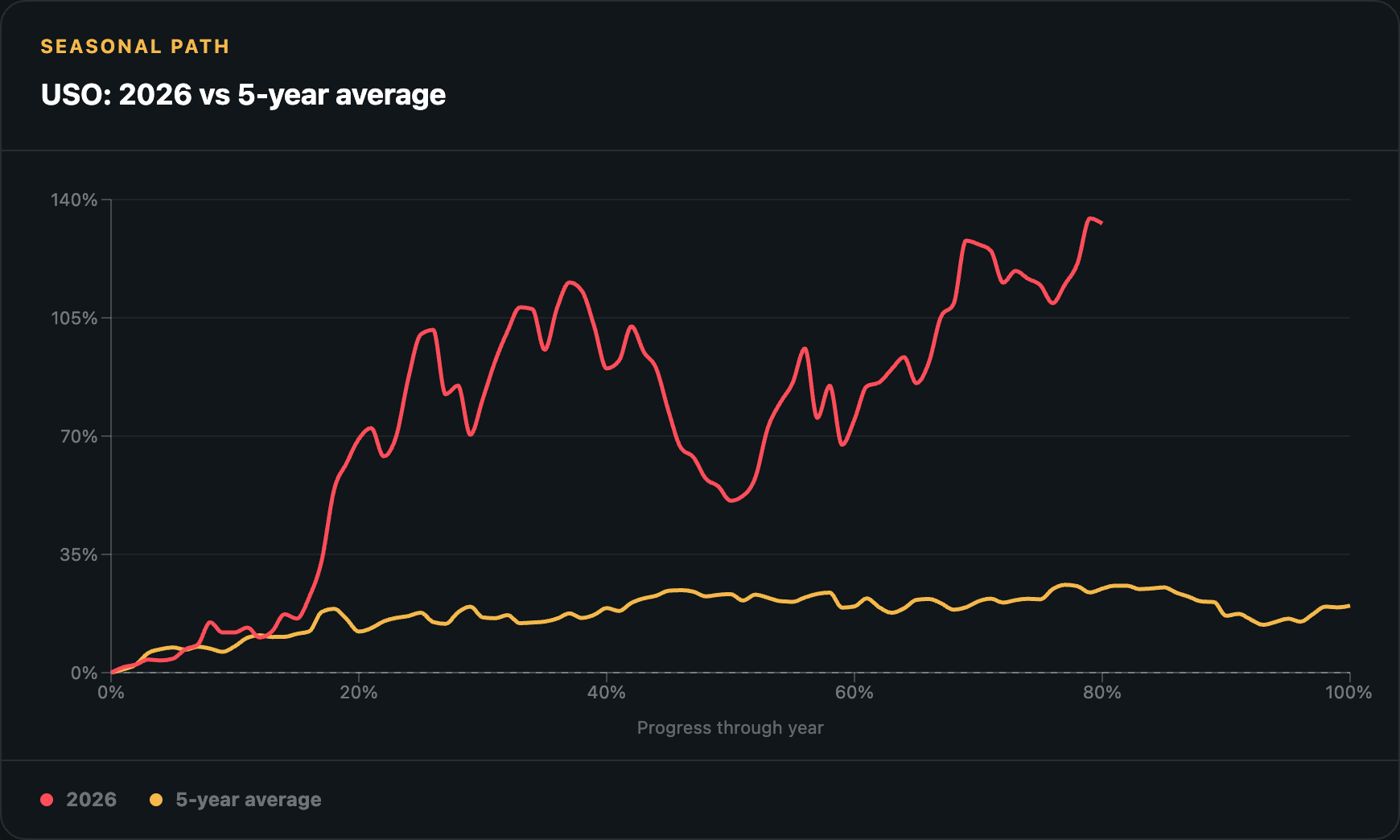
The five-year USO seasonal path softens around the end of October and deteriorates further during November. That is a headwind to extrapolating the latest rally, although current supply risks are a stronger immediate influence. Wednesday's petroleum report will help test the balance between available supplies and demand; ExxonMobil and Chevron's Friday results will add information on operating conditions. Equity market fear is relevant to the growth outlook, but it is not yet evidence that physical oil demand has collapsed.
We favour a soft start to the week ahead with some easing of the risk premium if no fresh material disruption emerges. That would be a pullback within the recent rise, rather than a top. USO support now lies at 164.67 and we would expect that to be tested near term; USO resistance is 184.43 giving room for a decent trade should support hold. For the other markets, oil's ability to hold its gains may matter as much as anything said in an earnings call. Sustained strength would keep pressure on margins and make the bond market's hopes for relief harder to fulfil.
US bonds: dead cat bounce in play?
Treasury asset managers increased their 10-year futures net long from 2,898,562 to 2,925,416 contracts over 13–20 October. The 26,854-contract addition consisted mainly of covering 24,050 shorts, alongside 2,804 new longs. Signed net exposure is at the 100th percentile of its rolling four-year history. Institutional positioning was already stretched towards the long side before Thursday's defensive rally. That doesn't prevent further gains, but it makes the market more vulnerable if the inflation outlook disappoints.
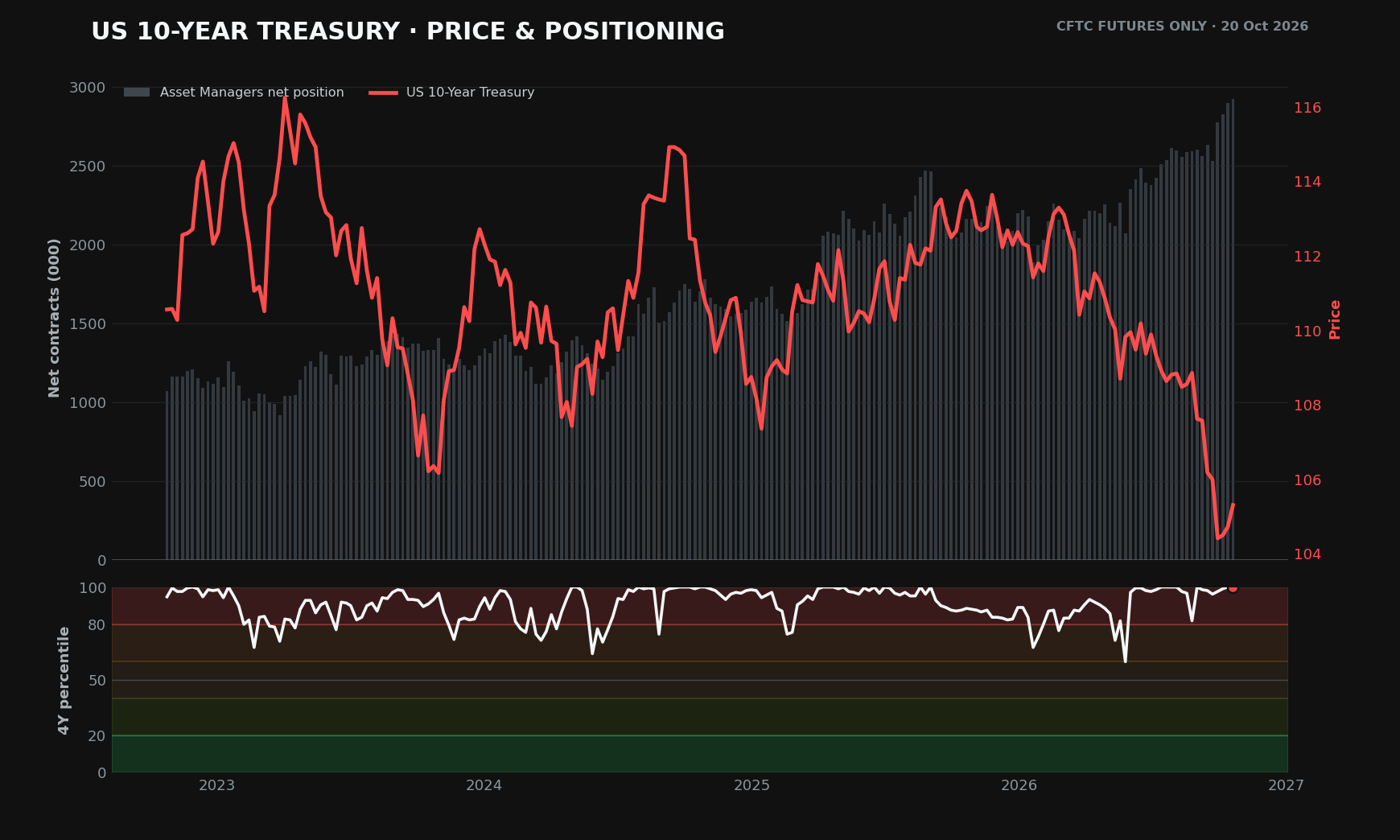
Wednesday–Friday inference: We think Thursday's strong buying probably reinforced the preference for duration, although Friday's yield rebound will have reduced the conviction behind chasing it. The 10-year yield returned to around 5% in late Friday trading. Treasuries had demonstrated that they could still cushion an equity shock, but the following session also showed that expensive oil and firm activity could quickly bring the inflation concern back into view.
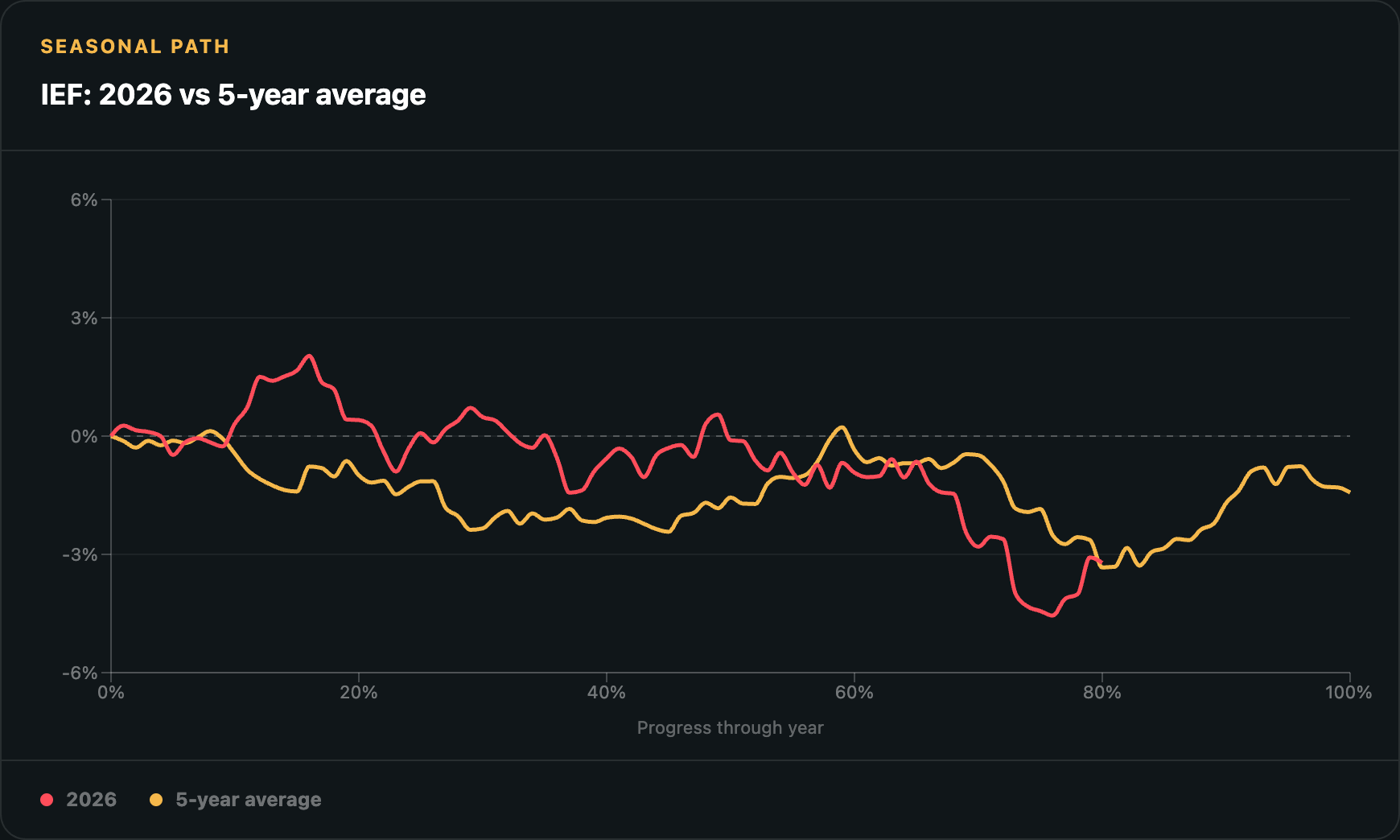
The five-year IEF seasonal path is uneven around the end of October, with a more sustained improvement later in November. It doesn't give us a strong reason to expect an uninterrupted rally over the next five sessions. The recent bounce also sits within a much weaker price trend. Fearful equity sentiment can support bonds, but the improvement in S&P breadth and resilience in business activity make a straightforward recession trade premature.
We expect defensive demand to offer some support early in the week, with the greater risk of a setback from Wednesday onwards. Our preferred outcome is that the Fed remains cautious about inflation, leaving Thursday's GDP and PCE releases and Friday's employment costs to challenge hopes of rapid relief. We would therefore treat early strength as a recovery within the broader decline in bond prices, rather than confirmation of a new sustained uptrend. Over the coming weeks we still favour a choppy bounce into TLT resistance 84.20-85.52.
The difficult feature of this market is that the same oil shock can hurt equities and limit their usual bond hedge. We think that argues for judging each defensive asset on its actual behaviour. Gold needs to regain a positive response to falling yields, Treasuries need inflation to co-operate, and defensive shares still need margins that can withstand higher costs. Shelter exists, but this week has shown that it has gaps.
Our next article will be published on Sunday. Until then, we wish you well for the week ahead. If you have any questions about anything covered here, please get in touch. We’re always happy to hear from you.



Comments
Log in or sign up to join the conversation.