


Week 46 | Outlook: Monday 9–Friday 13 November 2026
Are you not entertained? Thursday saw carnage for tech stocks, and although Friday gave investors a little breathing room, it would be generous to call it a recovery. The Nasdaq Composite rebounded about 1.1% after Thursday's 5.5% fall, while the S&P 500 gained just 0.3%. We think buyers have a reasonable chance of extending that rebound into the start of this week, but the argument for a lasting low is tenuous at best, and we see the chances of new lows in November as high odds at this moment in time.
The election has added another complication to the AI investment story. The prospect of greater scrutiny over data centre construction has forced investors to reconsider how quickly projects will proceed, with concerns about future policy/regulation dampening the mood. While we may not see outright project cancellations, we may see a more hesitant build out from here on as lending risk is reevaluated, which will have a knock on effect to suppliers dependent on that expansion. We think this backdrop is likely to keep AI stocks trading unevenly for the foreseeable future, and has the potential to cause a further flush in tech generally.
Friday's employment figures gave the economy a firmer footing without offering much help to hopes of easier monetary policy. October payrolls rose by 165,000, unemployment was 4.1% and average hourly earnings increased 0.4% over the month. That isn't the sort of report that forces the Fed to rescue falling share prices. It supports household income and company revenues, but also leaves Tuesday's inflation release with considerable power to interrupt the rebound.
Oil offers a possible route to relief, having fallen sharply as hopes of diplomatic progress reduced the premium for supply disruption. Unfortunately, the weekend begins with further reports of military action as well as negotiations. We wouldn't assume that lower oil prices already mean normal shipping conditions have returned, and while a sustained decline in energy costs would help the inflation outlook; another escalation could quickly put that benefit in doubt.
Our market breadth score remains mixed, even while sentiment has fallen into extreme fear, and that combination leaves room for sharp rallies in the areas that have suffered most. Tuesday's CPI and Friday's PPI bookend the main inflation risk data, while Cisco (CSCO) and Applied Materials (AMAT) report on Thursday. Wednesday's Veterans Day holiday closes the US cash-bond market while equities remain open.
US indices: how much of Thursday's damage can buyers repair?
The latest COT report covers Tuesday 27 October to Tuesday 3 November. Leveraged funds narrowed their S&P 500 net short by 28,286 contracts to 372,318, adding 23,190 longs and covering 5,096 shorts. We see that as a reduction in pessimism before the election reaction, but with a substantial net short still in place. Nasdaq-100 funds increased their net long by 7,772 to 10,073, near the upper end of its historical range. Russell 2000 positioning moved the other way, with the net short deepening by 6,999 to 55,080. There hasn't been a unified bullish move across the indices in some time now.
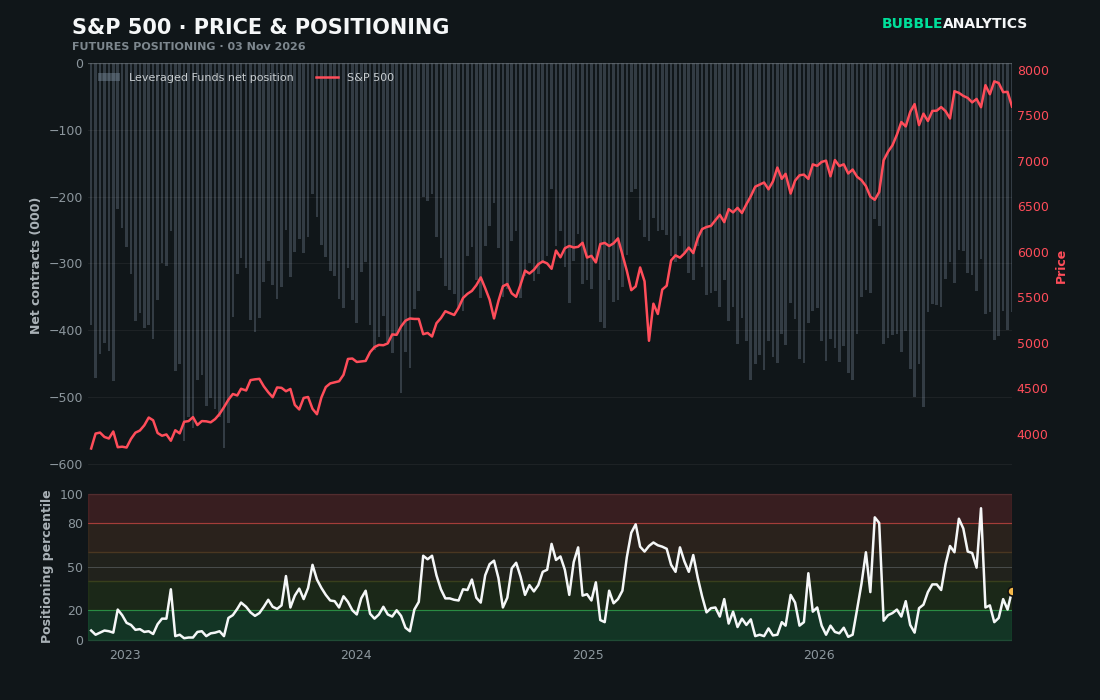
Wednesday–Friday inference: We think Thursday's reversal probably undid some of the earlier improvement in speculative appetite, particularly in technology. Friday's recovery softened the damage but left SPY below Tuesday's close. That favours a more defensive next report, although Monday and Tuesday still give buyers an opportunity to change the picture before the next snapshot.
Breadth at 54.4 and sentiment at 18.8 on 6 November make an interesting pairing. Participation is mixed, while market psychology is already in extreme fear. That would tend to support an initial recovery attempt more than it supports chasing fresh weakness immediately after a large fall. Five-year SPY seasonality supplies little additional help for this particular week: the average Week 46 return is approximately +0.02%, effectively flat, despite the more encouraging shape of the wider November profile.
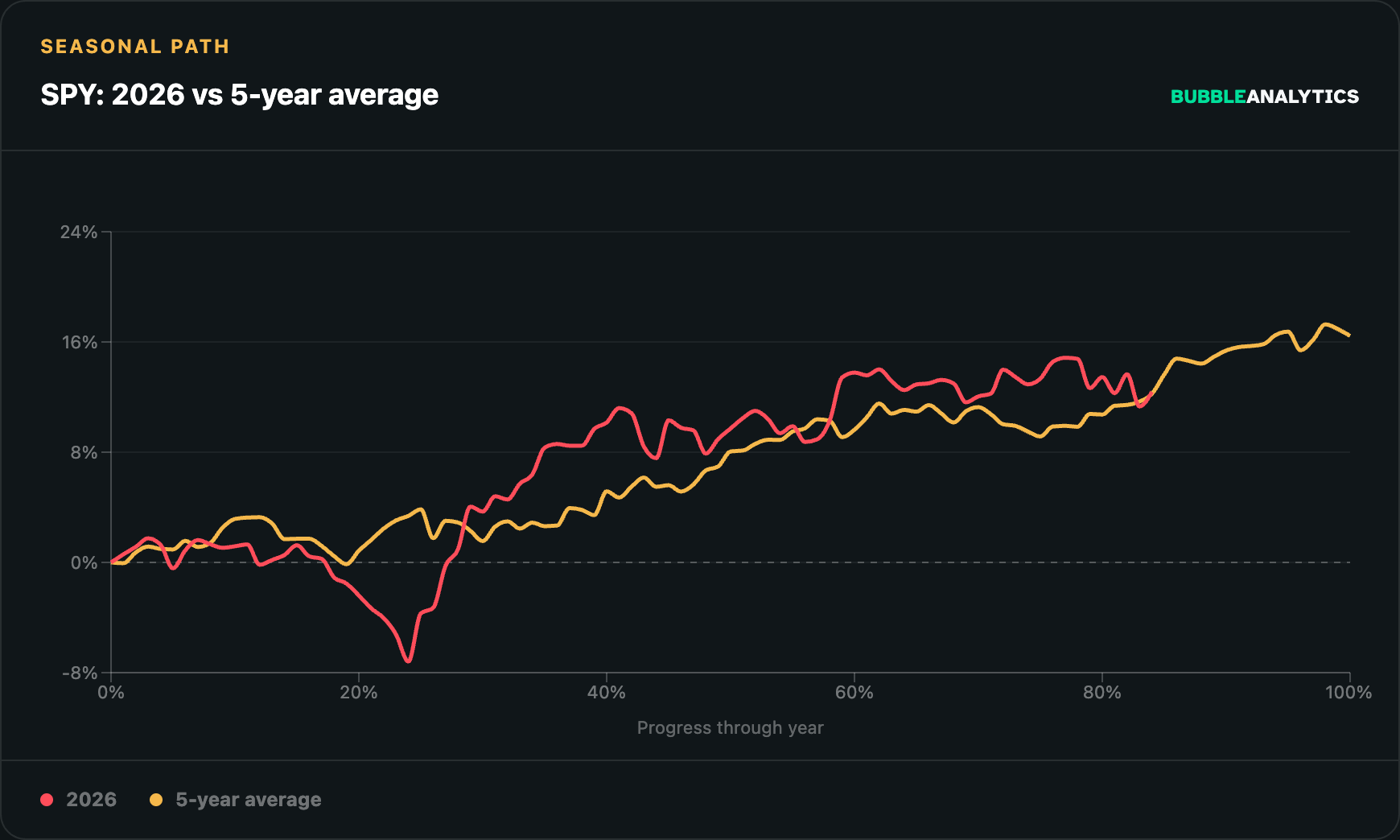
Last week's expected sequence broadly worked: an early recovery into midweek, then renewed selling. SPY closed Wednesday at 766.81 before falling to 733.00 on Thursday and recovering only to 735.29 on Friday. The condition for a more convincing low, a Friday close holding 749.83 failed, and the next support we had identified at 740.71 was scythed through with ease. For the coming week we favour some attempt at an early bounce, then renewed selling pressure. Resistance stands at 740.71-749.83; next downside target is 723.07.
Gold: political turmoil prompts a safe haven response
Managed money reduced its gold net long by 1,948 contracts to 103,614 between 27 October and 3 November. Longs fell by only 225, while shorts increased by 1,723. That position remains around the middle of its 4 year range, and left room for the subsequent recovery which doesn't require an exceptionally bearish starting point given the move we have seen in price. The report covering Tuesday 3 November itself shows reduced bullish exposure rather than the buying people may have inferred from the later price rise, meaning we can likely expect a sharp change when the next CoT report is released on Monday 16 November, covering positions as of Tuesday 10 November.
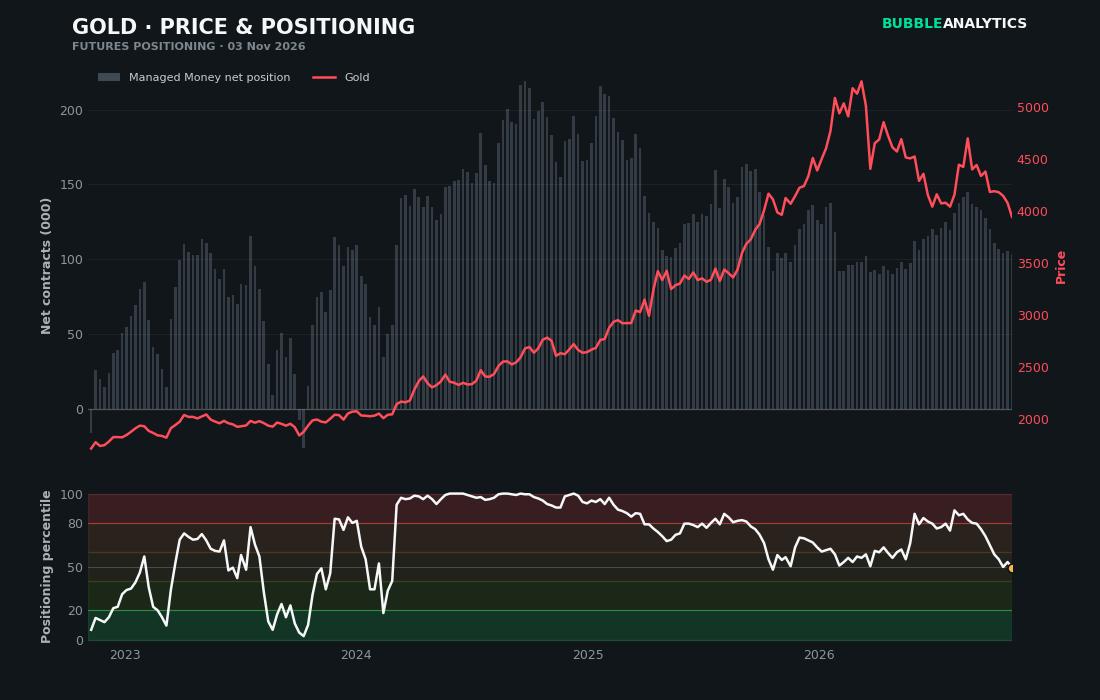
Wednesday–Friday inference: The strong rise through Thursday probably encouraged renewed bullish exposure after Tuesday's trimming. Friday's retreat took some of the enthusiasm out of the move, but GLD still finished well above Tuesday's close. We think the next report is more likely to show strong rebuilding rather than another decisive reduction, provided the first two sessions of the coming week don't reverse those gains.
Gold is now showing the defensive response that was missing from the previous week's trading. The Democrat clean sweep in the mid-terms throws the cat amongst the pigeons at home, and may prompt a more urgent response from the Trump presidency abroad. We think gold now has what it needs for this rebound to develop into a sustained rally. The 5 year Week 46 average is approximately −0.46%, so seasonality argues for allowing some consolidation after the recent advance, but we are now so far under the average return a sharper rebound cannot be ruled out.
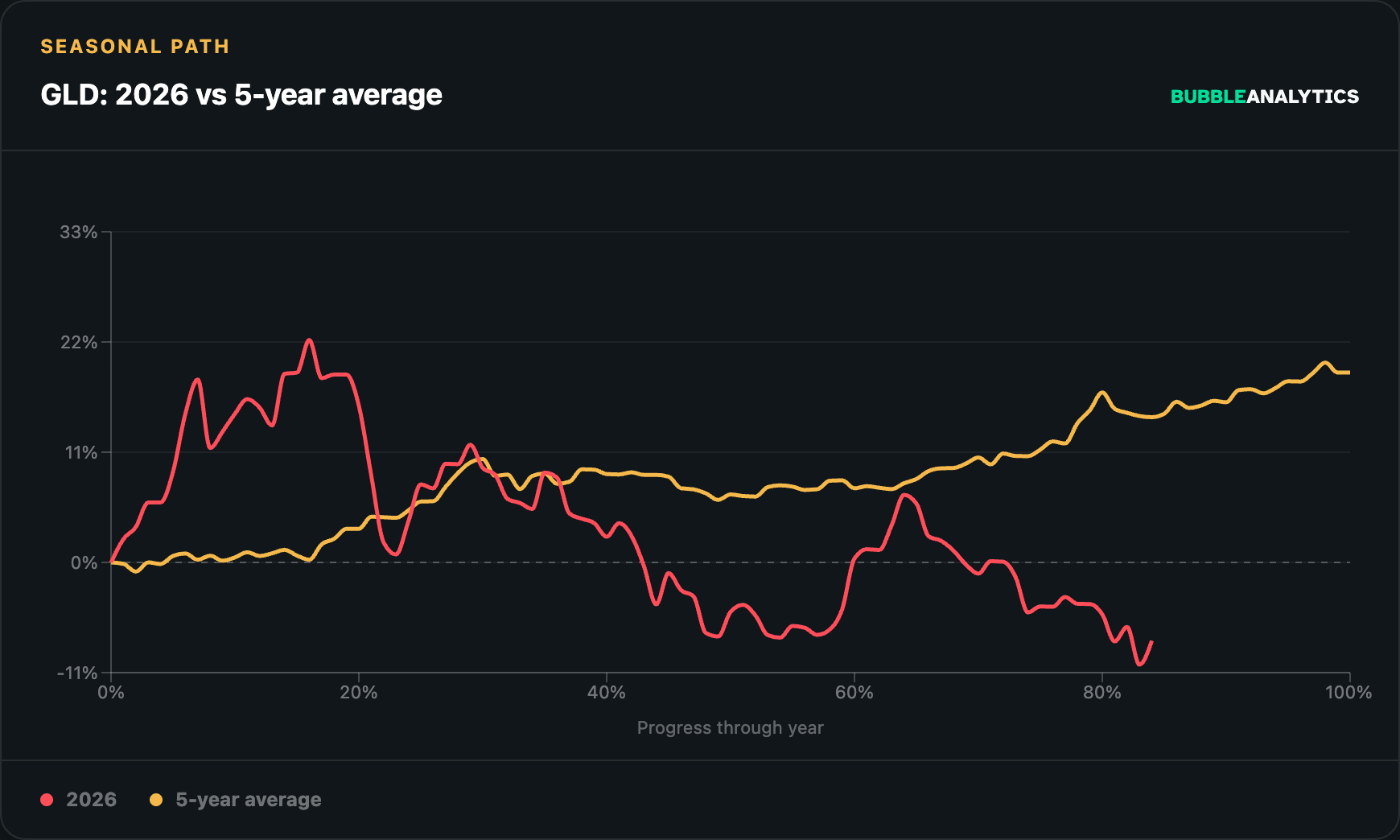
Last week we were looking for initial hesitation, followed by scope for a muted bounce that may turn into something more if the mid-terms bring political chaos. Looks like we got that chaos, and GLD finished at 372.52 on Friday, around 4.7% higher than the previous week's close. This week we favour some initial consolidation, followed by an attempt to take out Thursday's high of 378.97 which, if successful, gives us scope for a more sustained rally into year end with the first upside target at 408.23.
Oil: the bulls were tested rather more than expected
WTI managed money reduced its net long by 9,400 contracts to 21,728 over 27 October–3 November. Long liquidation of 10,051 outweighed short covering of 651. The remaining position sat near the lower end of its historical range. We think that describes a market with relatively little speculative enthusiasm already built in, which matters when considering how violently prices could respond to another supply scare. Short term however, it doesn't on its own establish that the selling has finished.
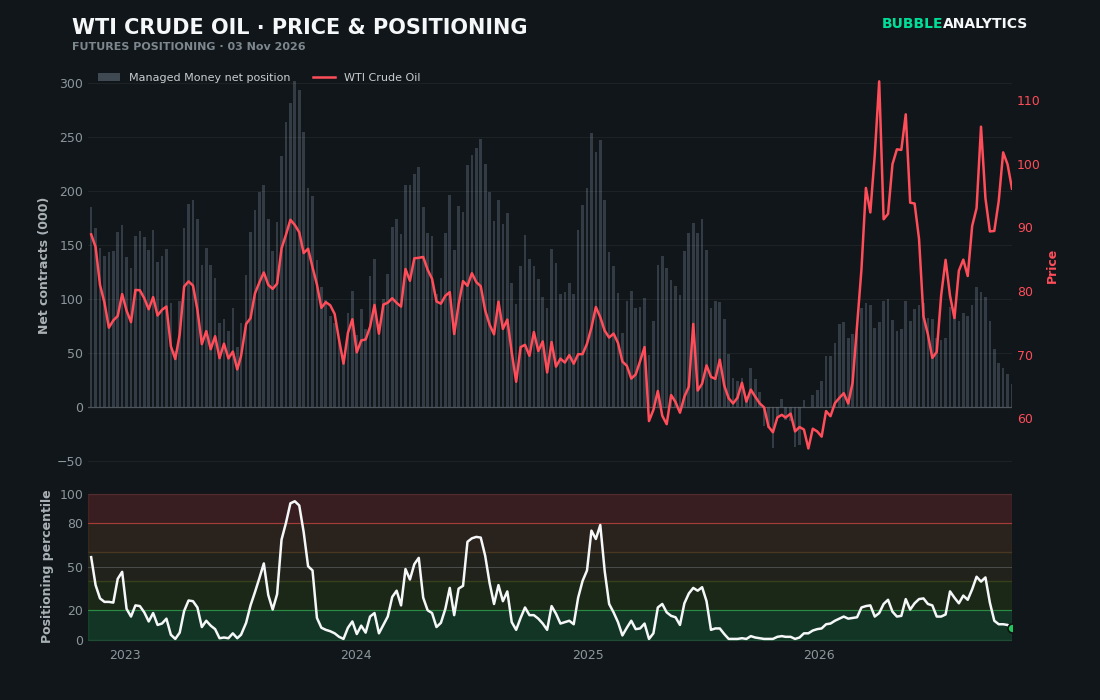
Wednesday–Friday inference: Wednesday's further drop probably extended the reduction in bullish exposure, while Thursday and Friday's partial recovery offered some relief. We think the balance still points towards reduced net length in the next report. Weekend developments and the first two sessions could alter that expectation quickly, given how sensitive oil remains to the perceived prospects for negotiations.
Reports of continued talks sit alongside fresh military developments around the Gulf. We don't see enough evidence to assume either a completed agreement or a lasting return to normal transport conditions. That leaves oil capable of opening higher even after such a sharp decline. Equity market fear adds a demand concern among oil stocks that can affect performance of the underlying commodity, but the immediate question remains unchanged - how much premium are buyers willing to pay for supply uncertainty.
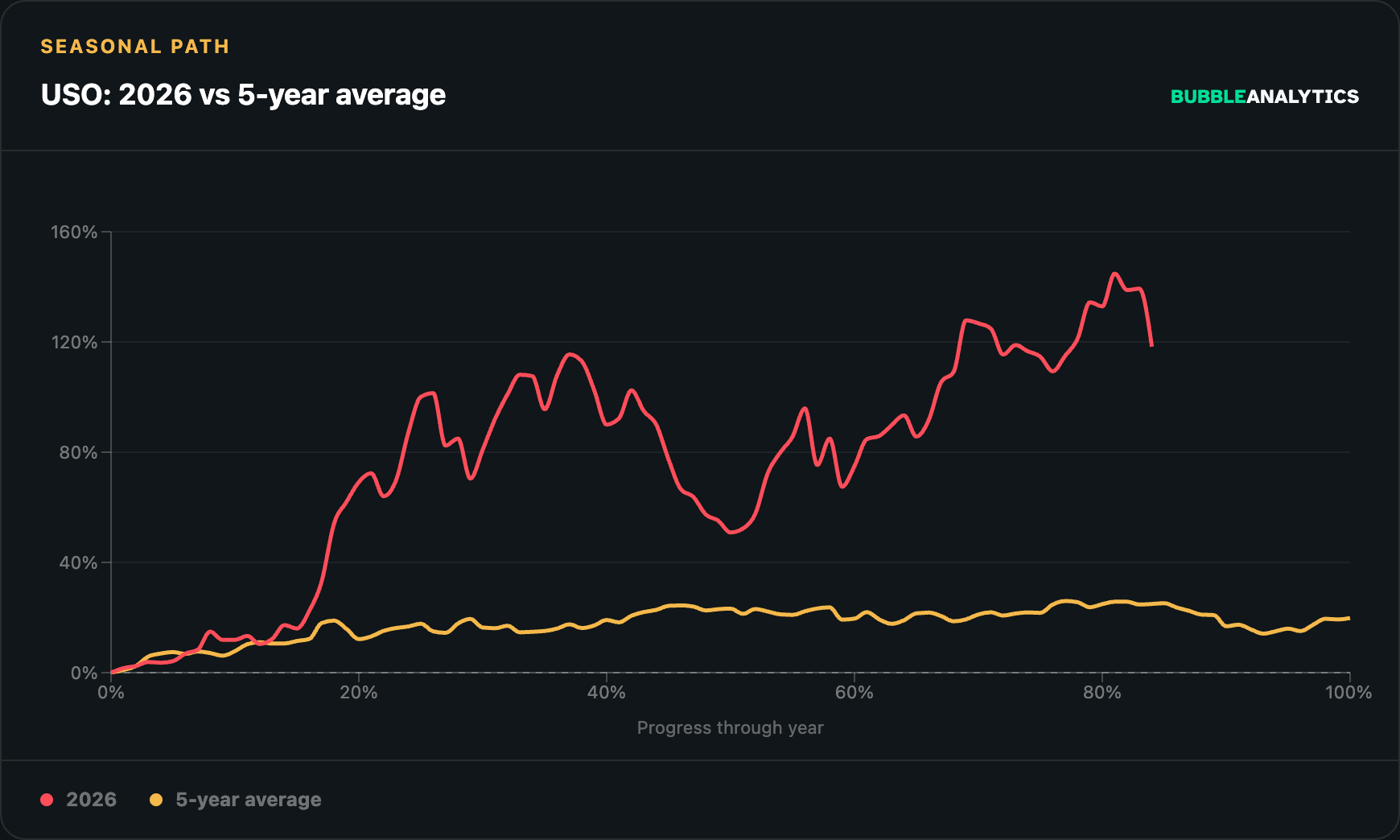
Five-year USO seasonality is the weakest of these four markets for Week 46, averaging approximately −3.41%. Thursday's petroleum report, delayed by the holiday to 17:00 GMT, offers a domestic check on inventories and demand but it can't settle the diplomatic question. We expect the recent decline to have marked a top of sorts, and lower prices are ahead generally unless supply news forces a reassessment.
Last week we favoured a test of the bulls' resolve while stopping short of calling an outright top, and that was probably too gentle a description of what followed. USO opened Monday below our first support at 164.67 and broke the lower 152.48 level on Wednesday, when it traded down sharply to 142.96. Friday's close at 148.41 left it approximately 12.1% lower over the week. This week we favour an opening recovery attempt on renewed risk concerns, with pressure on rallies as the week progresses. The former 152.48 support is the first of our existing levels worth watching on that recovery, with lower support now at 144.90 then 138.01.
US bonds: protection faces inflation fears and a crowded long position
Asset managers increased their 10Y Treasury futures net long by 30,072 contracts to 3,030,236 between 27 October and 3 November. They added 21,090 longs and covered 8,982 shorts. The position stood at the 99.5th percentile of its signed net-position history, so this remains a crowded defensive allocation. We think the demand is understandable given the recent decline in stocks, plus the absolute need for a relief rally in bonds, but the size of the existing holding leaves us open to a top if inflation data sours sentiment.
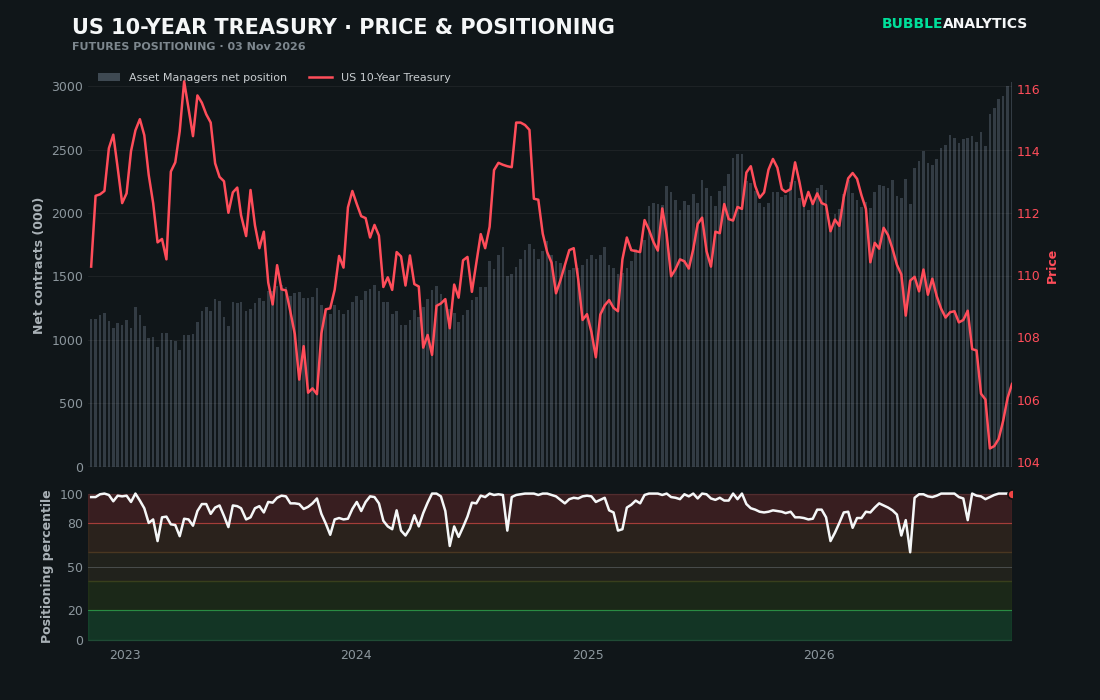
Wednesday–Friday inference: The recovery through Thursday probably reinforced demand for duration, with Friday's small IEF retreat tempering the addition. We think continued support is more likely than a wholesale unwind in the next positioning report. Tuesday's CPI arrives on the next observation date, however, and could materially alter that balance before positions are counted.
Five-year IEF seasonality is mildly positive, averaging approximately +0.14% for Week 46. Extreme fear in equities also helps explain why bonds have continued to rally, but economic data and this large existing long position make it hard to assume every dip will be now bought immediately. The Treasury sells three-year notes on Monday, ten-year notes on Tuesday and thirty-year bonds on Thursday. Those auctions will test demand alongside the inflation figures, with the cash market closed in between for Veterans Day.
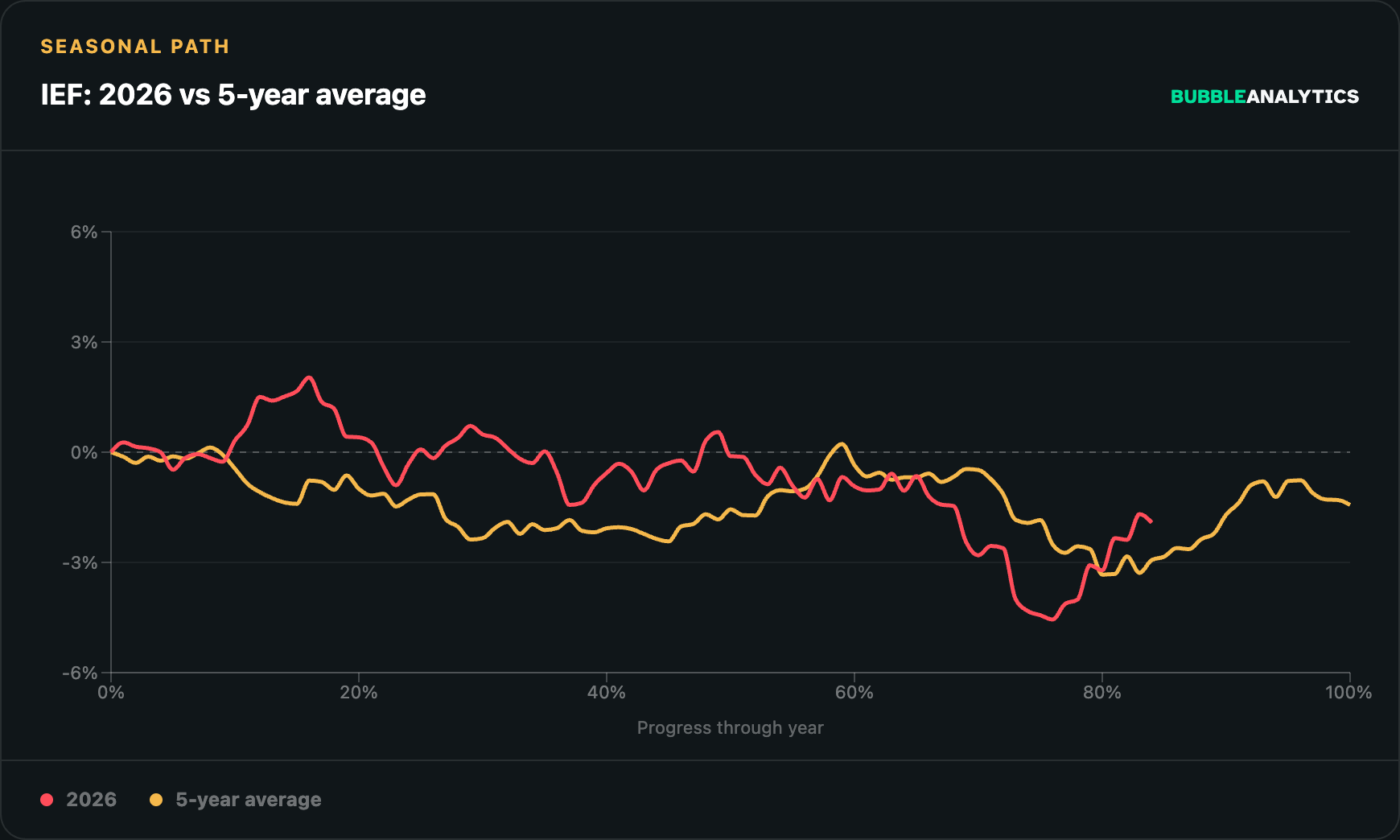
The call last week was for a pullback into Wednesday followed by a retest of the recent highs. The sequence was broadly right, but the turn came earlier: IEF weakened into Tuesday, recovered on Wednesday and advanced again on Thursday before easing on Friday. This week we favour early pressure around CPI and the first auctions, followed by another defensive bid later in the week if stock do resume their decline and inflation doesn't force yields higher. For IEF the 90.83 and 91.74 support levels remain useful, with 92.37–92.70 still the overall target.
Our next article will be published on Sunday. Until then, we wish you well for the week ahead. If you have any questions about anything covered here, please get in touch. We’re always happy to hear from you.



Comments
Log in or sign up to join the conversation.