

Week 47 | Outlook: Monday 16–Friday 20 November 2026
The S&P 500 (SPX) gained 2.51% and the Nasdaq Composite (NDX) 2.27% this week, despite both selling off at a fair pace and finishing lower on Friday. We had expected an early recovery followed by renewed selling, and that sequence broadly arrived, but the bounce was stronger than anticipated and gives the bulls some hope a swing low may be in place. Buyers have shown more resilience than the headlines suggest, although we think the recovery faces a much harder test with retail sales plus home depot (HD) earnings are released on Tuesday. Nvidia (NVDA) also report on Tuesday and need knockout numbers to restore damaged confidence.
Nvidia's leadership change removes another jenga support piece from the bullish AI narrative, but more importantly is a headache for Nvidia itself, who will now face severe regulatory scrutiny (and of course eye watering fines if charges are proven) when the investigation into how Chinese firms acquired so many cutting edge chips begins. Jensen Huang may have resigned on Thursday, but fanboys are already clamoring for his reinstatement and that may suit the board who will undoubtedly be looking to keep him close and make him the scapegoat. The question for investors is how competently the company can maintain its customer commitments and steer its core business strategy through the current storm.
Elsewhere, inflation concerns continue to dominate the economic outlook. October consumer prices rose 0.4% over the month, with core prices up 0.3%. Friday's producer figures showed a slower 0.3% monthly increase, but annual producer inflation reached 6.5%. That combination gives the Fed little reason to treat falling technology stocks as a call for easier policy. We think the chances of further tightening are all but certain and the question is how much by when, which adds an obstacle to continued investment in data centre expansion in terms of financing costs.
Gold (GLD) made an early attampt to breakout then gave back its gains and more when that failed, and bonds (TLT) fell hard as the week progressed. The traditional safe havens may be indicating a low is in place for equities. Oil finished lower over the week but recovered sharply from Tuesday's weakness, leaving the inflation benefit from cheaper energy looking less secure. This is a market where the reason stocks fall matters enormously: selling driven by higher borrowing costs needn't bring the same demand for gold and Treasuries as a straightforward growth scare.
Next week's main tests come close together. Tuesday brings US retail sales, industrial production, results from Home Depot and Disney, and Nvidia's earnings after the close. Wednesday adds housing starts and the minutes of the October Fed meeting, followed by Walmart (WMT) on Thursday and the final Michigan consumer survey on Friday. There is no new COT data to display this week. The Veterans Day holiday has delayed the report covering positions at Tuesday 10 November until Monday 16 November at 20:30 UK time.
US indices: a solid recovery but much to prove
Last week's early bounce was stronger than we allowed for. SPY closed Monday at 752.69, above our former 740.71–749.83 resistance area, and reached a Wednesday close of 759.81 before easing to 754.37 on Friday. The later selling fitted the sequence we expected, but the recovery held most of its ground and our 723.07 downside target was never in danger of being reached.
The last reported S&P 500 leveraged-fund position was a substantial net short at 3 November. Monday's rise and Wednesday's renewed advance would have put pressure on investors positioned for an uninterrupted decline. We think some reduction in bearish exposure is likely, alongside selective buying outside the weakest technology names. Friday's SPY close was still above Tuesday's, so the second half of the week doesn't support a story of new bulls abandoning the rebound.
There was nevertheless a clear loss of momentum after Wednesday. Nvidia's uncertainty spread beyond its own share price, with AMD and Broadcom (AVGO) also falling sharply on Friday. We think that probably encouraged renewed hedging around technology exposure ahead of Tuesday's results, even while investors retained positions elsewhere. Our reading is therefore a less defensive broad market alongside more cautious technology exposure, rather than a uniform return to risk taking. Monday and Tuesday could strengthen that divide, particularly if investors buy the wider index while keeping protection against an earnings disappointment.
Our breadth score improved to 57.0 on 13 November, still mixed but better than the previous week's 54.4. Sentiment rose from 18.8 to 23.0, moving out of extreme fear while remaining fearful. That gives buyers some support: participation has improved without enthusiasm becoming excessive. It also argues against treating every weak technology session as proof that the whole market is breaking down. 5 year SPY seasonality is almost flat for Week 47, averaging approximately +0.04%, so this particular week offers little help in deciding the argument.
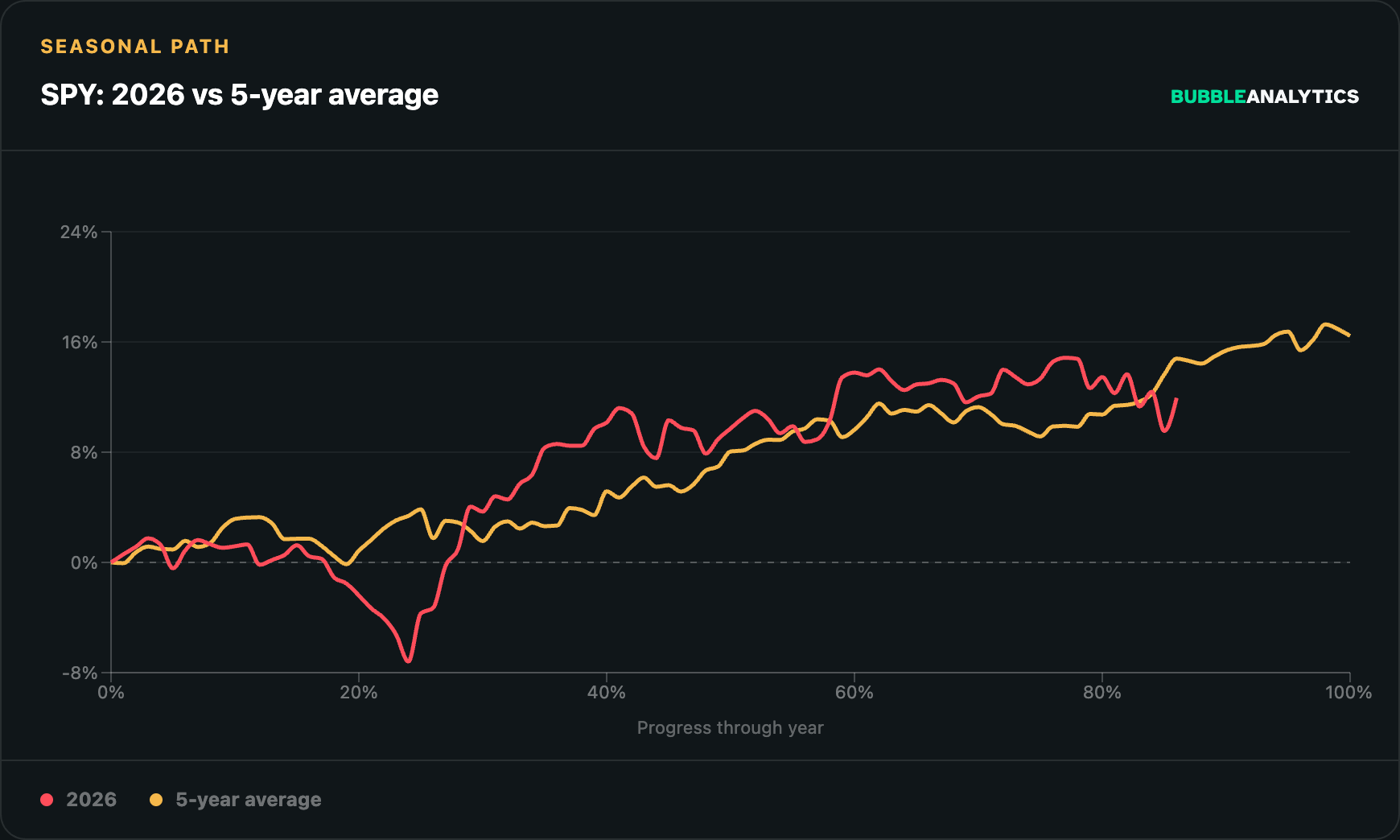
We favour an attempt to defend the rebound early in the week, with Tuesday's earnings reaction deciding whether it can carry further. Our base case on the technicals and current events remains bearish, but we will change that view if we can hold last week's low and trade above last week's high. Short term support is 740.71 and new lows would target 723.07; on the upside the first target is 763.81 followed by 775.98.
Gold: the failed breakout leans bearish
Gold gave us the move we wanted and then took it away. GLD traded just above the previous Thursday's 378.97 high on Monday, reaching 380.18 and closing at 379.53. That was the opening move we wanted for a more sustained rally described in last week's article, but It sold off immediately and finished Friday at 355.45, down approximately 4.58% over the week. Our 408.23 upside target remains a much more distant prospect after that reversal.
We think Monday's move probably drew buyers back towards gold just before Tuesday's inflation figures made that trade harder to hold. The last available managed money position, dated 3 November, wasn't exceptionally extended, but that doesn't prevent recently added longs from coming under pressure. The important change was the failure to hold a breakout in a week that ended full of reasons to seek protection, and Wednesday through Friday strengthened that interpretation. GLD finished approximately 3.77% below Tuesday's close, with Thursday doing much of the damage and Friday producing only a modest recovery.
Five-year GLD seasonality offers a more supportive backdrop for Week 47, averaging approximately +0.62%, with a stronger historical average in the following week. That leaves room for a rebound after such a sharp retreat. We wouldn't dismiss the possibility simply because this week's call failed, but the market now needs to show that buyers can hold gains when yields rise or the dollar strengthens. A brief rally on geopolitical headlines would be less persuasive than several sessions in which gold stops giving back its advances.
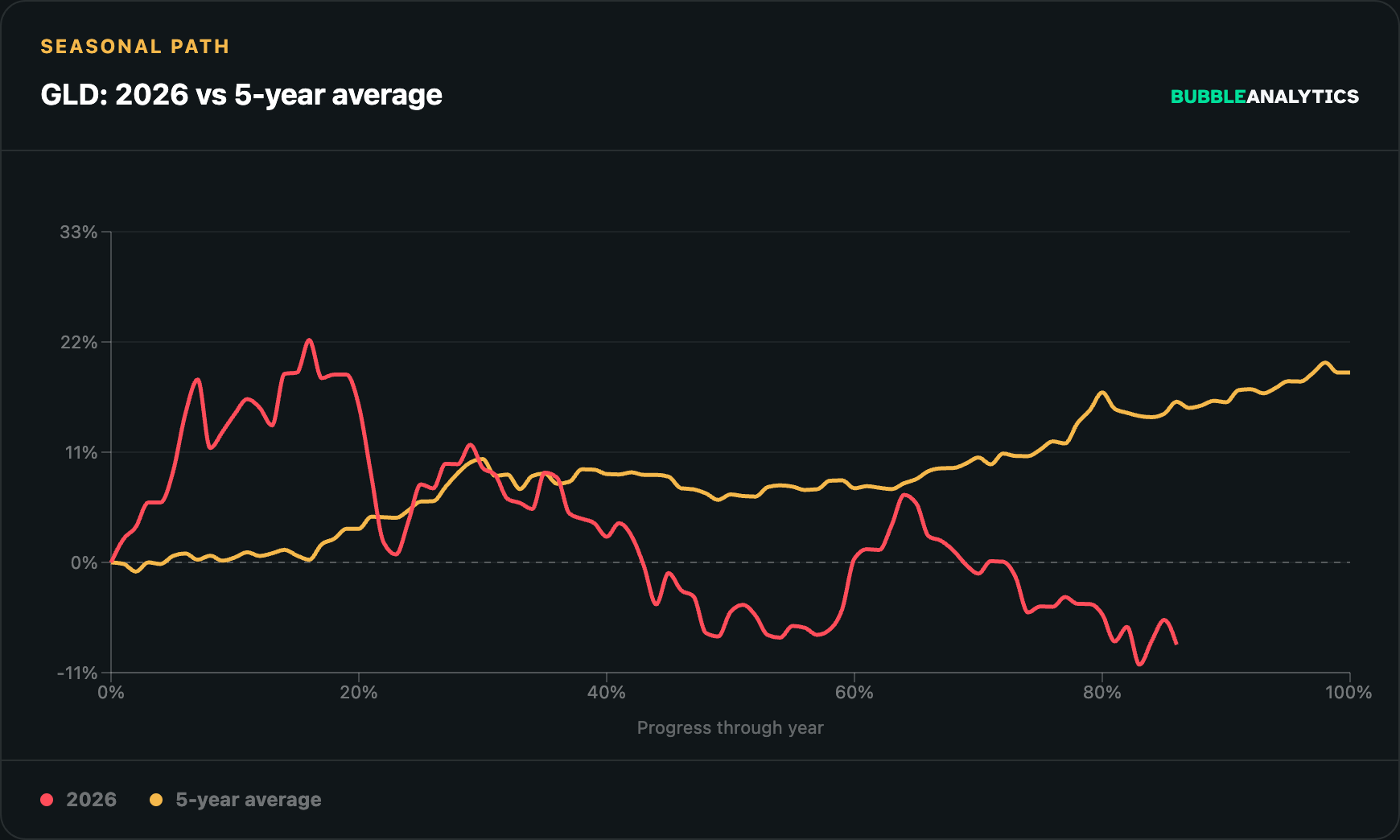
We favour an early attempt to stabilise, with scope for a rebound in GLD to 363, but overall we now expect new short term lows with a target at 339.83. If we do manage to rally this week, the target would be 374.03.
Oil: a market prone to whipsaw
Our expectation that oil would finish under pressure was broadly right, but the route was wrong. We favoured an opening recovery followed by selling. Instead, USO opened Monday at 142.55, already below the previous Friday's 148.41 close, and traded down to 138.47 on Tuesday before recovering later in the week. Friday's close of 145.58 left it approximately 1.91% lower over the week. The 138.01 support we identified wasn't quite reached, while 144.90 was lost and subsequently recovered at the close for the week.
The last available WTI managed money position was already lightly net long at 3 November. Monday and Tuesday's decline therefore points towards another difficult stretch for bullish conviction, rather than the unwinding of an obviously crowded long trade. We think the early selling probably reduced willingness to hold exposure through uncertain diplomatic headlines. The inventory backdrop offered little reason to rush back in: US commercial crude stocks rose by 4.7 million barrels in the week ended 6 November.
The later trading tells a different story. USO finished approximately 2.92% above Tuesday's close, largely because of Thursday's recovery. We think that move probably brought some short covering and renewed demand for protection against a supply shock. Our interpretation is that speculative conviction remains weak, but traders became less comfortable pressing the downside after the early sell off.
Weekend reports suggest that further US strikes on Iran may depend on whether there are new provocations. That leaves room for a smaller risk premium (for gold too), and we think the market can continue to remove some of the premium already built in while still reacting violently to individual threats. This is a market primed to whipsaw. The five-year USO average for Week 47 is approximately −1.42%, which supports caution about chasing a rebound, especially with the broader weekly decline still intact.
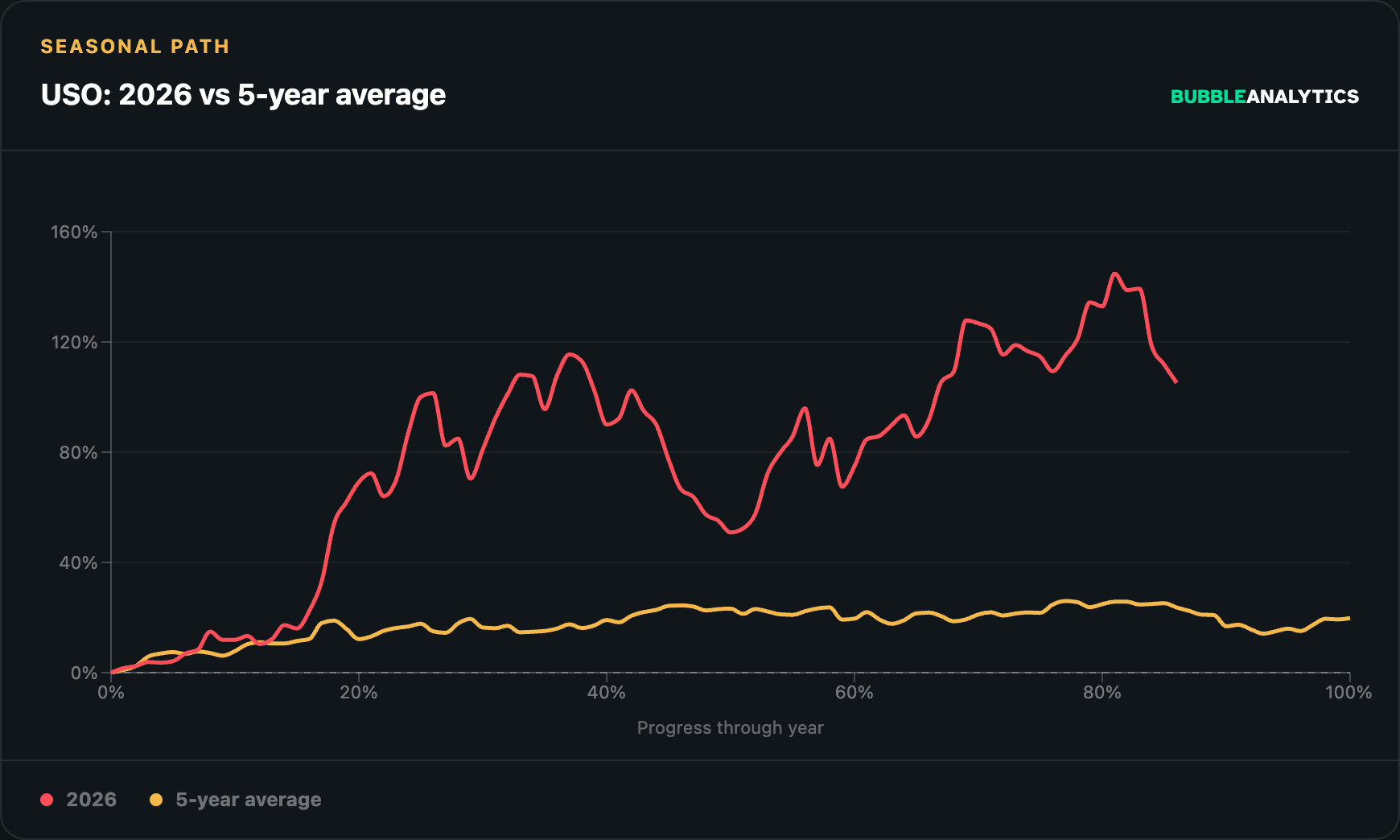
We favour an upside opening as traders assess the weekend news, followed by renewed pressure on recovery attempts if no fresh supply disruption is confirmed. The former 152.48 level remains relevant if the recovery extends, while 144.90 and 138.01 remain the existing support levels to watch. We still lean towards lower prices into December, but this week's late rebound is a warning against expecting the decline to proceed neatly.
US bonds: the fragile rally fails
Last week we were looking for early pressure around inflation and auctions, followed by a renewed bid if stocks weakened and inflation allowed it. The early pressure arrived; the later relief didn't. IEF closed Tuesday at 91.01, fell to 90.21 on Thursday and finished Friday at 90.04, approximately 1.98% lower over the week. Both 91.74 and 90.83 support levels were lost, and there was no attempt to hit our 92.37–92.70 area before the sell off began.
The last reported asset manager position in 10Y Treasury futures was heavily net long at 3 November. That creates a vulnerable backdrop when inflation news challenges the reasons for holding duration. We think Tuesday's inflation release and the subsequent rate-hike discussion encouraged a reduction in interest-rate exposure, with investors less willing to rely on weakness in equities to support bonds. A large existing long position can make an otherwise understandable defensive allocation painful when the policy outlook moves against it.
After Wednesday's cash bond holiday, Thursday and Friday brought further pressure rather than a return of the haven bid. IEF ended approximately 1.07% below Tuesday's close, and the key message to absorb would appear to be the persistence of selling when technology shares were also under pressure. That looks more consistent with investors demanding compensation for inflation and tighter policy and ignoring an equity decline that would normally draw buyers towards Treasuries. Will we now see both trade down together?
5Y IEF seasonality is positive for Week 47, averaging approximately +0.45%. That supports allowing for a recovery after the recent decline, but this week's price action gives us less confidence that seasonal demand will take control immediately. Tuesday's retail sales and industrial production figures could keep the pressure on if activity remains firm. Wednesday's Fed minutes will help to explain thinking, although the discussion predates the latest inflation reports. Friday's consumer survey offers another check on inflation expectations.
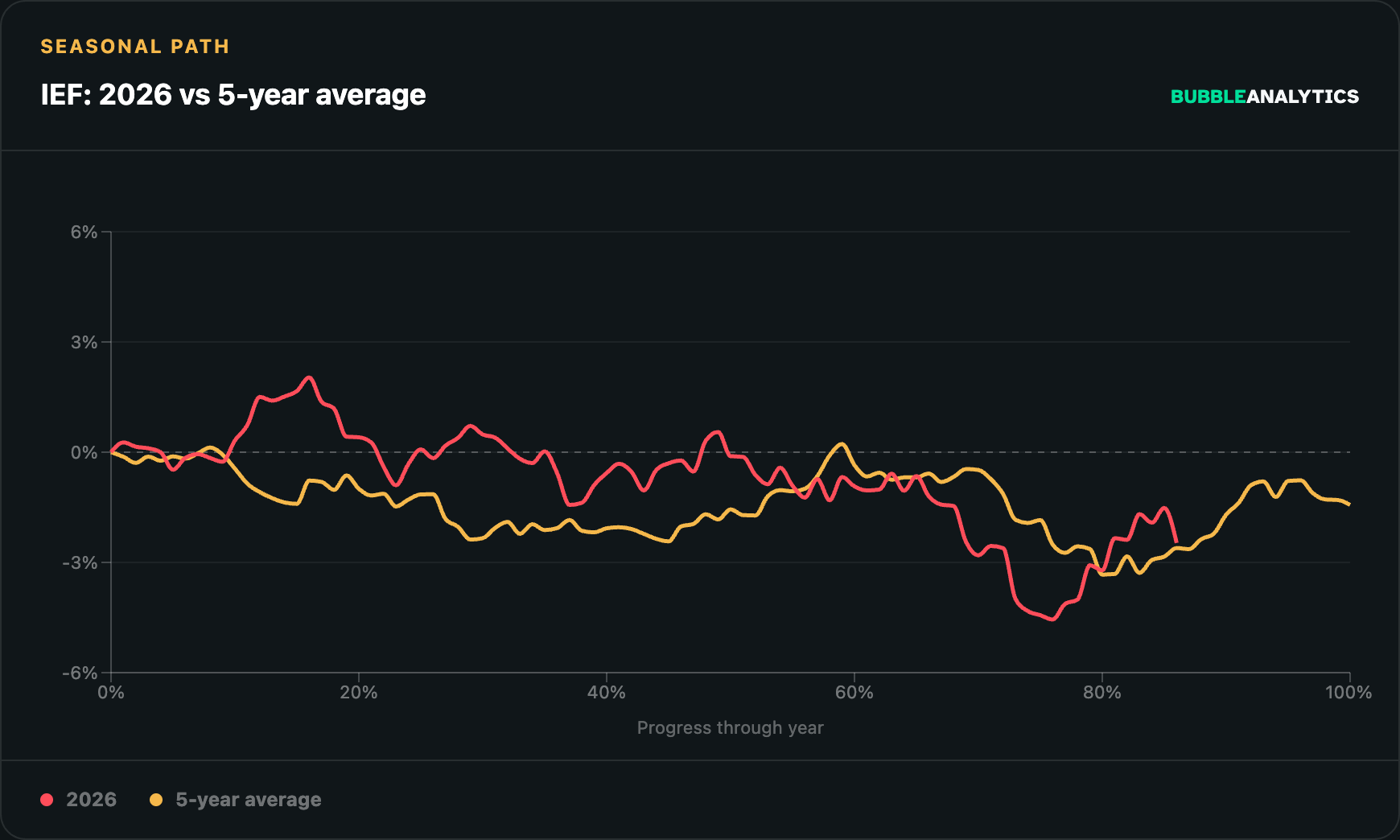
We favour a possible relief rally once the main data and minutes are out of the way but regard it as a bounce within a damaged trend. The old 90.83 and 91.74 supports now act as resistance levels for judging how much ground buyers can recover. If the sell off deepens the next targets are 88.52 then 87.78.



Comments
Log in or sign up to join the conversation.