


A few days ago, news headlines drew attention to publicly held U.S. national debt surpassing the 100% of GDP threshold for the first time since World War II, a milestone that carries far more significance than it may appear at first glance. In today’s report, I want to add my own perspective, including what this means for precious metals.
Put simply, this milestone signals that the debt burden has reached a level where it becomes much harder to grow out of. In an environment of higher interest rates, the system becomes increasingly sensitive to shocks, raising the risk of a fiscal crisis and policy responses that ultimately debase the currency, both of which are highly bullish for precious metals.
To start, I’d like to clarify the difference between total U.S. federal debt, or national debt, which is the more commonly cited figure, and publicly held U.S. federal debt, which economists focus on more closely when assessing fiscal conditions. This distinction is often misunderstood, so it is important to explain the differences.
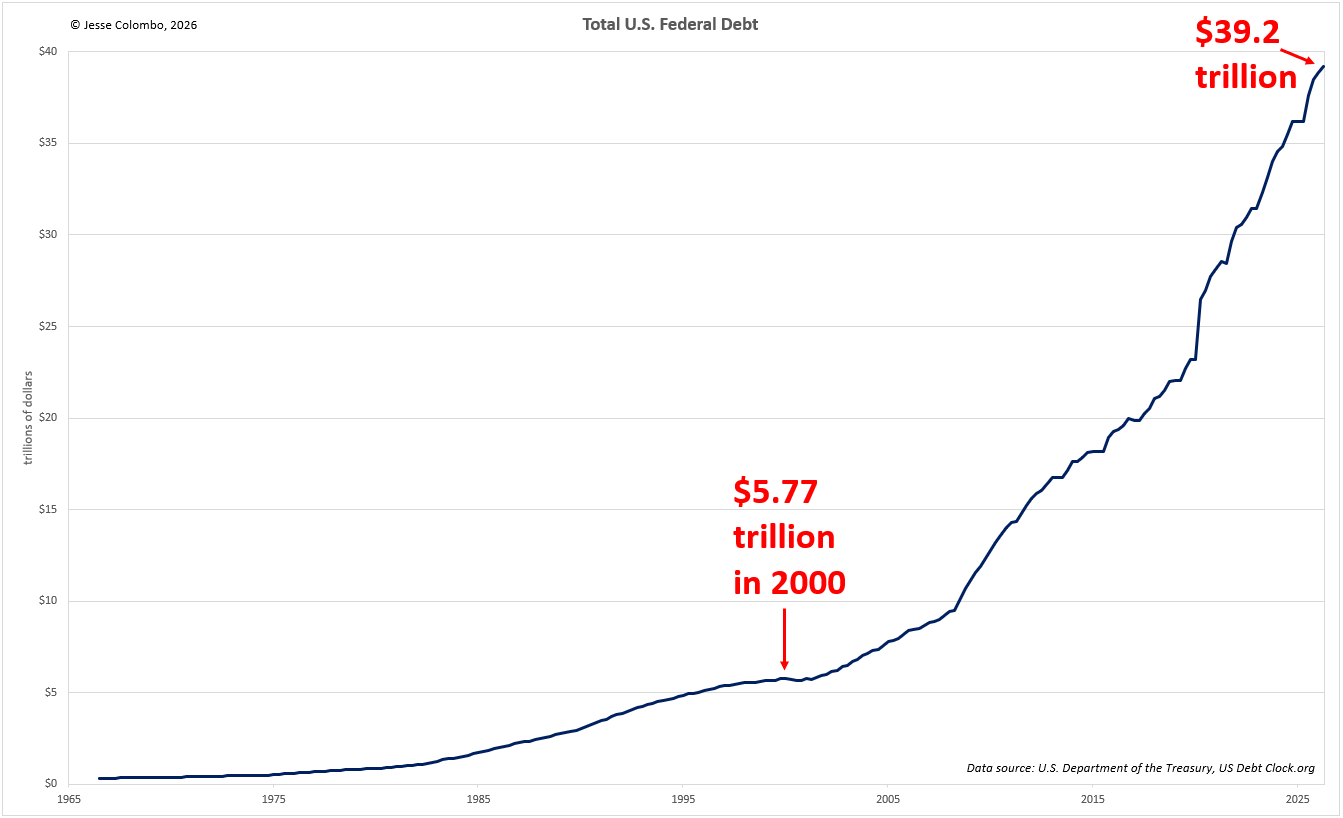
Total U.S. federal debt, which is commonly cited on sites like USDebtClock.org, is roughly $8 trillion higher than publicly held U.S. federal debt. The reason for this difference is that the total figure includes both debt held by the public and intragovernmental debt, which is money the government owes to itself, such as obligations to the Social Security Trust Fund, Medicare Trust Fund, and other government accounts.
Publicly held debt, on the other hand, is held by actual market participants such as foreign governments (China, Japan, etc.), the U.S. Federal Reserve, banks, pension funds, mutual funds, and individual investors. Economists focus more closely on this measure because it reflects real borrowing from the market, the true financing pressure on the government, and the interest burden paid to external holders.
As shown in the chart below, total U.S. federal debt has reached an all-time high of $39.2 trillion, up nearly sevenfold from $5.77 trillion in 2000:
Despite being roughly $8 trillion lower than total federal debt, publicly held federal debt has also reached an all-time high of $31.27 trillion, representing a more than eightfold increase from $3.69 trillion in 2000:
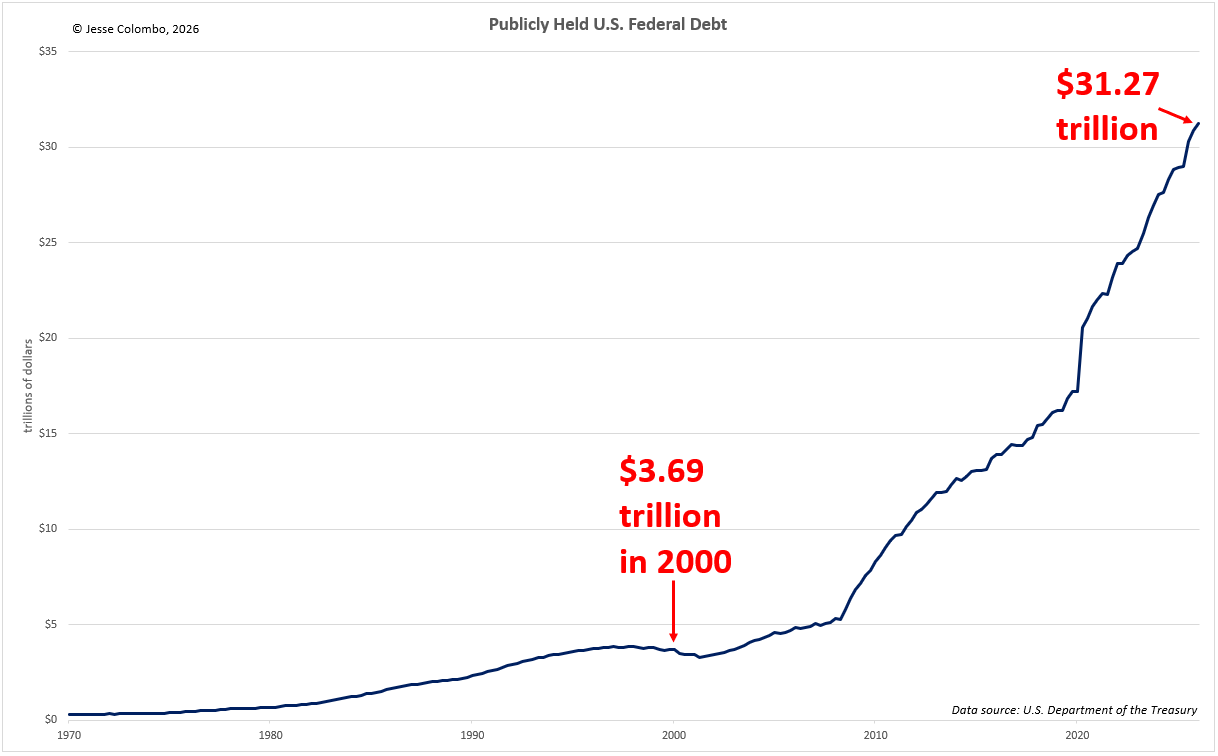
As I explained earlier, economists focus more on publicly held U.S. federal debt rather than total debt because it provides a clearer picture of fiscal conditions and risks, including the potential for a sovereign debt crisis in which investors begin to jettison U.S. government bonds, driving yields sharply higher and setting off a destabilizing spiral.
The recent headlines about the national debt exceeding 100% of GDP refer specifically to publicly held U.S. federal debt. As of March 31, it stood at $31.265 trillion, while GDP over the preceding year was $31.216 trillion, putting the ratio at 100.2%, up from 99.5% at the end of the last fiscal year on September 30.
What makes this recent debt milestone so notable and concerning is that it marks the highest level since World War II (as shown in the chart below), when massive wartime spending drove the surge. At that time, however, the country was able to rapidly reduce the debt burden thanks to the powerful post-war economic boom that followed over the next several decades.
Read the full article here



Comments
Log in or sign up to join the conversation.