

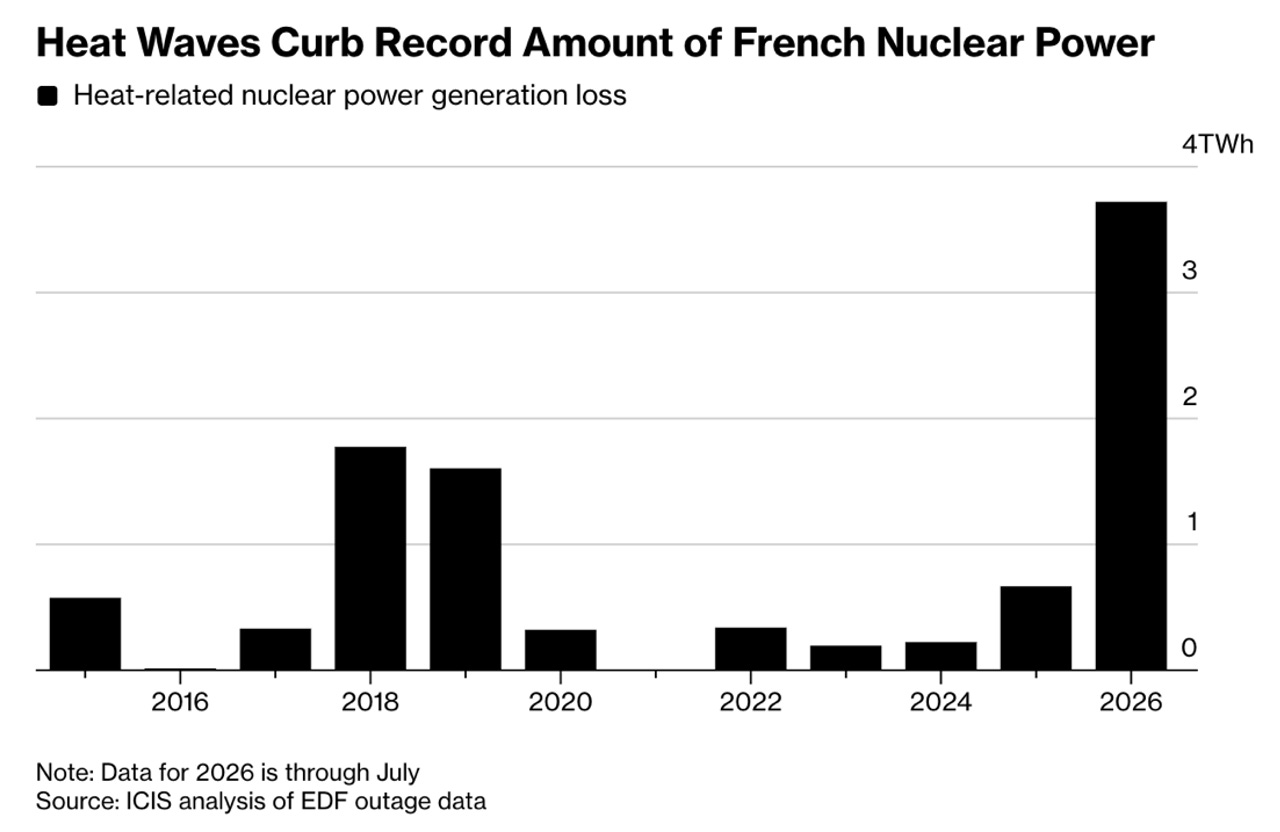
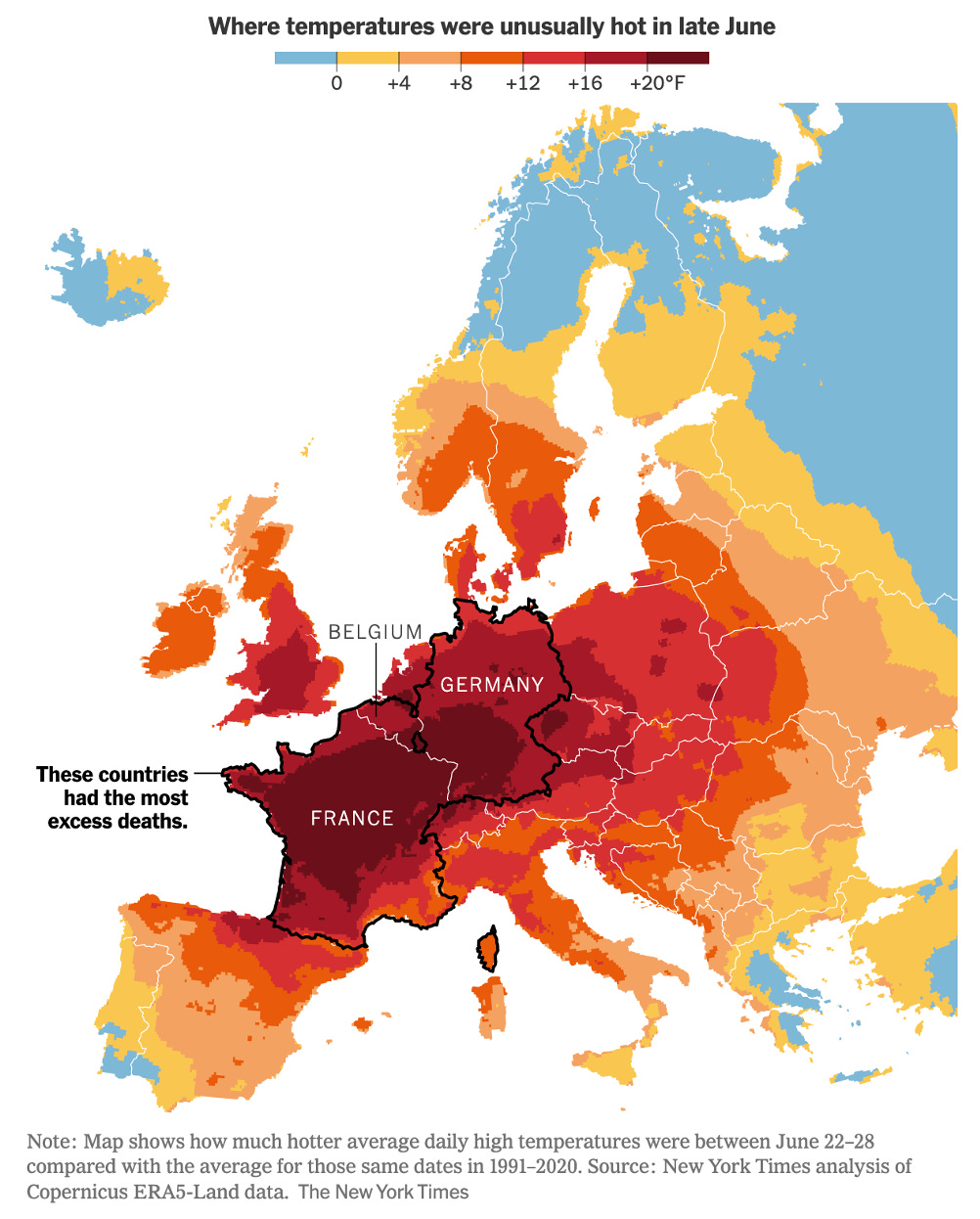
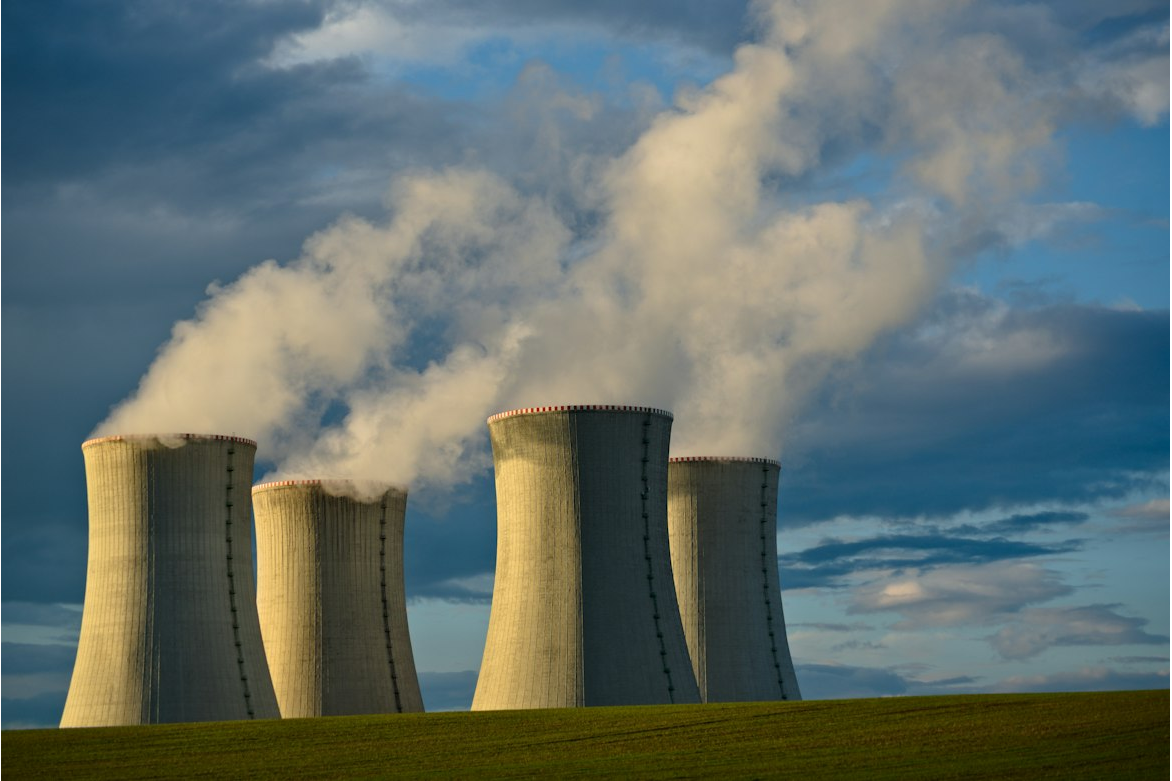
One of my dear friends from my Bear Stearns days in the 1990s, when I ran the analytics department in London, now splits her time between Silicon Valley and Rome. She just got back from Rome, complaining bitterly about the heat. That heat is doing more than spoiling vacations at some of the top tourist destinations, as it forced nuclear reactors offline in France, Romania and Hungary across Europe last week.
In France, the heat wave took out about 15% of the country’s nuclear capacity on Friday, with six of its major reactors fully offline and up to 9.4 gigawatts of power curtailed across nine reactors.
Combined with scheduled maintenance and other outages, the amount of unavailable nuclear capacity reached 27.7 gigawatts, the lowest level since August 2023. France normally gets about 70% of its electricity from nuclear power.
Farther east, record-low water levels on the Danube river forced Romania to shut its last operating reactor at Cernavoda on Thursday. Its other reactor had already gone offline in late July, so both of the plant’s 706-megawatt units, which normally provide roughly 20% of Romania’s electricity, are now down. Bucharest went so far as to having to declare an energy emergency for August and fired up a 330-megawatt lignite plant to cover the gap.
The Danube’s record-low levels have hit Hungary too. Its Paks nuclear power plant, which normally generates around half of the country’s electricity, fell to barely 10% of capacity earlier this month before rising water levels let it restart a second turbine.
These acute outages directly impact consumers’ utility bills. French wholesale power prices jumped more than 20% as nuclear availability dropped and wind generation remained weak.
And while France is still exporting power, its scheduled August exports are below July levels. As a result, Britain and Germany turned to more coal and gas when less French nuclear power was available.
Europe’s reactors will come back online when the heat passes, but the world’s reliance on nuclear power keeps rising, and new plants are being added faster than the uranium and enrichment behind them.
Washington Keeps Funding Reactors as Uranium Demand Climbs
Over in the U.S., the trend to keep adding nuclear power capacity and technology continues to rise. On August 13, X-energy (XE) said the Department of Energy would provide up to another $1 billion for its advanced nuclear project with the chemical company Dow in Seadrift, Texas. Total public funding since 2021 could now reach $2.15 billion. The reactors would operate at Dow’s petrochemical site, supplying both electricity and industrial steam, with startup targeted for the early 2030s.
That buildout comes on top of a U.S. nuclear fleet that already produces about 18% of the country’s utility-scale electricity, the second-largest source of electricity generation after natural gas.
Leaders in Washington want to keep its existing reactors operating while also developing advanced ones and adding new sources of reliable generation that will deploy energy to enable large scale manufacturing, data centers and other large power users. But every new reactor adds to the fuel the country must secure.
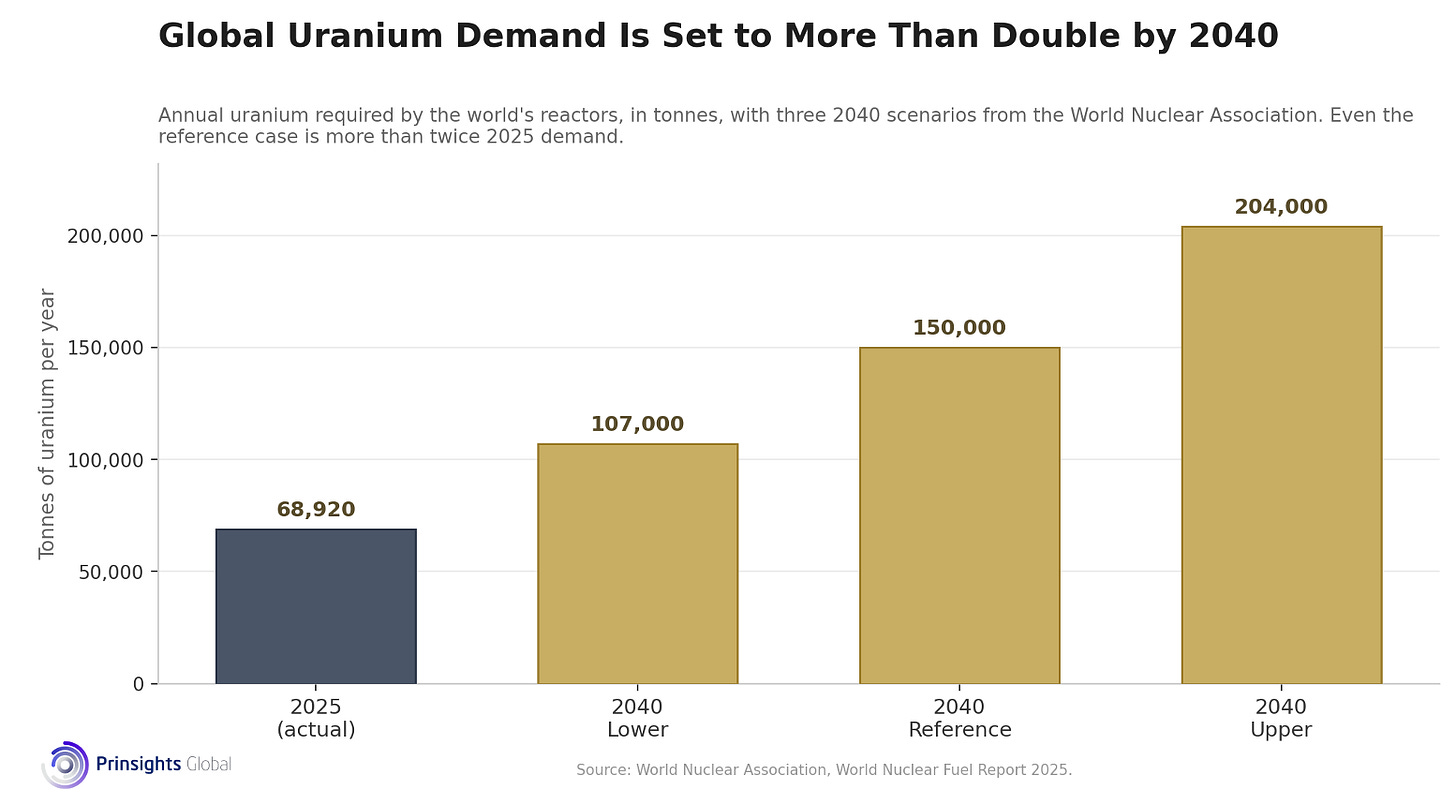
The World Nuclear Association estimates that global reactors required about 68,920 tonnes of uranium in 2025. Under its reference scenario, that requirement climbs to just over 150,000 tonnes by 2040, and its higher-growth scenario puts the number above 204,000 tonnes.
Supplying that much uranium is the hard part. Existing mines deplete, and new mines can take years to permit, build the proper finance levels and fully develop. But the uranium coming out of the ground is only the first step, since it still has to move through conversion, enrichment and fuel fabrication before it can produce a single watt of electricity.
In 2025, the world’s mines produced about 60,000 tonnes of uranium, short of the roughly 68,920 tonnes reactors needed, and the gap was filled from secondary stocks like government and commercial stockpiles, reprocessed fuel and re-enriched tails, the leftover uranium from earlier enrichment. The Association warns that supplying the growth it projects would take more than a fourfold rise in mine output, just as many existing mines are exhausted by the mid-2030s.
America Imports Almost All Its Reactor Fuel
Today, America has 94 commercial reactors, more than any other country, yet the utilities that operate them got only about 7% of their uranium from U.S. mines in 2025. The rest, both the raw uranium and the enrichment that turns it into fuel, is imported.
U.S. nuclear utilities have already signed contracts to buy between 36.7 million and 42 million pounds of uranium from foreign suppliers for delivery in 2026. Over the entire next decade, the uranium they have under contract from U.S. suppliers amounts to just 1.3 to 1.5 million pounds.
But the complex story does not stop there. Raw uranium cannot go straight into a reactor. It must first be enriched, a process that concentrates the fuel’s active isotope, and only a handful of specialized plants can do it. You see, American utilities buy most of that enrichment abroad.
Foreign companies performed 77% of the enrichment at U.S. reactors in 2025, and Russia alone accounted for 26%, more than any other country. A 2024 U.S. law banned Russian enriched uranium, but it granted waivers that let utilities keep buying it until those waivers expire at the start of 2028.
For strategic investors, this reliance is why the price keeps climbing. The uranium spot price is around $87 per pound today, off the near $100 it hit in late January. The more important number is the long-term price, the rate utilities lock in for years of future delivery. It reached about $95.50 in July, the highest in almost two decades, and it has risen steadily all year. Given all these forces at once, we expect it to rise further, toward our $110 forecast by year-end, a move that would lift domestic and allied miners and processors along with it.


Comments
Log in or sign up to join the conversation.