

As they say in real estate, it’s all about location, location, location.
Gold is a prime commodity example of this mantra in action. Last month, Lahontan Gold (LGCXF), a small Nevada-focused developer in the U.S. that’s advancing the past-producing Santa Fe mine in Walker Lane, agreed to buy Emergent Metals at a 48% premium. In the process, it took full control of the West Santa Fe gold project, cleared the royalties on it, and added a second Nevada deposit to its portfolio.
What made Emergent worth the premium was where its gold is, in Nevada. There, a company can permit a deposit, build the mine, and keep what it produces without worrying about nationalization creep. However, increasingly across much of the gold-producing world, none of that is guaranteed anymore.
For instance, over the course of 2024-2025, Mali’s military government extracted about $1.2 billion in back taxes and payments from foreign mining companies, temporarily seized stockpiled gold bars, and put Barrick’s flagship mine under state administration before a settlement resolved the dispute in late 2025.
This February, the government created a state mining company, Sopamim, to hold aggressive equity stakes across every working mine in the country. Burkina Faso nationalized five licenses and two working mines. Across West Africa’s Sahel, where a growing share of the world’s gold is dug, a government can rewrite the terms of a mine faster than a company can build one. This is why the country where gold deposits are located matters as much, or even more, than the amount of gold.
Location Matters: Building a U.S. Mine Can Take 29 Years
Tier-one jurisdiction means the rule of law holds, a permit stays a permit, and the royalty, tax and ownership terms a company signs today are the same ones in ten years. It is characterized as a state or a province with a record of legal and regulatory dependability. Nevada, Arizona, Ontario, Quebec, Saskatchewan, Western Australia, South Australia. Canada as a whole means little. The Yukon is not Ontario. After the Eagle mine’s heap-leach pad failed in 2024 and the territory put the mine into receivership, the Yukon’s reputation took the damage with it.
Locational consistency especially matters given how long project constructions take. Building a new mine in the United States takes about 29 years from discovery to first production, the second-longest timeline in the world, compared with about 27 years in Canada and 20 in Australia.
Those figures cover all mines. Gold projects tend to move faster, but even a gold mine in a stable country takes close to a decade to build. Permitting alone can take seven to ten years in the US and two to five in Canada and Australia. That means that for the entire period, a company might invest billions of dollars in the ground with no offsetting metal coming out, so the only thing protecting it is a government that keeps the terms it signed.
In the Fraser Institute’s 2026 annual survey of mining executives, Nevada grabbed the number-one spot as the most attractive place to invest on earth, moving up from second place the previous year, based on the solidity of this state government commitment to the mining process.
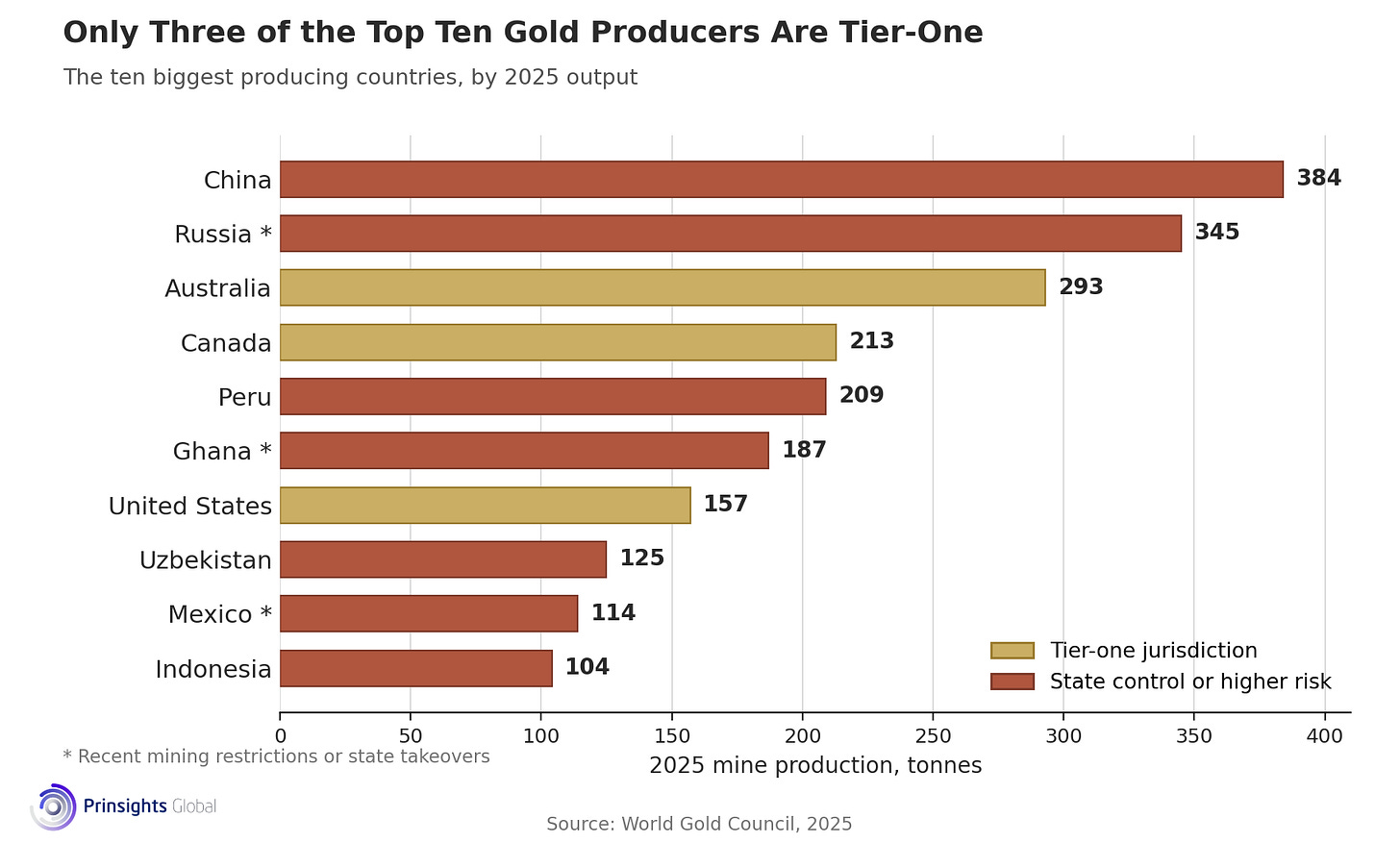
Only Three of the Top Ten Gold-Producing Countries Are Tier-One
Most of the world’s gold does not come from that kind of ground. By that dependability criterion, only three of the ten biggest producing countries qualify as tier-one. Those are Australia, Canada and the United States. But together, these countries mine only about one ounce of every six the world produces.
Meanwhile, the other seven carry varying degrees of state intervention, permitting risk and shifting fiscal terms, and the changes keep coming. Some of the movement within the global landscape includes:
· On September 1, Ghana, the biggest producer in Africa, banned the export of unrefined gold, forcing miners to refine it inside the country before it can leave.
· Mexico, the ninth-largest producer, still refuses to grant a single new mining concession under President Sheinbaum and has put its open-pit mines under review.
· Niger is rewriting its mining code, and Guinea, Tanzania and the Democratic Republic of Congo have each moved to take a bigger stake and a bigger cut of a mine’s revenue and gold exports before they leave the country.
The economic calculation for a miner is simple. Gold in the Sahel region can be taxed, diluted or seized with little warning. But that same ounce in Nevada or Quebec carries far less of that risk. As a result, those ounces command a jurisdiction premium, as do the miners that develop them.
The next wave of big gold comes with its own issues. The largest undeveloped deposit in the world, Russia’s Sukhoi Log, holds about 43 million ounces, but it’s locked behind Western sanctions. Other large finds waiting to be built include projects in Cote d’Ivoire, Guatemala and Guyana that have varying degrees of jurisdictional uncertainty.
With little new large-scale supply coming online in more politically stable countries, the majors are buying stable-jurisdiction deposits and bidding each other up to get them.
Gold Led a $41 Billion Deal Wave
Miners announced $41 billion of deals in the first five months of 2026. Gold was the biggest target, 31 of the 73 transactions.
In July, Equinox Gold completed its $5.1 billion acquisition of Orla Mining, building a North American producer above a million ounces a year. In Australia, Genesis and Vault Minerals agreed to merge, creating a gold company valued at about A$12.6 billion.
Canada has become the epicenter of this defensive consolidation sweep. Because stable provinces like Ontario and Quebec offer near-perfect policy predictability, global mining giants are aggressively outbidding each other for low-risk Canadian developments rather than gambling capital on volatile regions. Since the start of last year, nine separate takeovers of Canadian gold companies have each topped a billion dollars.
Majors are competing for large, low-cost assets in tier-one jurisdiction with predictable paths to production.
Comments
Log in or sign up to join the conversation.