


In August, investors poured $18 billion into gold-backed exchange-traded funds.
That was the second-largest monthly inflow in the history of gold ETFs.
Total holdings reached an all-time high of 4,189 tonnes, while assets under management jumped 16% in a single month to $615 billion.
And this signified much more than a few retail investors buying the dip.
North American funds took in $7.8 billion, their third-largest monthly inflow ever. European funds added another $7.9 billion, their largest on record.
And August was no outlier. Gold ETFs pulled in a record $19 billion in January. Last September, they attracted another $17 billion.
In other words, three of the four largest monthly inflows in gold ETF history have occurred in the past twelve months.
At some point, this is a full-scale reallocation developing in gold, not a speculative trade.
Central Banks Got There First
The story of the next leg of gold’s rise starts with a number most investors have probably never seen:
27%.
According to a European Central Bank report published in June, gold accounted for roughly 27% of global official reserves, compared with 22% for U.S. Treasuries. That put gold ahead of Treasuries for the first time since 1996.
In dollar terms, central banks held close to $4 trillion worth of gold, slightly more than the roughly $3.9 trillion they held in U.S. government bonds.
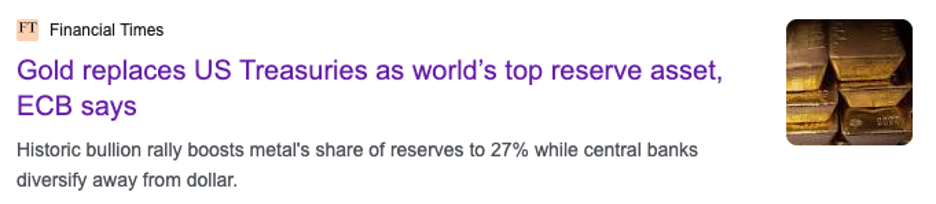
In other words, the institutions entrusted with safeguarding the reserves behind the world’s currencies now hold more gold, by value, than U.S. government debt.
Now, to be fair, soaring gold prices helped push gold over the line. But this did not come out of nowhere. Central banks have been steadily adding to their holdings for years.
They bought more than 1,000 tonnes in each of 2022, 2023 and 2024, followed by another 863 tonnes last year.
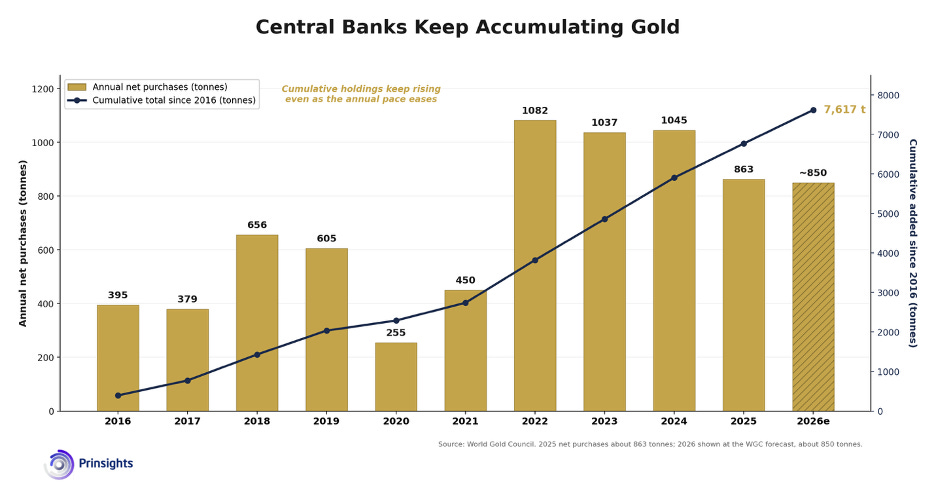
And they are not finished.
In the second quarter of 2026 alone, central banks bought another 289 tonnes, up 62% from a year earlier. Meanwhile, a record 45% of those surveyed by the World Gold Council say they expect to add more over the next twelve months.
Central banks have now been net buyers in every year since 2016. Put all that together, and by the end of this year they are expected to have added a cumulative 7,617 tonnes of gold over that period.
That pattern sends a message far beyond the central banks themselves.
Pension funds, sovereign wealth funds and other institutional investors pay attention to where the world’s reserve managers put their money. And what they see is a steady move toward an asset no government can print or default on, and that can be brought home when trust begins to fray.
If you have been underweight gold for years, that is becoming increasingly difficult to ignore.
They Want It Within Reach
And there is another sign of how central banks now think about gold.
They are not just buying more of it. They are also paying much closer attention to where it is kept and how quickly they can put it to use. We will cover this in greater detail in our monthly issue out tomorrow.
However, the overriding point is that central banks are increasingly treating gold as strategic insurance. They care where it is stored, who controls it and how quickly they can reach it if something goes wrong geopolitically or economically.
This doesn’t prove that they have suddenly lost all confidence in the dollar.
But central banks rarely issue a press release saying they trust another country a little less. They call it diversification, tradability or crisis preparedness.
Then they move the gold.
Where the Miners Come In
All that money pouring into gold ETFs, on top of everything else we have just covered, is obviously good news for anyone who owns gold.
But if this bull market continues, the outsized beneficiaries won’t be the ETFs.
They will be the companies that mine the metal.
And that is because they offer one thing no physically backed gold ETF can provide: leverage with respect to the underlying commodity itself.
Take a producer with all-in sustaining costs of roughly $1,800 per ounce. With gold around $4,350, it earns an AISC margin of roughly $2,550 on every ounce it sells. Raise gold by another $500 while leaving its costs where they are, and the gold price rises about 11%, but the miner’s per-ounce margin jumps nearly 20%, from $2,550 to $3,050.
That is the kind of leverage a good miner can give you. Once a mine is built and running, its costs do not rise dollar for dollar with the gold price, so much of the increase can flow through to cash generation.
Of course, the important word here is “good.”
High gold prices cannot rescue every miner. Some will waste the money on bad acquisitions. Some will dilute their shareholders. Others will watch their costs rise almost as quickly as the gold price.
The companies most likely to attract institutional capital are the ones with low costs, clean balance sheets, growing production and operations in reasonably stable jurisdictions.
And that brings me to tomorrow’s Prinsights Pulse Premium issue.
We are recommending a North American gold producer with a clear path to nearly doubling its production by 2030, costs that should move lower as its expansion projects come online and a flagship operation whose economics improve with every additional dollar in the gold price.
Tomorrow, we will lay out the full case, the risks, what we believe the company is worth and the price we are willing to pay.


Comments
Log in or sign up to join the conversation.